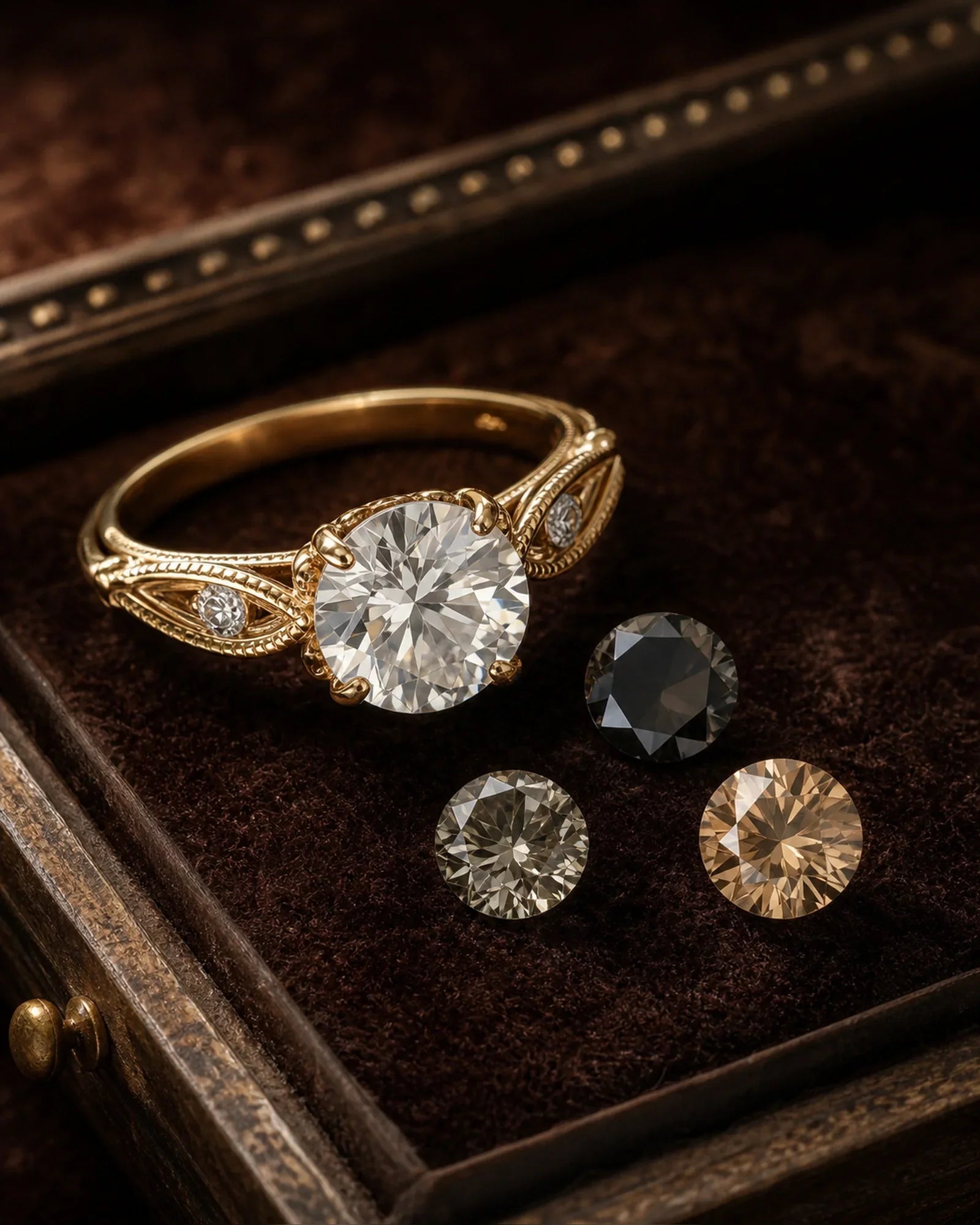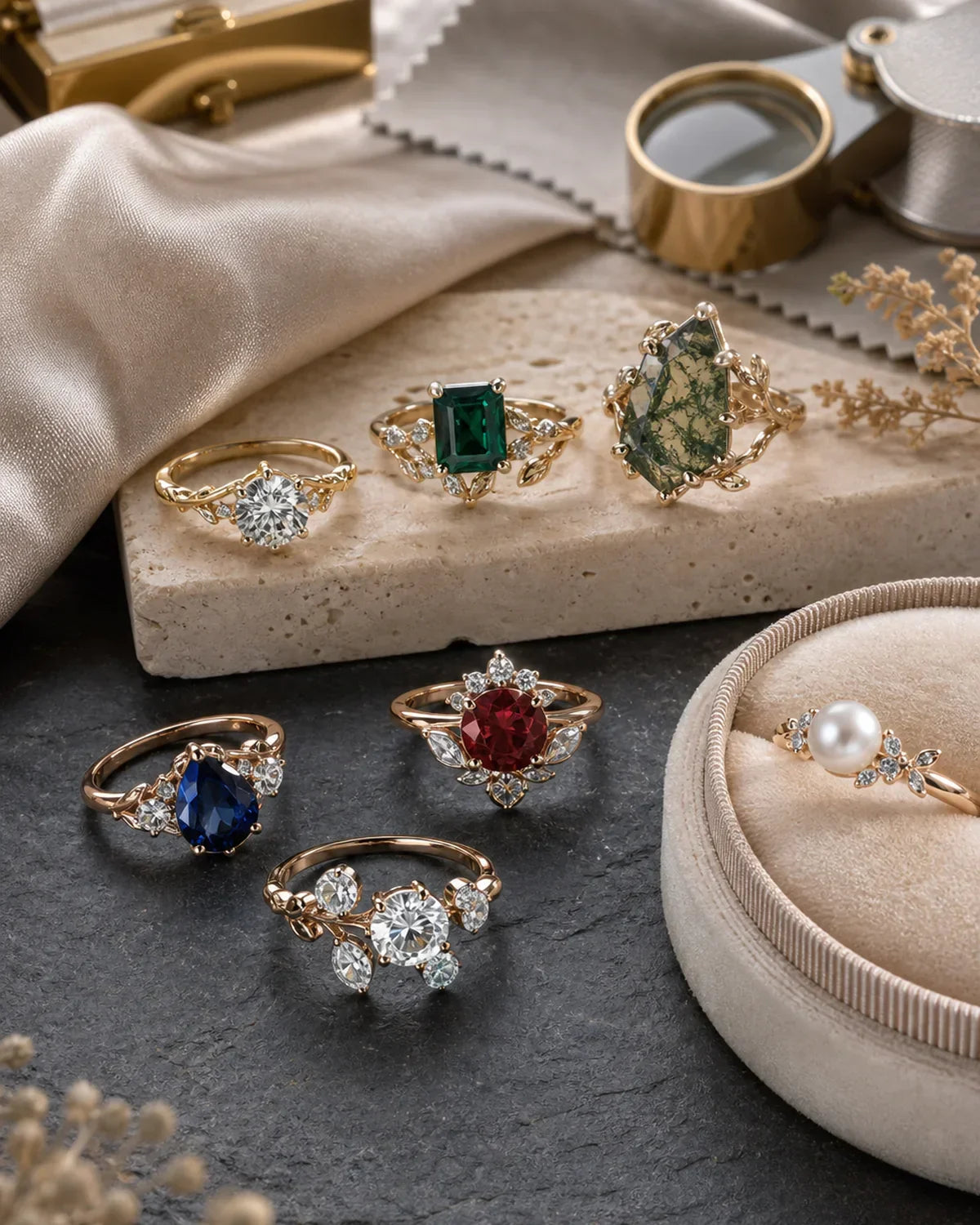

Gemstone cut types are often discussed as if every term means the same thing. In real buying decisions, they do not. A stone's shape is its face-up outline: round, oval, pear, emerald, kite, hexagon, shield, and so on. Its cutting style is the way the facets are arranged: brilliant, step, mixed, rose, portrait, fantasy, or another structure. Cut quality is the precision of the proportions, symmetry, polish, and light performance.
This distinction matters because a buyer may say "I want an emerald cut" when what they really mean is a rectangular stone with step-cut flashes. Another may ask for a "diamond shape" while shopping for moissanite, sapphire, ruby, emerald, morganite, alexandrite, garnet, opal, moonstone, or moss agate. The visual language comes from diamond shape charts, but the same outlines are used across many gemstones and ring styles.
The guide below treats gemstone cuts as ring design tools. It explains what each shape looks like, how it handles light, when it appears larger or smaller, which settings protect it, and which design moods it naturally supports.

How to read a gemstone cut guide
Before comparing individual cuts, it helps to separate four ideas: outline, ratio, facet structure, and setting exposure. Outline controls the first impression. Ratio controls whether the stone feels compact, balanced, long, or dramatic. Facet structure controls sparkle style. Setting exposure controls how safely the stone can be worn in a ring.
When this guide gives proportion ranges, treat them as practical shopping references rather than rigid grading standards. Fancy shapes are personal. A slightly fuller oval can look softer; a longer pear can look more dramatic; a squarer cushion can feel antique; a rectangular radiant can feel modern. The goal is to know what changes when the ratio changes.
Market frequency: which cuts are common, uncommon, and rare?
Jewelry shoppers often see shape names in a flat list. That is not how the market works. Some cuts appear everywhere because they are easy to understand, easy to set, and broadly flattering. Some are moderately common because they serve a specific design language. Others are designer cuts: highly useful in custom rings, but less likely to appear in a standard bridal case.
Cut, shape, and faceting style are not the same
In diamond grading, cut quality is a performance concept. GIA explains diamond cut as part of the 4Cs because proportions, symmetry, and polish affect how a diamond returns light. That is different from saying the stone is pear-shaped or emerald-shaped. A round stone can be poorly cut; an emerald-shaped stone can be beautifully cut; a sapphire can use a diamond-inspired outline without being a diamond.
For additional technical background, GIA's official diamond cut education page is a useful reference: https://4cs.gia.edu/en-us/diamond-cut/. For broader gemstone context, GIA's gemstone encyclopedia is also useful: https://www.gia.edu/gem-encyclopedia.
The major gemstone cut types
Round Brilliant Cut
Standard outline: circular. Typical ratio: about 1.00. Facet structure: brilliant style, usually with a table, crown, girdle, pavilion, and culet area. Light behavior: the benchmark for balanced brightness, fire, and scintillation.
Round is popular because it is easy to understand and rarely feels risky. It suits engagement rings, classic solitaires, halos, three-stone rings, and simple wedding stacks. It is also forgiving across many hand shapes because it has no point direction and no sharp corners.
- Advantages: strong sparkle, timeless look, easy setting fit, strong resale familiarity, flexible with prong, bezel, halo, and cathedral settings.
- Watch points: it can look expected if the setting is too plain, and it may not appear as large as elongated shapes of the same carat weight.
Oval Cut
Standard outline: elongated oval. Typical ratio: about 1.30 to 1.50, with longer fashion ovals sometimes above that. Facet structure: brilliant style. Light behavior: bright and lively, with possible bow-tie shadow through the center.
Oval is loved because it gives a long face-up silhouette without the pointed ends of marquise or pear. It often looks larger than round at the same weight and can make fingers appear longer. It works beautifully in solitaire rings, hidden halo settings, three-stone rings, and east-west designs.
- Advantages: elegant spread, flattering length, modern popularity, easy to soften with a halo or side stones.
- Watch points: check for a distracting bow-tie, overly thin ends, or a ratio that looks too narrow for the setting.
Pear Cut
Standard outline: rounded end tapering to one point. Typical ratio: about 1.45 to 1.75. Facet structure: brilliant style. Light behavior: lively sparkle with a directional silhouette.
Pear is both romantic and architectural. Worn point-up, it lengthens the finger; worn point-down, it can feel softer and more teardrop-like. It is especially strong in vintage, nature-inspired, floral, and statement designs because the point creates movement.
- Advantages: strong visual size, elegant direction, useful in leaf and floral compositions, memorable without feeling too unfamiliar.
- Watch points: the point needs a secure V-prong or protective setting, and symmetry is essential because uneven shoulders are easy to see.
Emerald Cut
Standard outline: rectangular with clipped corners. Typical ratio: about 1.30 to 1.50. Facet structure: step cut with long parallel facets. Light behavior: broad flashes, mirror-like contrast, less tiny sparkle than brilliant cuts.
Emerald cut feels refined because it does not try to sparkle in every direction. It shows clarity, geometry, and calm. It works well with tapered baguettes, bezels, hidden halos, art deco halos, and minimal cathedral settings. For colored gems, it can make the color look deep and glassy.
- Advantages: elegant, architectural, modern or vintage depending on setting, excellent for clean lines.
- Watch points: inclusions and windowing are easier to notice, and exposed clipped corners need thoughtful prongs or bezel support.
Cushion Cut
Standard outline: square or rectangular with rounded corners. Typical ratio: 1.00 to 1.20 for square-to-soft rectangular looks. Facet structure: brilliant, modified brilliant, or antique-inspired chunky facets. Light behavior: soft fire, romantic glow, and sometimes a crushed-ice effect.
Cushion cut is the bridge between classic and antique. It can feel plush and old-world in yellow gold, or modern when set simply. It is good for halos because the rounded corners soften the frame, but it can look dated if the halo is thick or the band is over-decorated.
- Advantages: romantic outline, comfortable corner protection, beautiful in vintage and halo designs.
- Watch points: compare facet patterns carefully; some cushions look watery, some crushed, and some chunky.
Princess Cut
Standard outline: square with sharp corners. Typical ratio: 1.00 to 1.05 for a classic square. Facet structure: brilliant style. Light behavior: strong sparkle with a crisp geometric face.
Princess cut offers a clean square look without the quietness of a step cut. It suits modern minimal rings, channel-set bridal sets, and square halos. The contrast between sharp outline and lively brilliance makes it useful for buyers who want geometry and sparkle at once.
- Advantages: bright, graphic, clean, often efficient in rough yield for diamonds.
- Watch points: the four corners are vulnerable, so prongs must protect them. Very high settings can feel snag-prone.
Marquise Cut
Standard outline: long oval with two pointed ends. Typical ratio: about 1.75 to 2.20. Facet structure: brilliant style. Light behavior: strong spread and lively edge sparkle, with possible bow-tie effect.
Marquise is one of the most face-up-efficient shapes. It looks large for its weight and can make the finger appear longer. It also reads beautifully as a leaf shape in botanical settings, especially when used as side stones or accents.
- Advantages: dramatic spread, elegant length, vintage history, useful for floral and leaf designs.
- Watch points: both tips need protection, symmetry is unforgiving, and overly thin marquise stones can feel severe.
Radiant Cut
Standard outline: square or rectangular with clipped corners. Typical ratio: 1.00 to 1.20 for square radiant, 1.25 to 1.45 for rectangular radiant. Facet structure: mixed brilliant. Light behavior: bright sparkle with a durable geometric outline.
Radiant cut is useful when a buyer likes emerald-cut shape but wants more sparkle. The clipped corners make it easier to set than princess, while the rectangular version has a modern, elongated look.
- Advantages: bright, modern, good corner durability, works with hidden halo and three-stone settings.
- Watch points: compare patterning; some radiant cuts show crushed-ice sparkle while others have broader flashes.

Medium-frequency cuts with strong design identity
Asscher Cut
Asscher is a square step cut with cropped corners and a deep, concentric look. A typical ratio is near 1.00. It has less glitter than round or radiant, but more architectural depth. It is excellent for art deco rings, bezel settings, and vintage halos. The main caution is clarity and depth: a poor Asscher can look dark or glassy in the wrong way.
Heart Cut
Heart cut is symbolic before it is subtle. Its ratio usually sits close to 1.00, but the quality depends on the cleft, lobes, and point symmetry. It can look playful, romantic, or high jewelry depending on scale. It works best when the setting is restrained, because the shape already carries the message.
Trillion Cut
Trillion cut has a triangular outline with either straight or slightly curved sides. It is often used as a side stone, but it can be striking as a center in modern rings. It offers good spread and sharp geometry. Points need protection, and the setting must avoid making the triangle look unstable on the hand.
Baguette Cut
Baguette is a narrow rectangular step cut. It is usually used as an accent, side stone, channel-set detail, or art deco element. It gives structure rather than fire. Baguettes are excellent for framing emerald, Asscher, radiant, and oval centers, but they show chips and dirt more easily than tiny round accents.
Half Moon Cut
Half moon stones are most often used as side stones next to oval, round, cushion, or emerald centers. They visually hug the center stone and can make a three-stone ring feel fluid. The curve must match the center's outline; if the gap is too wide, the design looks poorly fitted.
Rose Cut
Rose cut has a flat base and domed triangular facets. It glows more than it flashes. It is historically rooted, lower profile, and poetic in vintage or antique-inspired settings. It is not the best choice for buyers who want maximum brilliance, but it is excellent for soft, old-world character.
Designer and unusual gemstone cuts
Designer cuts are not automatically better than classic cuts. They are more specific. Their value lies in the way they change the ring's personality. These shapes are especially useful for shoppers who want unique engagement rings or a custom design that does not look like a standard solitaire.
Kite Cut
Kite cut has a diamond-like outline with a long point and shorter shoulders. It can feel celestial, gothic, modern, or nature-inspired depending on the setting. It works well in north-south orientation for drama and east-west orientation for a more graphic look. Points must be protected, and a matching wedding band often needs careful planning.
Hexagon and Long Hexagon Cut
Hexagon cuts offer geometric structure without the sharp severity of kite or coffin. A regular hexagon feels balanced and modern; a long hexagon feels more elongated and architectural. They suit bezels, double bands, minimalist settings, and art rings. Because there is less industry standardization, buyers should review the exact outline rather than relying on the name alone.
Shield Cut
Shield cut has a strong top line and a lower point, giving it a protective, heraldic mood. It can be used as a center stone in gothic or statement rings, or as side stones in custom three-stone layouts. It is distinctive but not always easy to pair with a straight wedding band.
Coffin Cut
Coffin cut is niche, dramatic, and strongly associated with alternative bridal and dark romance. It has a tapered geometric outline that suits black gemstones, salt and pepper diamonds, garnet, and moody moss agate. It should be set with enough metal protection at corners and ends, especially in daily-wear rings.
Lozenge, Bullet, and Portrait Cuts
Lozenge cuts read as clean diamonds or elongated rhombus shapes. Bullet cuts often work as tapered side stones. Portrait cuts are flat, transparent, and usually chosen for quiet, glass-like beauty rather than sparkle. These are custom-design shapes; they need a jeweler who understands proportion, setting height, and edge protection.
Rare and artistic cuts
Fantasy, freeform, step-rose hybrid, and geometric custom cuts sit outside the normal shape chart. They may use concave facets, asymmetry, sculptural outlines, or unusual tables. These cuts can be extraordinary in artistic rings, but they require more trust in the cutter and designer. There is no single ideal ratio. The question becomes whether the shape, material, and setting make a coherent object.
These cuts are not usually chosen for the most sparkle or the simplest buying process. They are chosen when the wearer wants the ring to feel personal, sculptural, and difficult to duplicate.
Sparkle, brightness, and visual size comparison
| Goal | Best cut types | Why they work | Watch point |
|---|---|---|---|
| Most sparkle | Round, oval, radiant, princess, pear | Brilliant or mixed facet structures create many small flashes. | Fancy brilliant cuts may show bow-tie or crushed-ice patterns. |
| Strongest brightness | Round, radiant, oval, cushion | They return more face-up light than most step or portrait cuts. | Cut quality still matters more than the name. |
| Largest face-up look | Marquise, oval, pear, emerald, elongated radiant | Elongated outlines spread weight across the finger. | Very shallow stones can look larger but weaker in light. |
| Most classic | Round, oval, cushion, emerald | They have long bridal history and wide setting compatibility. | Classic can become generic if proportion and setting are not considered. |
| Most modern | Radiant, emerald, hexagon, kite, east-west oval | Clean geometry and unusual orientation feel current. | Modern shapes need clean metalwork; clutter weakens the effect. |
| Most vintage | Rose, cushion, Asscher, emerald, marquise | They connect naturally with antique and art deco jewelry language. | Too many vintage details can feel costume-like. |
| Most unique | Kite, shield, coffin, hexagon, portrait, freeform | The outline itself becomes the design signature. | Check wearability, wedding-band fit, and replacement difficulty. |
How cut type changes ring design
A gemstone shape is never isolated once it enters a ring. The setting either supports the outline or fights it. Round and oval are flexible because they have no vulnerable corners. Emerald, princess, radiant, kite, hexagon, shield, and coffin need more thoughtful edge protection. Pear and marquise need point protection. Rose and portrait cuts need low, secure settings because their beauty comes from surface and transparency, not height and pavilion depth.
| Ring style | Best fitting cuts | Design logic |
|---|---|---|
| Solitaire | Round, oval, emerald, radiant, pear, cushion | The center stone must carry the entire visual weight, so proportion is everything. |
| Three-stone | Oval, emerald, pear, radiant, cushion, Asscher | Side stones can balance length, add width, or frame step-cut geometry. |
| Halo | Round, cushion, oval, pear, emerald, radiant | A halo adds size and brightness, but it must follow the outline closely. |
| Cluster and floral | Round, pear, marquise, trillion, oval | Small shapes can become petals, leaves, or organic clusters. |
| Leaf and nature-inspired | Pear, marquise, oval, kite, moss agate freeforms | Pointed or elongated stones echo leaves, vines, drops, and branches. |
| Gothic | Kite, shield, coffin, marquise, pear, hexagon | Sharp silhouettes and architectural outlines create mood quickly. |
| Minimalist | Emerald, oval, round, hexagon, portrait | Clean settings let outline and proportion do the work. |
| Luxury statement | Emerald, radiant, oval, pear, marquise, fantasy cut | Scale, spread, and cutting precision create presence. |
For a botanical or organic ring, shape can be more important than carat weight. Pear, marquise, and kite cuts can suggest leaves or petals, which is why they work naturally in nature inspired engagement rings. For period styling, step cuts, rose cuts, marquise, and cushion shapes sit comfortably inside vintage engagement rings. For a clean contemporary ring, emerald, radiant, oval, and hexagon often look strongest with less decoration.
Setting compatibility: which cuts need which support?
Setting choice is partly aesthetic and partly practical. The more corners and points a stone has, the more the setting must protect them. The more a stone relies on brilliance, the more the setting should allow light and cleaning access. The more a stone relies on broad flashes or transparency, the more the setting should avoid visual clutter.

| Setting | Works especially well with | Reason |
|---|---|---|
| Prong setting | Round, oval, cushion, radiant, pear, marquise | Prongs hold the stone while leaving more gemstone visible. V-prongs are useful for points. |
| Bezel setting | Emerald, Asscher, hexagon, kite, portrait, softer stones | A rim of metal protects edges and creates a modern outline. See bezel set rings for this design language. |
| Halo setting | Round, cushion, oval, pear, emerald | A halo increases perceived size and can soften or frame the center. Compare halo rings when the center needs more presence. |
| Hidden halo | Oval, radiant, emerald, cushion, pear | It adds side sparkle without changing the top outline too much. |
| Cathedral setting | Round, oval, emerald, radiant, cushion | Raised shoulders visually lift the center and can make the ring feel more architectural. |
| Three-stone setting | Oval, pear, emerald, cushion, Asscher, radiant | Side stones balance the center and add width. Explore three stone rings for proportion ideas. |
| East-west setting | Oval, emerald, marquise, radiant, baguette, hexagon | Turning the stone sideways makes elongated shapes feel more modern and lower profile. |
Which cut should you choose?
If the goal is maximum sparkle, start with round, oval, radiant, princess, pear, or cushion. If the goal is a quiet, refined look, compare emerald, Asscher, baguette, portrait, or rose cut. If the goal is visual size, compare marquise, oval, pear, emerald, and elongated radiant. If the goal is "not like everyone else's ring," compare kite, hexagon, shield, coffin, lozenge, and freeform shapes.
Hand shape can guide the first shortlist, but it should not dictate the final answer. Short fingers often benefit from vertical length: oval, pear, marquise, elongated cushion, and emerald can all help. Long fingers can carry almost any shape, including wider cushion, round, Asscher, heart, shield, and east-west settings. Narrow fingers may need careful width control; a very wide halo or cluster can overpower the hand even if the center stone is beautiful.
Metal and setting style also change how a cut feels. Yellow gold makes emerald, cushion, rose, and marquise feel warmer and more antique. White metal makes step cuts and modern geometric shapes feel crisp. Rose gold softens pear, oval, cushion, and floral clusters. A dark gemstone in a kite or coffin shape reads much more alternative than the same outline in a clear moissanite.
Fast answers for common buying questions
Which gemstone cut looks the biggest?
Marquise usually gives the strongest face-up spread, followed by oval, pear, emerald, and elongated radiant. The caveat is depth: a stone that is too shallow may look larger but lose beauty. Size should not be separated from light performance.
Which gemstone cut is the most sparkly?
Round brilliant is the benchmark. Oval, pear, princess, radiant, and some cushion cuts can also be very bright. Step cuts such as emerald and Asscher are not meant to sparkle the same way; they show broad flashes instead.
Which cut is best for short fingers?
Oval, pear, marquise, emerald, and elongated radiant can visually lengthen the finger. Avoid making the ring too wide with a heavy halo if the finger is short and the desired look is delicate.
Which cut is best for long or slim fingers?
Long fingers can wear round, cushion, Asscher, emerald, oval, marquise, and unusual geometric cuts well. Wider settings, three-stone layouts, and east-west orientations can add balance.
Which cut is best for an engagement ring?
For the safest long-term choice, round, oval, cushion, emerald, radiant, and pear are strong options. They have good design flexibility and are familiar enough to feel enduring. For a more individual ring, kite, hexagon, shield, and portrait cuts can work beautifully when the setting is carefully designed.
Which cut is best for vintage style?
Cushion, rose, Asscher, emerald, marquise, and old European-inspired round shapes are the most natural vintage choices. Pair them with milgrain, tapered side stones, warm gold, or engraved details for a stronger antique mood.
Which cut is best for nature-inspired design?
Pear and marquise cuts are especially useful because they can read like petals or leaves. Oval and kite cuts also work well, especially with moss agate, moonstone, sapphire, or moissanite in organic settings.
Which cut is the most unique?
Kite, shield, coffin, long hexagon, portrait, and freeform cuts are the least likely to look like a standard bridal ring. The best unique cut is still one that can be protected, cleaned, and paired with the wearer's preferred wedding band.
The most useful way to compare gemstone cuts
Do not begin with the longest list. Begin with the feeling the ring should create. If the answer is timeless and bright, compare round, oval, and cushion. If it is sleek and architectural, compare emerald, Asscher, radiant, and hexagon. If it is romantic and directional, compare pear and marquise. If it is artistic or alternative, compare kite, shield, coffin, portrait, and freeform shapes.
Then move from mood to mechanics: where are the points, how exposed are the corners, does the ratio flatter the hand, will the setting protect the stone, and does the ring still make sense from the side? A gemstone cut is not only a shape on a chart. It is the beginning of the entire ring design.