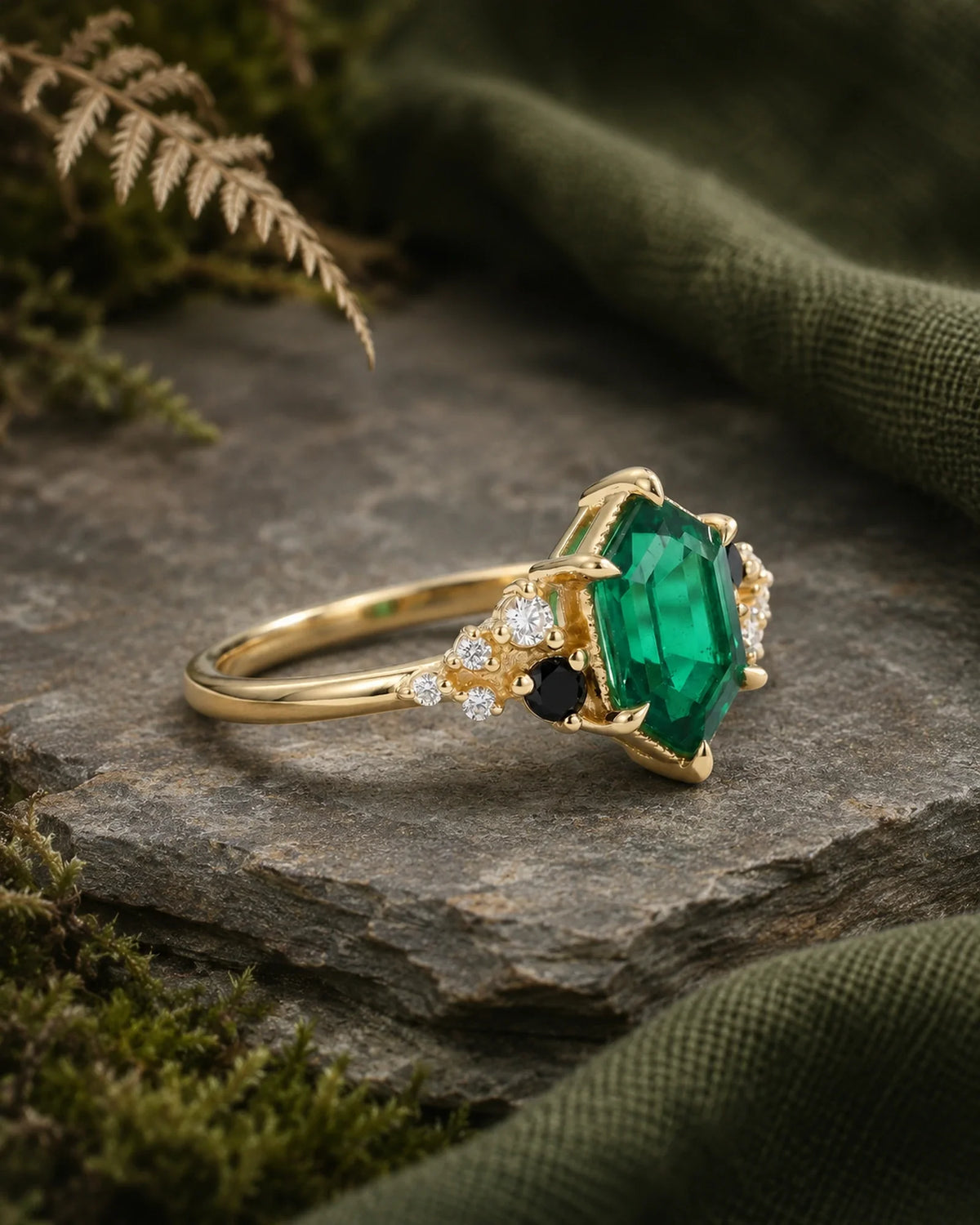

There isn't one minimum band width that makes every leaf engagement ring suitable for daily wear. A 1.5 mm band needs more scrutiny than a wider version of the same design, but a “2 mm” label doesn't tell you how much metal remains between two leaves or below a side stone. Before choosing the thinner option, ask for finished width and thickness at the base, the shoulder and the narrowest leaf connection, in your ring size and metal.
You may love the way a fine band nearly disappears beside the stone. That doesn't mean you have to give up the look. Sometimes keeping the top-view line slender while adjusting the underside is the right conversation to have. Sometimes the extra material needs to be at a leaf junction, not around the whole band. The useful question is where the design needs support, and which changes you'll actually see or feel.
Width is the line you see. Thickness is the depth you may miss.
Band width is the distance across the shank along the finger. Thickness, sometimes called depth, is the distance from the inside surface touching your finger to the outside surface of the metal. Neither is the ring's overall height: a tall basket can hold the stone well above a thin band.
When comparing a 1.5mm vs 2mm engagement ring band, specify whether you mean the plain lower shank or the decorated shoulders. At the same location, a 2 mm-wide solid section contains more metal across its width than a 1.5 mm section of the same thickness and profile. It will usually resist bending differently. That does not translate into a universal percentage increase in strength. Rounded edges, depth, alloy, ring size, joins and openings change the comparison.
A half-round section has a domed outside; a knife edge can look particularly fine from above but feel different against adjacent fingers. An open vine has air within its outline. You can't compare any of these by multiplying the widest visible span by its height and calling that the amount of supporting metal. Ask the designer to show a section through the exact area you are discussing.

Also establish when the dimensions apply. A manufacturing model may include material for finishing. A catalog number may be an approximate design reference without specifying its location. “1.8 mm before polishing” and “1.8 mm on the finished lower shank” are different commitments. Ask for the intended finished dimensions and the maker's applicable tolerance, not a promise that polishing will make every part more delicate.
The leaf isn't always the narrowest part
A sculpted leaf can be broad at its center and very narrow where it joins a vine. Two leaves may spread across several millimeters while each connects through a much smaller bridge. The broad silhouette looks substantial, but it doesn't make that bridge solid. Likewise, one branch crossing another doesn't prove that they are joined: the connection may be real, a visual overlap, or an open gap.
Follow the metal from the plain band toward the head. Does it taper gradually, split into two rails, or end at a tiny connection to a stone seat? Look from underneath as well as from above. A raised leaf can have thickness without much support at its root. A recessed engraving on a continuous band is another construction altogether. Our ring anatomy guide names these parts; here the point is to find the smallest section doing a structural job.
Don't ask a designer to make every leaf “thinner” in one instruction. Separate the tip, the carved vein, the supporting root and the band underneath. You might prefer a flatter leaf tip, a less pronounced vein or fewer openings rather than less metal at the connection. For anyone who wears gloves or catches rings on knitwear, keeping a motif close to the band can be more useful than shaving a fraction off the shank width.
Three botanical rings, three different questions
These examples are current catalog designs, not a ranking of durability. Their listed dimensions are nominal references, not measurements taken from these photographs. We do not have verified production cross-sections for the leaf junctions, accent seats or sizing areas. Those need confirmation on the selected design before a structural comparison can be made.
| Design | Listed width × thickness | What to recheck |
|---|---|---|
| Elowen leaf-and-vine solitaire | Approx. 1.8 × 1.4 mm | The separate rails and their connections to the head. |
| Elaria leaf three-stone ring | Approx. 1.7 × 1.3 mm | Support under the marquise seats and where leaves meet the shank. |
| Lunavelle crescent leaf cluster | Approx. 1.7 × 1.3 mm | Local sections around the emerald seats and crescent transitions. |
Elowen: openwork without accent-stone seats
The Elowen leaf-and-vine solitaire has an oval lab-grown diamond and no side stones. Its openwork still divides the shoulder into separate paths. Ask for the finished width and depth of each rail at its narrowest point, and where those rails join the basket. The nominal 1.8 mm band width does not mean each vine is 1.8 mm wide. Removing side stones avoids their seats, but doesn't remove the need to check the openwork.

Elaria: leaves beside two marquise settings
The Elaria moissanite leaf ring has two marquise moissanites beside the oval center. Its listed 1.7 × 1.3 mm band reference doesn't describe the metal left below each accent pavilion, the pointed underside of the stone. Ask whether widening the lower shank would leave those upper seats unchanged, and whether a proposed larger accent needs a redesigned shoulder rather than simply a bigger opening. Also confirm the final center measurements; the description includes a reference size but asks for measurement confirmation.

Lunavelle: more details to allow room for
The Lunavelle moss agate crescent ring combines botanical openwork with green emerald accents and crescent motifs. It shares Elaria's nominal band dimensions, but the shoulders are visibly different. Ask which part the reference describes and request a section through an accent-bearing junction. If making the ring slimmer would reduce the supporting metal, discuss fewer accents or a shallower decorative relief instead. The main stone, the smaller stones and their settings all belong in the wear and repair conversation.

Small stones change what “a little thinner” means
To fit an accent, a setter needs a seat for the stone and metal to hold it. A section with a stone opening is not a solid band of the same outside dimensions. Look for the metal remaining under the seat and between neighboring seats. Pavé continuing down the sides can also bring stone settings into an area that might otherwise be available for sizing. These are reasons to ask for a local section, not reasons to rule out small stones.
Ask for the assessment in the actual alloy. Gold karat alone is not a strength rating, and changing from gold to platinum doesn't automatically make an unchanged delicate junction adequate. A larger center, taller head or larger ring size can also change the design brief. If you've approved a narrow band and then changed the center, have the shoulders and head connection reviewed again.
Can a thin botanical ring be resized?
Sometimes, but thinness is only part of the question. The more useful starting point is whether there is a plain, sufficiently substantial sizing area opposite the head. In a conventional resizing, the jeweler may remove or add metal and rejoin the shank, as described in Stuller's ring-sizing explanation. A patterned or stone-set band cannot be treated like an undecorated band without considering what happens to the details and settings.
Changing the circumference can alter curvature and alignment farther up the ring. Depending on the design, a jeweler may need to check or adjust the head and accents after sizing. On a very fine or worn lower shank, rebuilding or replacing part of the shank may be more appropriate than stretching it. A large change may call for a remake. There is no responsible fixed allowance that applies to every botanical ring.
Before ordering, ask which direction and range the maker would consider for your specific ring, whether the leaves or stones restrict that range, and whether a matching band can be changed separately. Read the guide to resizing by ring structure for the broader differences. Do not assume a general resize service means your chosen openwork design qualifies. Get sized for the intended finger and consider the full stack before approving the order.
Ask for a drawing that answers your question
For a custom thin leaf engagement ring band, the most useful drawing isn't another glossy front render. Request a dimensioned section at the lower shank, at a representative shoulder and at the narrowest important leaf or accent junction. A section should identify what has been cut through; an outside measurement across two vines does not measure either vine on its own.
- Finished width and thickness at each named position, with the section profile shown.
- Local metal remaining beside and below an accent seat, and the narrowest supporting connections.
- Metal alloy, finger size, center dimensions, head height and any intended taper.
- Where the plain sizing area starts and ends, plus the maker's proposed resize options.
- Which dimensions are manufacturing allowances and which are finished targets, including the agreed tolerance.
Those requests apply whether you start among leaf engagement rings, prefer the petals in floral ring designs, or want a custom botanical design. You don't need to become a CAD technician. You need the person making the ring to show where the dimensions apply and explain the consequences of the change you want.
A structural revision costs more than the extra gold alone. Altering the taper or leaf roots may require modeling, revised stone seats, another approval and extra finishing. Ask what changes in the quote if you keep the same center but reinforce the local junctions, or simplify the decorative shoulders while keeping the lower band. The aim is a fine-looking ring with an understood construction, not the smallest number the listing will let you choose.