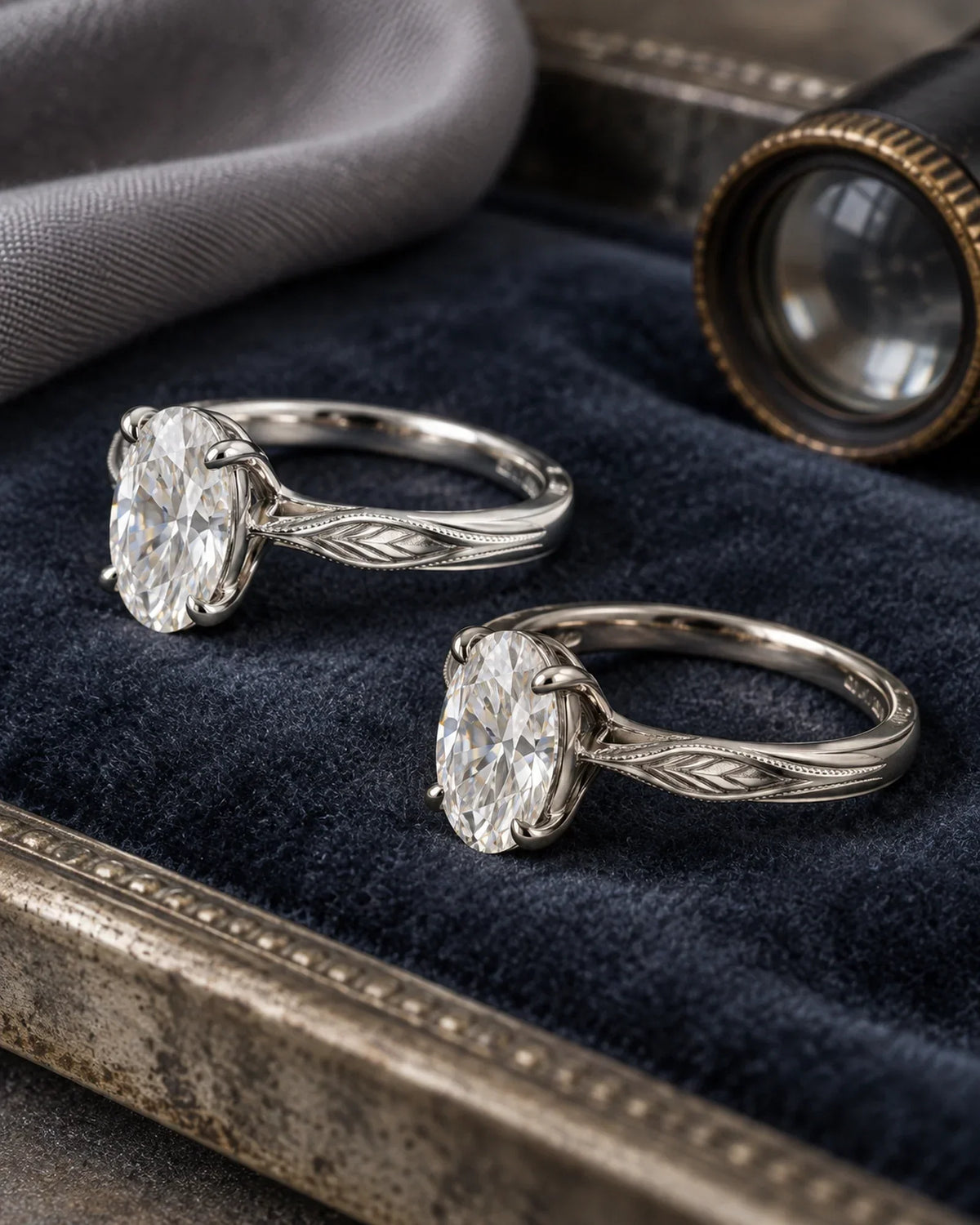

The difficult part of choosing a moss agate wedding band is not finding another ring with green details. It is finding a band that belongs beside one particular stone, clears one particular setting and remains comfortable when both rings move during ordinary wear.
The shortest useful answer is this: match the engagement ring's structure before matching its decoration. A high bridge may accept a straight band. A low basket, wide halo or pointed center usually needs a curved, chevron or open design. After that geometry is solved, use metal color and accent placement to connect the rings without trying to duplicate the moss inside a natural stone.
Why apparently matching rings fail to fit
A top photograph can hide every part that controls band fit. Turn the engagement ring sideways and locate its lowest outward obstruction. That may be the basket under the center, the gallery rail around it, a halo rim, a side-stone prong or a sculpted leaf on the shoulder. The wedding band's inside edge must pass that point without pushing against it.
Three problems account for most disappointing pairings:
- The band matches visually but collides physically. Two rings can share rose gold and marquise accents while the band still stops several millimeters from a low basket.
- The contour is correct but too exact. A deep curve can lock the two rings into one position, look incomplete alone and become misaligned after resizing.
- The surfaces meet in the wrong place. A wedding band should not repeatedly rub an exposed moss agate edge, a delicate prong tip or a row of tiny accent stones.
A small space is not automatically a defect. A consistent 1–2 mm gap can make a stack feel lighter, allow both designs to remain legible and reduce hard contact. The key is intent: uneven spacing caused by a collision is different from a deliberately balanced gap. The flush-fit and gap wedding-band guide covers those trade-offs in more detail.

Pair the color family, not an imagined exact pattern
Natural moss agate is valued for variation. One stone may be nearly transparent with fine fern-like threads; another may carry dense green clouds, dark branches or milky areas. That individuality means a second moss agate element is unlikely to be a perfect duplicate. Treat the stones as relatives rather than twins.
Pale, translucent stones
Stones with open transparent areas feel light and airy. Rose gold can warm the clear body and soften fine green inclusions. White gold creates a cooler, cleaner outline and lets pale material remain visually crisp. If the wedding band contains many bright stones, keep them narrow enough that their brilliance does not overpower the quieter center.
Deep green or densely included stones
Yellow gold reinforces olive, forest and earthy tones and gives a richer vintage impression. A simple polished or lightly textured band can be more successful than another highly detailed ring because it provides a visual boundary around the complex center. Dense stones also benefit from open areas in a stack; surrounding every edge with sparkle can make the composition look crowded.
Cool green and black contrast
White metal supports bluish greens and contemporary geometry. Black rhodium creates the strongest graphic contrast, especially with gothic halos and pointed bands, but it is a surface finish rather than a permanently black metal. Friction between stacked rings can reveal the underlying metal over time, so periodic refinishing should be part of the ownership plan.

When choosing remotely, ask for a face-up image in neutral light, a side view and a short video of the actual center stone if that service is available. Look at inclusion density, transparent areas and any pale seams before choosing the metal. For a custom pair, approve the center first and use it as the color reference for the complete stack.
How center shape changes the wedding-band plan
Oval: flexible, but not automatically straight-band friendly
Oval moss agate has no point to protect and usually creates the easiest transition into a contour. It can pair with a shallow curved band, a marquise crown or a restrained cluster. Yet an oval halo or low basket may still block a straight ring. Check the side profile rather than assuming that a rounded outline guarantees a flush fit.
Pear: give the point a clear direction
A pear center naturally suits a V-shaped or chevron band. The band can echo the point at one end or balance the rounded end with a gentler curve. Decide which direction the pear will be worn before finalizing an asymmetric companion ring. For a botanical design, marquise accents can suggest leaves without physically touching the vulnerable tip.
Kite: use angle, negative space and restraint
A kite center creates a decisive vertical axis. A shallow standard curve often looks unrelated, while a chevron or open band can follow the lower angle cleanly. Leave enough negative space for the outline to remain visible. When both rings use sharp peaks, inspect the tips from the side so one does not catch beneath the other.
Long hexagon: preserve the architecture
Elongated hexagons work well with contour bands that repeat their angled shoulders, open bands that stop before the center or vine bands that soften the geometry. A broad straight band can make the center look top-heavy unless the engagement ring is raised sufficiently. This shape is especially sensitive to rotational misalignment, so a fitted contour should have a little tolerance rather than a rigidly tight outline.
Straight, curved, chevron, open or spacer?
| Band type | Best use | Main advantage | Check before ordering |
|---|---|---|---|
| Straight | Raised center with an open bridge | Easy to wear alone and combine later | Band height must pass beneath the lowest obstruction |
| Curved or contour | Oval centers, low baskets and rounded halos | Creates controlled spacing around the head | Curve depth, width and rotation tolerance |
| Chevron or V-shaped | Pear, kite and pointed clusters | Echoes direction and frames a tip | The peak must not press against the stone or prongs |
| Open band | Wide halos, low settings and unusual outlines | Allows clearance without a deep visible curve | Open ends need secure construction and safe edge placement |
| Spacer | Stacks with rubbing or delicate pave edges | Separates contact points and adds a calm line | Combined width and comfort across the finger |
Profile matters as much as outline. A wedding band may clear the basket in plan view yet sit higher than the engagement-ring shank, producing a step between the rings. Compare shank thickness, finished band height and where decorative stones begin. Our high-set and low-profile ring guide explains how bridge clearance affects daily comfort and wedding-band options.
What to confirm before ordering a matching band
- Exact ring size for both pieces; wider combined stacks can feel tighter.
- Center shape and dimensions, not merely a name such as “pear.”
- Distance from the finger to the lowest basket, halo or decorative shoulder.
- Wedding-band height and inside-edge profile at the closest point.
- Whether a visible gap is acceptable and how much.
- Whether each ring should look complete when worn alone.
- Reasonable resizing range for both shanks.
- Future plans for soldering, an anniversary band or a spacer.
If the engagement ring already exists, the most reliable route is to fit the band to the finished piece. Measurements and photographs help, but a physical ring or accurate three-dimensional model reveals prong projections and small asymmetries that a top view misses. For a new purchase, a tested moss agate engagement ring set reduces uncertainty because the two profiles are planned together.
Cleaning a moss agate ring with its matching band
Clean the two rings separately. Use lukewarm water, mild soap and a very soft brush or lint-free cloth. Support the ring over a bowl rather than an open drain, work gently beneath the basket and along the inside curve of the band, rinse thoroughly and dry completely before restacking.
Do not make steam or ultrasonic cleaning the default for a naturally included stone. Moss agate is quartz, but its visible internal features and the unknown history of an individual stone make controlled hand cleaning the more conservative routine. Avoid bleach, harsh household chemicals and sudden temperature changes. Remove the stack before heavy impact, rough gripping or work that traps grit between the rings.

During cleaning, inspect the closest contact points. Look for a polished groove, a lifted prong, a loose accent or a black finish beginning to wear where the rings rub. Fine jewelry should receive periodic professional inspection, especially when a fitted band touches a halo or pave shoulder every day.
Six bridal sets that solve different pairing problems
These examples are useful as construction references, not just style choices. Compare how each companion band responds to the center outline and how much negative space remains around the engagement ring.


For a wider view of available center shapes and setting styles, compare the moss agate engagement ring collection. Buyers who prefer foliage details can narrow the search through moss agate leaf rings, while milgrain and antique-inspired profiles appear among vintage moss agate designs.
Frequently asked questions
Can any wedding band fit a moss agate engagement ring?
No. Gemstone identity does not determine fit; the setting does. A straight band may fit a raised solitaire but stop against a low basket, halo or side cluster. Compare side profiles and exact measurements.
Should a moss agate wedding band sit completely flush?
Only if the geometry allows it without pressure. A small, even gap can be comfortable and protective. Flush fit is a style preference, not proof of better construction.
How do I match the green in a moss agate ring?
Match the broad color family and inclusion density, then let the metal and accent pattern connect the pieces. Exact duplication is unrealistic for natural stones. Approve the actual center stone before finalizing a custom pair.
Is a bridal set better than buying the wedding band later?
A set is usually safer for pointed centers, low profiles and wide decorative heads. Buying later offers more flexibility when the engagement ring has ample clearance or when the wearer wants to build the stack gradually.
Can moss agate bridal sets be resized?
Many can, but the reasonable range depends on shank design, pave coverage, engraving and contour depth. Resizing can change how two shaped rings meet, so both pieces should be checked together afterward.
Should the rings be soldered together?
Soldering can stabilize alignment and reduce independent movement, but it removes solo-wear flexibility and links future repair or resizing decisions. Try the unsoldered stack first and discuss contact wear with a jeweler before making the choice permanent.
The final decision
A successful moss agate ring with matching band is not the pair with the most repeated leaves or the closest shade of green. It is the pair whose profiles clear each other, whose contact points are controlled and whose combined width feels natural on the hand. Solve the geometry first, use color and motif to create harmony second, and keep maintenance realistic. That order produces a bridal stack that remains convincing long after the first photograph.