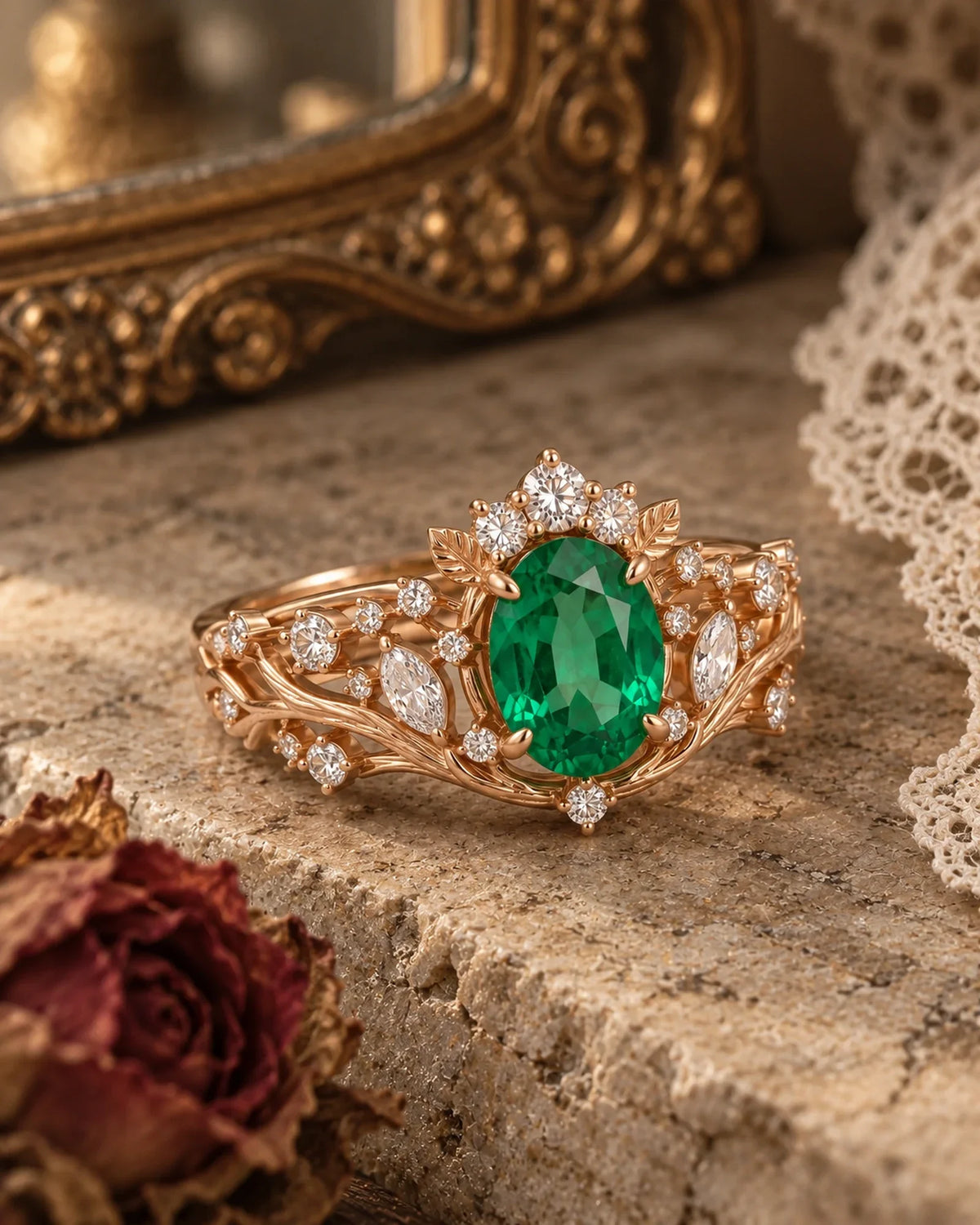

The ring you loved looked sharp and lively. Now the center seems milky, or a rainbow patch sits stubbornly across its surface. It is easy to jump from "something looks different" to "I bought the wrong stone." Pause before reaching for a stronger cleaner.
If you are asking "why is my moissanite cloudy," first separate surface residue from the way the stone handles light. Lotion, soap and deposits behind the stone can dull its appearance. A surface film may look iridescent. Faceting, lighting, internal features or damage can create different problems, and cleaning will not correct all of them.
The useful question is not whether moissanite is supposed to sparkle forever. It is what changed, where it changed, and whether the change remains after appropriate cleaning. That gives a jeweler something concrete to investigate rather than a vague description of a disappointing ring.
Start with what changed, not how much it sparkles
Was the stone clear when it arrived? Does the haze affect the whole ring or one patch? Did you notice it after applying sunscreen, after a knock, or only in an enlarged phone photo? A ring that gradually loses contrast needs a different investigation from a new stone that has always looked soft in the center.
| What you notice | A possibility, not a diagnosis | Useful next step |
|---|---|---|
| Several stones look dull after regular wear | Residue on exposed surfaces or behind the stones | Check condition and care instructions, then clean gently if suitable |
| A stationary rainbow-looking patch on the table | A surface film, sometimes called an oil slick | Ask the maker about an approved treatment if gentle cleaning fails |
| Softness changes markedly with angle or lighting | Facet reflections, double refraction, camera focus or cut appearance | Compare the dry stone in ordinary light, both by eye and on video |
| A new pale mark after impact, movement or snagging | Possible damage or setting trouble | Stop wearing and arrange inspection before cleaning |
| Haze persists after careful cleaning and drying | Remaining deposits, surface condition or internal features | Request examination rather than escalating household remedies |
These clues overlap. A photograph cannot reliably tell you whether a mark lies on the surface, underneath it, or on a reflected facet. Do not scrape at a spot to find out, and do not push the stone to test whether it is loose.
The film you see and the fire you love are different
Everyday products can leave a coating across the table, the large flat facet on top, or collect near the prongs. Deposits on the pavilion, the angled lower half of the stone, can affect its face-up appearance even when the top feels clean. A polished crown is only part of the optical surface.
The expression moissanite oil slick usually describes a rainbow-like surface patch rather than the stone's colorful flashes. Charles & Colvard discusses organic film in its moissanite jewelry care advice. The nickname does not identify the chemistry of every patch or establish a universal removal method.
Fire appears as flashes of separated colors as the ring and light move. A film may look more like a continuous sheen over a particular area. That is an observation to share with the jeweler, not a definitive home test. Colored reflections can come from your surroundings too.
Be especially careful with specialist polishing cloths. A product intended for the stone may be unsuitable for surrounding metal or rhodium plating on white gold. Ask for the exact approved product and instructions for your ring, not a remedy borrowed from a different setting.
One careful cleaning, then a fair comparison
For an intact, uncoated moissanite ring in a compatible gold or platinum setting, a mild wash is a reasonable starting point. First confirm the instructions for every component. A moissanite center beside pearl, opal, treated emerald or an unknown coated accent does not make the whole ring safe to soak.
Stop before cleaning if a stone rattles, a prong has lifted, the ring recently suffered a hard impact, or you see a possible chip. Antique jewelry and pieces with uncertain treatments also belong with a professional first.
- Record the starting appearance. Use indirect daylight, a clean phone lens and a plain background. Keep the ring's angle and distance consistent. Avoid flash and filters.
- Use a gentle wash only when the ring permits it. Prepare lukewarm water with a little mild liquid dish soap, without abrasive or harsh additives. Avoid boiling water and sudden temperature changes.
- Brush accessible areas lightly. Use a clean, very soft brush. Work around the crown and reachable underside without forcing bristles between tight stones or levering against a prong.
- Rinse and dry completely. Rinse in a separate bowl rather than over an open drain. Blot with a clean lint-free cloth, then let recesses air-dry. Handle the ring by the band.
- Compare under the original conditions. Look with your eyes before zooming into a photograph. Note whether the film, overall contrast or only one local patch changed.
GIA ultrasonic cleaning precautions explain why treatments, delicate gems and setting condition matter when choosing a cleaning method. A home ultrasonic cleaner is not the next automatic step simply because the center is moissanite.

For a real before-and-after record, photograph your own dry ring in the same light. Comparing a hazy kitchen snapshot with a sharply lit studio listing will exaggerate differences. Even a useful home record cannot establish material identity or rule out damage.
Why wiping the top may not be enough
Think about where a ring sits: close to skin, hand cream and soap. The underside can be less visible but more difficult to reach. In a halo or cluster, neighboring stone seats create additional recesses. Leaf and vine details can collect residue where decorative forms meet the shoulder.
A helpful distinction is openwork versus access. A visible gap in decorative goldwork does not necessarily lead to the pavilion. Nor does a tall setting automatically make cleaning easy. Ask for an underside photograph showing the actual route to the back of the center and the small accents.

When choosing among halo engagement rings, compare the basket and accent seats as well as the outline. With leaf engagement rings, ask how sculpted details will be cleaned without catching a brush. Beautiful complexity is not a defect; it simply deserves a workable care plan.
If the brush cannot reach a deposit comfortably, leave it. Pins, needles and hard toothpicks are not substitutes for an appropriate cleaning channel. A jeweler can examine the recess and choose a method compatible with the entire ring.
Sometimes the appearance belongs to the cut
Moissanite is doubly refractive: in some viewing directions, light traveling through it can produce doubled-looking facet junctions. The visibility depends on viewing direction and cutting orientation. This is different from a removable coating, and it does not mean every soft-looking stone is showing double refraction.
Facet arrangement also changes the kind of sparkle you see. A brilliant style, a densely fragmented crushed-ice appearance and broad step facets do not return light in the same visual pattern. Fine reflections can blend in a photograph; broad facets may show quieter areas between flashes. Neither effect should automatically be called dirt.
Cut quality still matters. A persistent lifeless area, uneven contrast or softness you dislike may require an evaluation of proportions, polish and internal features. Cleaning cannot rearrange facets, remove internal inclusions or repair chipped edges.
Consider two practical situations. A stone that looked crisp on arrival but became dull after months of wear gives you a reason to investigate deposits. A clean new stone that looks soft from its first ordinary-light video gives you a reason to discuss cut appearance. These are troubleshooting examples, not reports of customer cases.
If it is still cloudy, give the jeweler a better brief
Moissanite still cloudy after cleaning is a reason to investigate, not a reason to scrub harder. Stop repeating increasingly aggressive methods. Toothpaste, abrasive silver polish, acids, bleach and household descalers are not general-purpose solutions for a mounted ring.
Arrange prompt inspection if the change followed a knock, a prong catches unexpectedly, a stone moves, or one edge has a new pale mark. Otherwise, send the seller your original photographs, a short dry-stone video and a clear account of the safe cleaning already attempted.

- Was the haze present on arrival, gradual, or sudden?
- Is it localized to the table, an edge, the underside or several stones?
- What cleaner, brush and water temperature were used?
- Are there coatings, mixed gemstones or recently repaired areas?
- Can the jeweler check residual deposits, polish, chips, internal features and stone security?
If material identity is uncertain, request the purchase specifications and appropriate testing. Appearance and a basic tester reading alone are not a complete identification. The aim is an explanation and suitable care, not an automatic replacement or an unsupported promise that nothing is wrong.
Make the care routine easier to keep
Remove the ring before applying rich hand cream or sunscreen, and put it back once your hands are dry. Hold the band rather than rubbing the stone between your fingers. These small changes limit fresh residue without turning ownership into a daily polishing project.
There is no single cleaning interval for every wearer. Let the ring's appearance, its structure and the maker's advice guide you. If film returns unusually quickly after an appropriate wash, record the timing and ask about the cause rather than buying a succession of stronger products.
Keep routine setting inspections separate from cleaning. A bright stone can still sit in worn prongs, and a dull stone can be securely mounted. Removing residue is not a substitute for checking whether the jewelry remains safe to wear.
For buyers: compare the maintenance, not just the sparkle
If you are still choosing from moissanite engagement rings, these recent designs illustrate different facet and setting conversations. They are not fixes for an existing cloudy stone. In cluster engagement rings, remember to ask about the little stones too.

Aureline Step-Cut Cluster
Listed 6 x 8 mm step-cut center. Review its broad reflections in ordinary light and ask about access behind the geometric accents.
14K gold options from $1,160 USD

Elarisse Leaf Ring
Listed 6.5 mm round center and 14 round accents. Ask how leaf seats and neighboring prongs will be inspected and cleaned.
14K gold options from $890 USD

Rosavelle Vintage Cluster
Listed 6.5 mm round center with eight accents. Request a bottom view; a smaller accent count alone does not prove easy access.
14K gold options from $860 USD
Listed specifications and available 14K starting prices checked October 8, 2026. Catalog images show the complete ring without cropping. Confirm the selected metal, size, final price and individual care instructions before ordering.
The questions worth asking before you worry
Does moissanite get cloudy over time?
Ordinary wear does not mean moissanite should inherently turn milky. Its appearance can change because of deposits or surface conditions, while cut and internal features may have been present from the start. Do not treat a lifetime-sparkle claim as a diagnosis of your ring.
Can I remove every oil-slick patch at home?
No universal method is safe for every mounted ring. Gentle cleaning may help some residue, but a persistent patch needs maker-specific advice or professional examination. An online photograph cannot tell you which compound is present or whether the surface is coated.
Why does it look cloudy only in phone photos?
Close focus, reflections, exposure and dense facet patterns can reduce apparent contrast. Compare by eye in indirect daylight and normal indoor light. If the softness remains visible, ask for an evaluation rather than dismissing it as a camera problem.
You do not have to ignore a change in a ring you love. Start gently, compare fairly, and stop when cleaning stops answering the question. Getting the cause right matters more than making the next photograph sparkle.