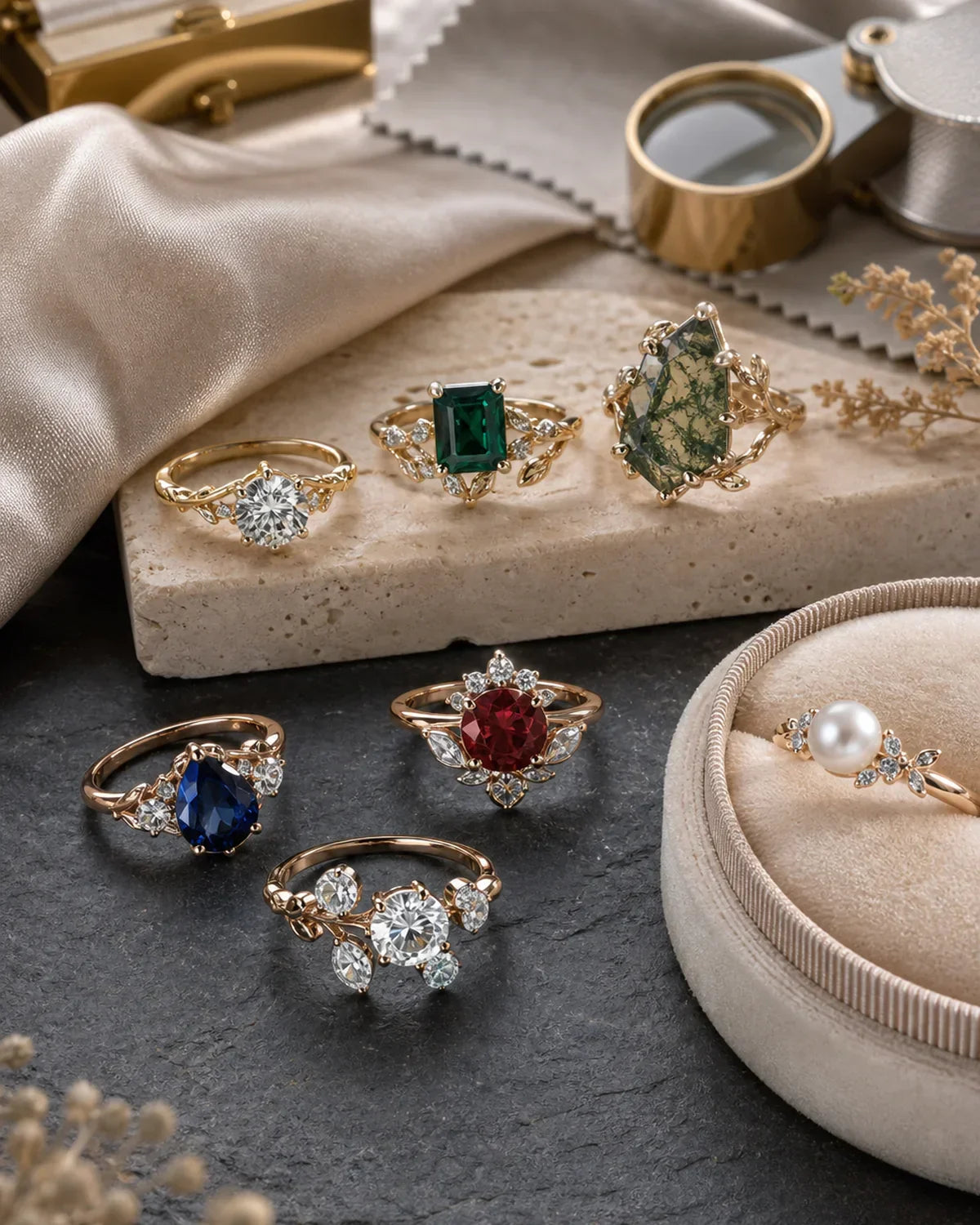

Un anillo de compromiso woodland no es simplemente una piedra verde con una etiqueta de estilo natural. Las mejores versiones transmiten la sensación de que todo el anillo pertenece a un mismo pequeño universo: una piedra central musgosa, un engaste de hojas que suaviza los hombros, una banda con formas de rama, una superficie de oro texturizada o un halo que parece botánico en lugar de perfectamente circular.
Por eso este estilo se ha convertido en una categoría tan útil para quienes buscan algo más específico y no se conforman con un solitario sencillo, pero tampoco quieren un anillo que parezca de disfraz. Un anillo de compromiso woodland puede ser romántico, terroso, de inspiración vintage o discretamente moderno. El lenguaje de diseño es natural, pero el resultado final depende de las proporciones.
La búsqueda suele comenzar con un anillo de ágata musgosa, porque el ágata musgosa ya lleva el espíritu del bosque en su interior. A partir de ahí, la decisión se vuelve más matizada: ¿el engaste debe usar hojas, ramas, textura de corteza, una banda de vid o un halo inspirado en la naturaleza? Cada detalle cambia la personalidad del anillo.

¿Qué Hace que un Anillo se Sienta Woodland?
La palabra woodland sugiere algo más específico que inspirado en la naturaleza. Un anillo floral puede evocar un jardín. Un anillo de olas puede evocar la costa. Un anillo celestial puede resultar místico. Woodland se acerca más a la imaginería del bosque: musgo, corteza, ramas, hojas, verdes suaves, oro cálido, textura irregular y una sensación de movimiento sereno.
Eso no significa que cada detalle deba ser literal. De hecho, el diseño literal suele ser donde los anillos woodland fallan. Demasiadas hojas, demasiada textura y demasiadas piedras de acento pueden hacer que un anillo se sienta recargado en lugar de orgánico. Los diseños de anillos de compromiso de bosque más logrados suelen elegir una idea dominante y dejar que los demás detalles la apoyen.
Ágata Musgo: La Piedra Central de Bosque Más Versátil
El ágata musgo es popular en anillos woodland porque no necesita una explicación compleja. Sus inclusiones verdes pueden parecer sombras de helechos, líquenes, copas de árboles o paisajes vistos a través de la niebla. Ese patrón interno otorga a un anillo de compromiso de ágata musgo una sensación de lugar, que es exactamente lo que muchas novias alternativas buscan.
Lo importante es entender que el ágata musgo no es uniforme. Algunas piedras son pálidas y translúcidas con suaves vetas verdes. Otras son más oscuras, densas y dramáticas. Una piedra central de ágata musgo clara suele sentirse etérea y romántica; una piedra más oscura resulta más boscosa y con mayor presencia. Ninguna es automáticamente mejor. La elección correcta depende de si el anillo debe sentirse delicado o envolvente.
La forma también importa. El ágata musgo ovalada se siente más suave y clásica. La de pera tiene un movimiento natural de lágrima u hoja. La de cometa resulta más artística y menos predecible. Las formas marqués y hexágono alargado pueden verse impactantes, pero requieren proporciones cuidadosas en la banda para que el anillo no se vuelva demasiado puntiagudo en la mano.
Engastes de Hoja: Románticos sin Ser Demasiado Literales
Los engastes de hoja son una de las formas más llevables de incorporar detalles woodland a un anillo de compromiso. Las hojas pueden ubicarse a lo largo de los hombros, actuar como garras, enmarcar la piedra central o aparecer como piedras de acento en forma de marqués. En comparación con una banda esculpida de ramas, un engaste de hoja puede mantenerse bastante discreto y cómodo.
Para quien compara anillos de compromiso con hojas, la pregunta clave es si las hojas se sienten integradas. Una banda con hojas bien lograda debe guiar la mirada hacia la piedra central. Un diseño más débil parece que las hojas se añadieron después. La diferencia es sutil en las fotos, pero evidente en la mano.
Los motivos de hojas también transmiten simbolismo sin necesidad de volverse sentimentales. Sugieren crecimiento, renovación y un nuevo comienzo. En un anillo de compromiso de estilo bosque, ese simbolismo resulta especialmente natural porque el motivo no está aislado; pertenece al lenguaje forestal más amplio del diseño.
Bandas de rama y perfiles orgánicos
Una banda de rama cambia el carácter de forma más drástica que un adorno de hojas. En lugar de un perfil liso y simétrico, el anillo puede presentar curvas que recuerdan a ramitas, hombros irregulares o una banda dividida que parece haber crecido alrededor de la piedra. Aquí es donde un anillo de compromiso orgánico puede volverse verdaderamente distintivo.
El desafío es la comodidad de uso diario. Los engastes de rama pueden engancharse si las puntas están demasiado elevadas o la textura es demasiado afilada. Un anillo también puede verse pesado si la idea de la rama está sobrecargada. Para uso diario, busca un diseño de rama con puntos de contacto suaves, puntas seguras y suficiente espacio negativo alrededor de la piedra central.

Oro texturizado: corteza, metal martillado y calidez
El oro texturizado es una de las formas más sutiles de dar a un anillo una sensación de bosque. Una banda de oro amarillo pulido puede verse clásica, mientras que una textura de corteza, una superficie martillada o un acabado suavemente irregular hacen que el mismo anillo se sienta más arraigado. El efecto puede ser sutil, especialmente a distancia, pero cambia cómo se percibe el anillo de cerca.
El oro amarillo es el compañero más natural para este estilo porque evoca calidez: luz solar, corteza, hojas secas y joyería antigua. El oro rosa hace que los anillos de estilo bosque se vean más suaves y románticos. El oro blanco también puede funcionar, especialmente con ágata musgosa, pero suele crear un efecto más frío y moderno.
Si el anillo ya tiene un centro de ágata musgosa con patrones y adornos de hojas, mantén el oro texturizado con moderación. Un pequeño detalle de corteza a lo largo del hombro suele ser suficiente. Si la piedra central es moissanita clara o diamante, el oro texturizado puede asumir más protagonismo en la narrativa del diseño.
Halo inspirado en la naturaleza vs. halo estándar
Un halo estándar es un círculo limpio de piedras pequeñas alrededor de la piedra central. Puede añadir tamaño y brillo, pero no transmite automáticamente una sensación de bosque. Un halo inspirado en la naturaleza es diferente. Puede utilizar piedras en forma de marqués que recuerdan a hojas, agrupaciones irregulares, separaciones que imitan pétalos o un halo parcial que parece más una corona que un círculo perfecto.
Esta distinción es importante porque muchas personas que buscan un anillo de compromiso con halo no quieren que se sienta demasiado pulido o anticuado. Un halo botánico puede enmarcar la ágata musgo de forma preciosa, ya que aporta luminosidad alrededor de una piedra más suave. También puede hacer que un anillo de moissanita transparente se sienta más boscoso sin necesidad de un centro verde.
El enfoque más seguro es el equilibrio. Si el halo es de hojas o floral, la banda puede ser más sencilla. Si la banda ya tiene forma de rama, el halo debe ser más delicado. Demasiados detalles orgánicos en competencia pueden hacer que el anillo pierda el foco.
| Detalle boscoso | Ideal para | Qué tener en cuenta |
|---|---|---|
| Centro de ágata musgo | Color de inspiración forestal y patrón interno natural | Variación de la piedra; cada gema puede verse diferente en persona |
| Engaste de hojas | Detalle botánico romántico que sigue siendo cómodo de llevar | Hojas elevadas que pueden engancharse en la ropa |
| Aro de rama | Estilo boscoso, orgánico y modelado a mano | Volumen, textura áspera o dificultad para combinar con la alianza |
| Oro texturizado | Profundidad similar a la corteza y calidez terrosa | Exceso de textura que compite con una gema llamativa |
| Halo botánico | Brillo adicional sin un efecto de halo plano | Demasiados acentos que compiten con la piedra central |
Cómo elegir la dirección boscosa adecuada
Empieza por elegir la historia visual principal. Si la piedra es la protagonista, elige primero la ágata musgo y mantén el engaste lo suficientemente limpio para que se vean las inclusiones. Si el trabajo de metal es la protagonista, elige un aro de rama o una banda texturizada y considera una piedra central más transparente. Si el romance es la protagonista, los hombros de hojas o un halo botánico pueden ser la opción más acertada.
También ayuda pensar en la alianza desde el principio. Un anillo de compromiso boscoso con un aro de hojas liso puede combinarse fácilmente con una banda recta. Un anillo de rama o enredadera suele necesitar una banda curva. Un juego nupcial de ágata musgo resuelve ese problema al diseñar el anillo de compromiso y la banda juntos, pero el conjunto completo debe sentirse equilibrado en el dedo.
Seis anillos boscosos para comparar


Los productos anteriores son puntos de comparación útiles porque cada uno enfatiza una parte distinta del lenguaje del bosque: ágata musgo, engastes de ramas, textura de corteza de árbol, halos de hojas y juegos de novia con enredaderas. El objetivo no es elegir el anillo con más detalles, sino aquel donde los detalles se sientan intencionales.


Preguntas frecuentes
¿Qué es un anillo de compromiso de estilo boscoso?
Un anillo de compromiso de estilo boscoso incorpora detalles inspirados en el bosque, como ágata musgosa, hojas, bandas con formas de ramas, oro texturizado, engastes de enredadera o halos botánicos. Es más específico que un anillo de inspiración natural en general, porque su estética está ligada a imágenes del bosque.
¿Es el ágata musgosa adecuada para un anillo de compromiso?
El ágata musgosa se valora por sus inclusiones verdes únicas y su aspecto natural. No es tan dura como el diamante, el zafiro o la moissanita, por lo que es ideal para quienes se sienten cómodos quitándose el anillo para trabajos pesados, impactos fuertes, limpieza o actividades que puedan rayarlo o golpearlo.
¿Son prácticos los engastes de hoja para el uso diario?
Pueden ser prácticos cuando las hojas son lisas, de perfil bajo y están integradas en la banda. Las puntas de hoja muy elevadas, las texturas afiladas o las filigranas delicadas pueden requerir más cuidado. Siempre revisa el perfil lateral y los puntos donde pueda engancharse, no solo la vista superior.
¿Qué metal luce mejor en anillos de compromiso de estilo boscoso?
El oro amarillo es el más cálido y el que más evoca el bosque, especialmente con ágata musgosa y textura de corteza. El oro rosa resulta más suave y romántico. El oro blanco aporta un tono más frío y moderno, que funciona bien cuando el diseño ya es muy detallado.
¿Cómo evito que un anillo boscoso se vea recargado?
Elige un elemento principal: el centro de ágata musgosa, el engaste de hoja, la banda de rama, el oro texturizado o el halo botánico. Deja que los demás detalles complementen ese elemento en lugar de competir con él.
Un anillo de compromiso boscoso funciona porque resulta personal sin necesidad de ser llamativo. El diseño adecuado puede evocar musgo, hojas, ramas y luz de bosque, manteniendo al mismo tiempo la elegancia de la joyería fina. Busca primero la proporción, después el simbolismo, y añade detalles solo donde aporten algo real al anillo.