
Moissanite engagement rings have become one of the fastest-growing alternatives to traditional diamond rings, especially among buyers looking for exceptional brilliance, durability, and long-term value. However, one of the biggest challenges buyers face today is understanding how to identify a truly high quality moissanite ring.
Online, many moissanite rings appear similar at first glance. Product photos are often heavily edited, lighting conditions vary dramatically, and technical gemstone terminology can feel confusing for first-time buyers.
As a result, many shoppers ask questions like:
- Why do some moissanite rings sparkle more than others?
- Does moissanite get cloudy over time?
- Why does certain moissanite look yellow or gray?
- Is expensive moissanite actually better?
- Will the stone scratch or lose brilliance with daily wear?
- How can I tell if the craftsmanship is good?
In reality, high quality moissanite is not determined by size alone. The most important factors are cut precision, color balance, clarity, craftsmanship, and setting durability.
According to gemological standards referenced by organizations such as the Gemological Institute of America (GIA), optical performance plays a major role in how gemstones reflect light, brilliance, and fire. Even a large stone can appear dull if the cut quality is poor.
This guide explains how to evaluate moissanite rings from a practical and professional perspective, helping buyers understand what truly matters for long-term beauty and everyday wear.
What Is Moissanite?

Natural vs Lab-Created Moissanite
Natural moissanite was first discovered in 1893 by French scientist Henri Moissan inside a meteor crater. The mineral, composed of silicon carbide, is extremely rare in nature.
Because natural moissanite is so scarce, nearly all moissanite used in jewelry today is laboratory-created.
Unlike imitation stones such as cubic zirconia, lab-created moissanite has its own unique chemical structure and optical properties. It is considered a genuine gemstone material rather than a simple diamond simulant.
Why Moissanite Became Popular for Engagement Rings
Moissanite became especially popular because it offers several advantages for everyday engagement rings:
- Excellent durability for daily wear
- Very high brilliance and fire
- Affordable compared to natural diamond
- Ethical and sustainable sourcing appeal
- Strong resistance to scratching
Its refractive index is even higher than diamond, which is why moissanite often displays stronger rainbow fire under direct lighting.
The 4 Main Factors That Determine Moissanite Quality
1. Cut: The Most Important Factor
Cut quality has the biggest impact on how a moissanite ring looks in real life.
Many buyers assume larger carat weight automatically means a more impressive ring, but poor cutting can make even a large stone appear dull, lifeless, or uneven.
A well-cut moissanite reflects light evenly across the entire stone, creating balanced brilliance and fire. Poorly cut stones may show:
- Dark zones
- Uneven sparkle
- Flat appearance indoors
- Windowing effects
- Harsh artificial glare
Round brilliant cuts generally maximize sparkle because their faceting pattern is optimized for light return. Shapes like oval, pear, and marquise may appear visually larger, while emerald cuts create a cleaner, mirror-like reflection.
Precision cutting and symmetry are especially important in moissanite because its high refractive index amplifies imperfections in facet alignment.
Some premium moissanite stones are cut using Hearts & Arrows precision faceting, designed to improve optical symmetry and light performance.
2. Color: Understanding Moissanite Color Grades
Moissanite is commonly graded similarly to diamonds using color ranges such as:
- D–F (colorless)
- G–H (near colorless)
- I and below (warmer tones)
Higher quality moissanite usually appears more neutral white under different lighting conditions.
Lower quality stones may show:
- Yellow undertones
- Gray appearance
- Greenish tint under sunlight
Larger stones often reveal color more easily than smaller stones, especially above 2 carats.
Metal color also affects appearance:
- White gold and platinum pair best with colorless moissanite
- Yellow gold can complement warmer near-colorless stones
- Rose gold often softens slight warmth naturally
Many buyers searching for the most diamond-like appearance prefer DEF or high GH color grades.
3. Clarity: What Actually Matters?
Most quality moissanite stones are considered eye-clean, meaning inclusions are not visible without magnification.
Unlike diamonds, clarity differences in moissanite are usually less important visually because the stone’s brilliance masks minor inclusions effectively.
However, lower quality manufacturing may create:
- Internal haze
- Reduced transparency
- Surface blemishes
- Oily appearance under lighting
Many people confuse dirt buildup or oil residue with permanent cloudiness. In reality, properly manufactured moissanite does not permanently become cloudy under normal wear conditions.
Regular cleaning helps maintain maximum brilliance.
4. Craftsmanship & Setting Quality
Even a beautiful moissanite stone can feel cheap if the ring craftsmanship is poor.
Long-term durability depends heavily on:
- Prong security
- Metal thickness
- Stone alignment
- Polishing quality
- Structural engineering
Common problems seen in low-quality rings include:
- Loose stones
- Bent prongs
- Thin bands warping over time
- Uneven settings
- Weak side stone security
For daily wear engagement rings, craftsmanship matters just as much as the center stone itself.
Does Moissanite Scratch or Wear Down Over Time?
Moissanite ranks approximately 9.25 on the Mohs hardness scale, making it one of the hardest gemstones used in jewelry.
Compared to other gemstones:
| Gemstone | Mohs Hardness | Daily Wear Suitability |
|---|---|---|
| Diamond | 10 | Excellent |
| Moissanite | 9.25 | Excellent |
| Sapphire | 9 | Excellent |
| Emerald | 7.5–8 | Moderate |
| Opal | 5.5–6.5 | Low |
This means moissanite is highly resistant to scratching and very suitable for everyday wear.
However, hardness does not mean indestructible. Rings can still experience:
- Loose prongs
- Metal wear
- Stone impact damage
- Scratches on the metal setting
Protective settings and proper maintenance remain important.
Why Some Moissanite Rings Look Cheap
Not all moissanite rings are created equally.
Lower quality rings often suffer from:
- Poor cutting precision
- Weak setting craftsmanship
- Overly gray body color
- Harsh rainbow glare
- Thin plated metals
- Weak structural support
One common misconception is that more rainbow sparkle automatically means higher quality. In reality, balanced brilliance is usually considered more refined and luxurious than excessive glare.
Photography can also be misleading online. Strong studio lighting may exaggerate sparkle while hiding issues such as poor symmetry or uneven transparency.
Best Moissanite Shapes for Different Styles

Round Cut
Round brilliant cuts generally produce the strongest sparkle and most balanced light performance.
Best for:
- Classic engagement rings
- Maximum brilliance
- Timeless appearance
Oval Cut
Oval moissanite appears larger visually because of its elongated shape.
Best for:
- Elegant finger coverage
- Modern engagement styles
- Slimming appearance on the hand
Emerald Cut
Emerald cuts emphasize clarity and clean reflections instead of intense sparkle.
Best for:
- Minimalist aesthetics
- Luxury-inspired designs
- Sophisticated understated style
Pear & Marquise Shapes
These elongated cuts create dramatic finger lengthening effects but may require more protection at pointed tips.
Cushion Cut
Cushion cuts combine softness with vintage-inspired sparkle patterns.
Recommended Moissanite Engagement Rings

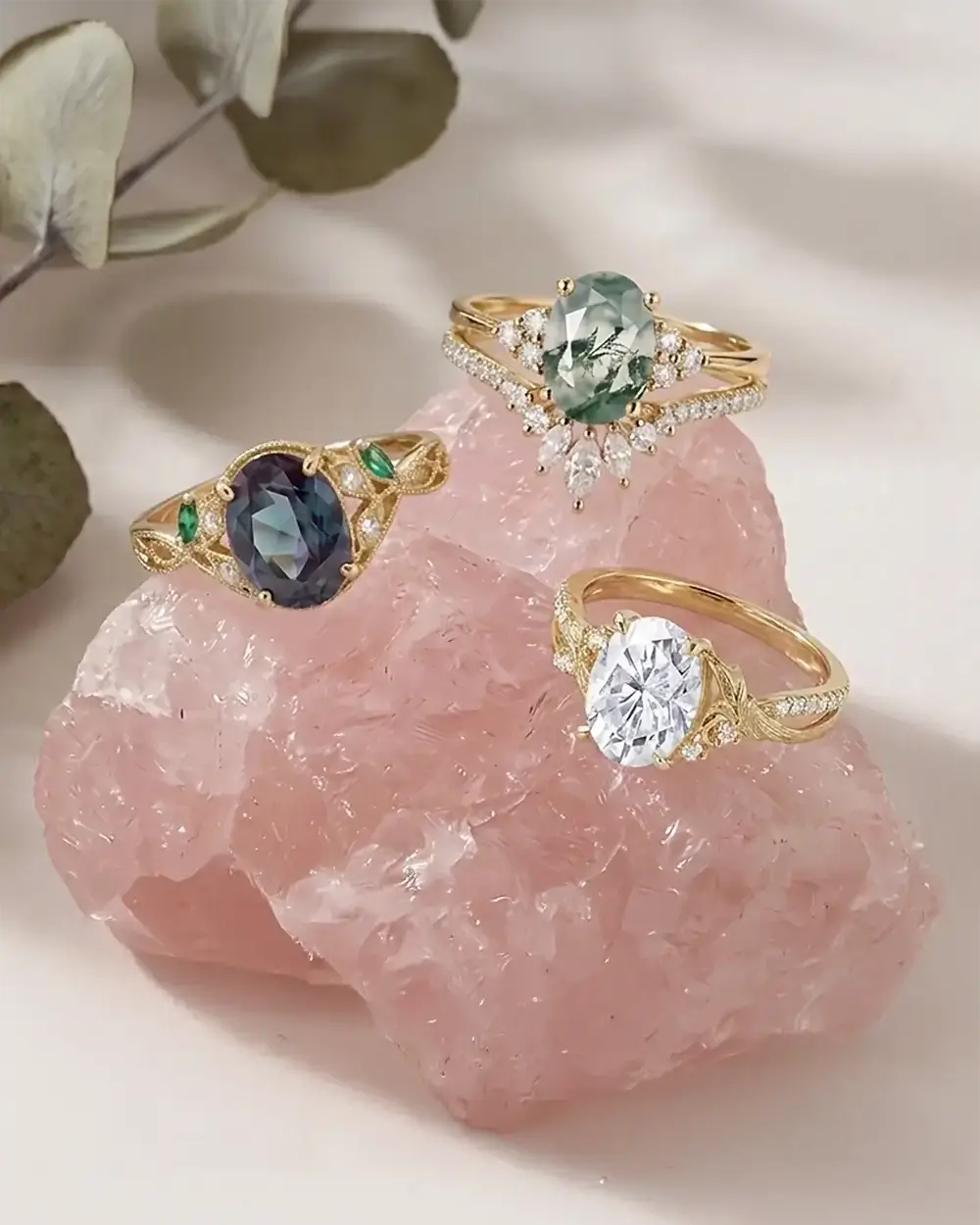
Vintage Oval Moissanite Leaf Engagement Ring
$890

Oval Moissanite Flower Engagement Ring Set
$1,380

Pear Moissanite Leaf Engagement Ring Nature Inspired
$890

Oval Moissanite Leaf Engagement Ring
$920

Four Leaf Clover Halo Rings Cushion Moissanite Engagement Ring
$1,060

Luxurious 3-Piece Pear-Cut Moissanite Engagement Ring Set
$1,960
Best Moissanite Ring Settings for Daily Wear
Prong vs Bezel Settings
Prong settings maximize light exposure but leave edges more vulnerable to impact.
Bezel settings surround the gemstone with metal, offering stronger protection and improved long-term durability for active lifestyles.
Hidden Halo vs Solitaire
Hidden halo designs add additional sparkle but may require more frequent cleaning because dirt can accumulate underneath the setting.
Solitaire rings are generally easier to maintain long term.
Thin Bands vs Durable Bands
Ultra-thin bands may appear delicate online but can increase risks such as:
- Bending
- Loose stones
- Warping over time
Structural stability is extremely important for daily wear engagement rings.
How to Choose the Right Moissanite Ring for Your Lifestyle
Best for Active Lifestyles
- Round cuts
- Bezel settings
- Lower profile rings
- Durable thicker bands
Best for Minimalist Style
- Emerald cuts
- Solitaire settings
- Clean metalwork
Best for Vintage or Nature-Inspired Designs
- Cushion cuts
- Pear shapes
- Floral or leaf-inspired settings
Frequently Asked Questions
Does moissanite get cloudy over time?
No. Quality moissanite does not permanently become cloudy. Dirt and oil buildup can temporarily reduce sparkle but can be cleaned easily.
What moissanite color grade looks most like diamond?
DEF and high GH moissanite color grades are generally considered the most diamond-like.
Is moissanite durable enough for everyday wear?
Yes. Moissanite is one of the most durable gemstones used in engagement rings.
Why does some moissanite look too rainbow-like?
Moissanite naturally produces more fire than diamond because of its higher refractive index. Poor cutting can exaggerate this effect.
Which moissanite cut sparkles the most?
Round brilliant cuts usually deliver the strongest sparkle and light performance.
Is moissanite better than cubic zirconia?
Yes. Moissanite is significantly harder, more durable, and optically superior to cubic zirconia.
Can moissanite pass a diamond tester?
Many moissanite stones can trigger diamond testers because they conduct heat similarly.
What is the best setting for everyday wear?
Bezel and secure prong settings are generally best for long-term daily wear.
Final Thoughts
A high quality moissanite ring is not simply about carat size or sparkle intensity. True quality comes from balanced cut precision, color consistency, clarity, craftsmanship, and durable construction.
For long-term satisfaction, buyers should focus on how the ring performs in real everyday life — not only how it appears under studio lighting.
The best moissanite engagement ring balances brilliance, comfort, durability, and personal style in a way that remains beautiful for years of daily wear.