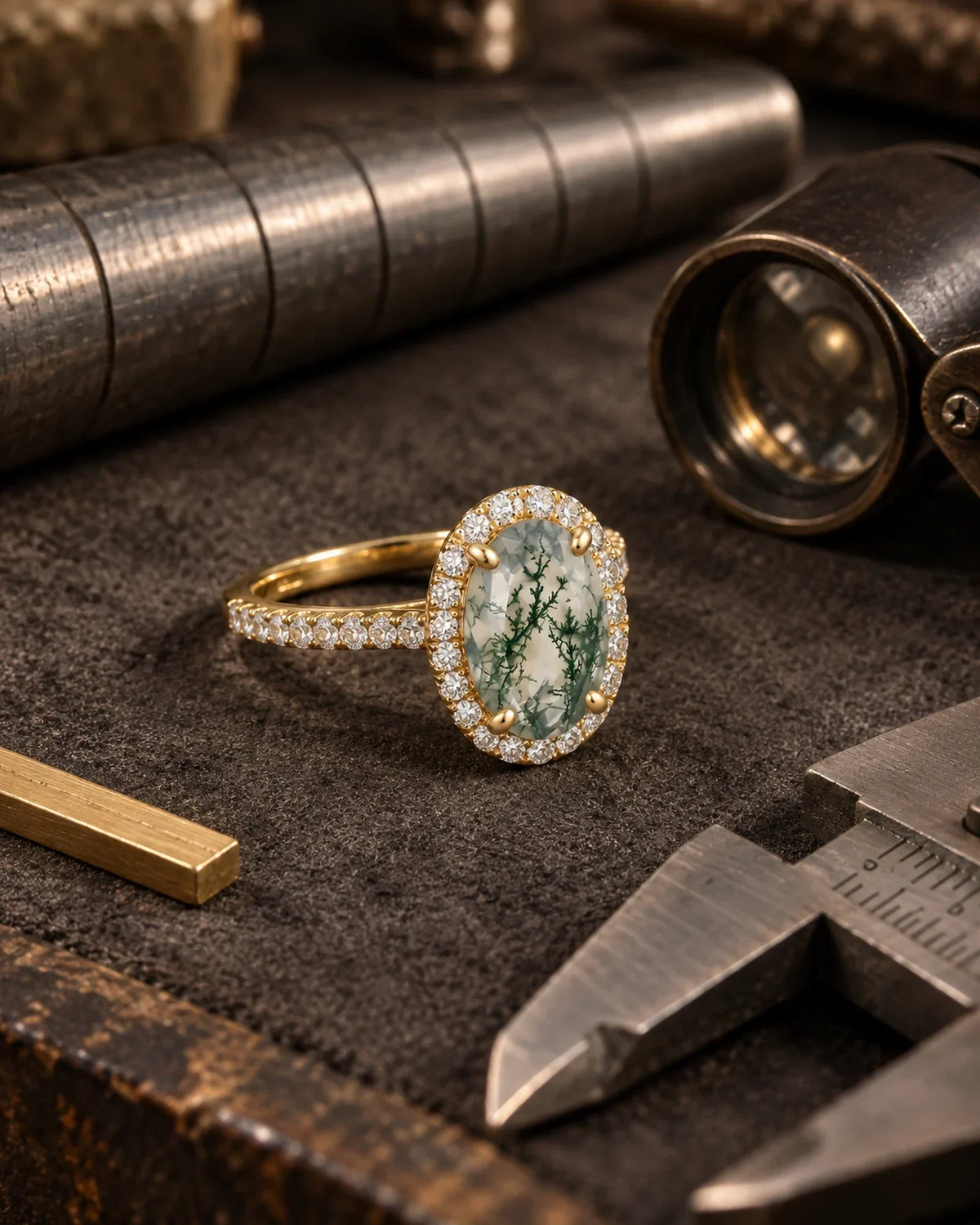

The first sign of a prong problem may be very small: a new catch on a sleeve, a tip that looks flatter than it used to, or a faint sound from the setting during ordinary movement. Engagement ring prong maintenance means recognizing those changes before a stone becomes unsecured, then choosing the repair that addresses their cause.
Prongs are the small metal supports that overlap a gemstone's edge and hold it in its seat. Their appearance matters, but their remaining thickness, contact and structural condition matter more. A beautiful claw can still be poorly fitted; a rounded tip can be secure even when it looks less delicate. This guide explains what you can observe, when to stop wearing the ring, and how a jeweler decides between tightening, retipping and a replacement setting.
Warning signs worth taking seriously
A new snag on clothing
Claw prongs and pointed decorative details can occasionally catch fabric even when sound. What matters is a change: a previously smooth ring starts catching in the same place, or a fiber remains trapped beneath a tip. That can indicate a lifted edge, burr, bent prong or worn contact area. Stop wearing it until the cause is identified. Do not pull the ring through fabric to reproduce the snag; that can make the damage worse.
Rattling, clicking or visible movement
A sound noticed during normal handling may come from a loose center or accent stone, although a multi-part design can have other sources. Treat it as a reason to inspect, not a diagnosis. A gemstone that visibly rotates or shifts is an urgent concern. Do not deliberately shake the ring, tap the table or push the stone with a nail. Lack of sound does not prove that the setting is secure.
A thinner, shorter or raised tip
Compare the tips with photographs taken when the ring was new. One may become flattened by repeated contact while another stays rounded. A tip can also lift away from the stone after a knock. A visible gap, a new sharp edge or metal that appears missing deserves professional assessment. Surface shine can hide how much metal has worn away, especially after polishing.
New asymmetry or a tilted stone
Some rings deliberately use different prong shapes, uneven botanical details or paired claws. Those features do not need to become perfectly identical. The warning sign is a new difference: one tip moves sideways, the stone no longer sits level, or the head leans relative to the band. The entire basket, gallery or shoulder connection may need attention, not just the most noticeable tip.

A safe home check takes observation, not pressure
Choose a clear table, good light and a padded tray. Handle the ring by its band so you are not loading the head. Look from above and from both sides for new gaps, missing tips, an altered stone position or damage to the supporting metal. A phone macro photograph can help record changes, but reflections and limited focus can create misleading gaps. A loupe helps only if you can hold the ring steadily without squeezing it.
- Start with a baseline. Save clear top and side photographs after delivery or a completed repair. Know whether the original design has rounded, claw, double or V-shaped prongs.
- Look for change. Compare height, overlap and profile with the baseline rather than trying to judge security from a single photograph.
- Check neighboring contact. Notice whether a wedding band rubs a prong, gallery rail or small accent setting during ordinary wear. Do not force the rings together.
- Record the event. Tell the jeweler about a snag, impact, resize, previous repair or unusual sound. That history can identify where to inspect closely.
Do not use pliers, tweezers, needles, glue or a household file to tighten or smooth a prong. Do not run cotton or thread around the tips as a catch test. If you suspect looseness, skip home cleaning, steam and ultrasonic equipment until the setting has been assessed. For a sound ring, use only cleaning appropriate to its gemstones and treatments.
A bench inspection examines the contact at the stone seat, prong thickness, cracks, joins and supporting basket under magnification. Your home check is an early-warning habit. It cannot establish that hidden metal is sound. The engagement ring anatomy guide helps you describe the part that changed.
How often should you check ring prongs?
For a ring worn daily, a professional check around every six months is a reasonable starting point. Jewelers Mutual's inspection guidance recommends twice-yearly inspections and suggests shorter intervals for valuable pieces worn regularly. That is a maintenance recommendation, not a universal warranty requirement or a promise that nothing can happen between visits.
Your jeweler may recommend a shorter interval for thin antique claws, a high exposed head, extensive pavé, repeated snags, prior repairs or a stack with contact wear. A ring kept mainly for occasional use still needs checks, particularly before extended wear. Any new symptom overrides the calendar.
| When | What to do | Why |
|---|---|---|
| When putting it on or taking it off | Notice new catches, missing metal or changed stone position | Small changes are easier to recognize against familiar daily wear |
| About every six months for daily wear | Arrange a professional setting inspection | Magnification reveals wear and contact problems you may not see |
| After a hard knock or serious snag | Stop wearing and request a prompt check | Damage can occur long before the next scheduled visit |
| After resizing or setting work | Confirm all stones and stack contact points were rechecked | Changing ring geometry can affect stone seats and alignment |
Keep dated inspection notes and repair photographs. Check the actual service or insurance terms for any required schedule. Inspection and cleaning are separate decisions: cleaning should follow confirmation that the setting and gemstone can tolerate the proposed method.
Retipping vs resetting: choose the repair by the damage
People often use “resetting” for several different services. Ask the jeweler to specify whether the proposal means reseating the existing stone, replacing one prong, or replacing the whole head. Those are different levels of work.
| Service | What it changes | When it may be appropriate |
|---|---|---|
| Tightening or reseating | Restores proper stone contact using sound existing metal | A displaced or loose stone with adequate prong thickness |
| Retipping | Adds metal to rebuild worn tip coverage, then shapes it | Local tip wear with a sound prong body and supporting structure |
| Prong replacement | Rebuilds a damaged support beyond the tip | A cracked, broken or excessively thin individual prong |
| New head or remount | Replaces the stone-bearing assembly or broader mounting | Several weak supports, unsuitable seats or widespread damage |
Retipping restores metal that has been lost. It does not mean simply squeezing a worn tip harder against the gemstone. The added material must be suitable for the alloy and repair method, and the finished tip must overlap the stone without an awkward lump. There is no fixed age at which every engagement ring needs retipping. Wear, remaining metal, previous work and actual contact determine the decision.
Laser welding can localize heat, while other repairs may require removing the stone before joining metal. The choice depends on access, alloy, gem identity and treatment. Even a hard gemstone can have vulnerable inclusions, fractures or treatments. Moonstone, opal, emerald and other sensitive stones require a specific protection plan. White gold may need refinishing or rhodium after work; plating changes appearance but does not rebuild a worn prong.

Why repeated loosening deserves a wider diagnosis
A stone that loosens again shortly after tightening needs more than another routine squeeze. The seat may be poorly fitted, a prong may flex, the head may have a weak connection, or the wedding band may repeatedly strike it. Ask for the cause and supporting photographs before approving another repair.
One documented example in GIA's jewelry workmanship case study involved an engagement ring with extensive metal porosity. Appraiser Teri Brossmer recommended a remake; a later inspection found that the returned piece had instead been locally repaired. The lesson is specific: rebuilding a visible surface is not always enough when the underlying metal is compromised. This is a published industry example, not a claim about the products shown here.
Special structures need special inspection points
Four prongs, six prongs and botanical shoulders
A six prong engagement ring can offer more retaining points than a four prong engagement ring, but count alone does not establish security. Seats, overlap, metal thickness and support matter. Double prongs also need independent inspection of each claw; one can hide wear behind its partner. Decorative leaves or petal-shaped metal may frame the stone without actually retaining it. Ask which components are functional prongs.

Independent prongs within a leaf design
The Sylvena oval moissanite leaf solitaire separates its four rounded center-stone prongs from its engraved leaf shoulders. Inspect the retaining tips and their connections; the surrounding leaves do not substitute for secure stone contact.
Pear, kite and marquise points
Pointed gemstones need careful protection at corners and tips. V-prongs can shelter a point, but their contact must avoid damaging pressure and allow the stone to sit correctly. An ornamental border is not automatically a protective setting. With unique engagement rings, check both the retaining system and where exposed points meet clothing or adjacent bands.

Inspect the point and the actual retaining metal
The Elyndra kite moissanite cluster ring illustrates why detail can obscure the inspection area. Its pointed center, milgrain frame and accent settings require separate checks. A photograph cannot confirm the contact hidden beneath a decorative edge.
Halo, shared prongs and sensitive stones
In a halo or cluster, the center setting and small accent settings are separate systems. A secure main stone does not guarantee secure melee. Shared prongs need particular attention because one damaged support can affect neighboring stones. Hidden halos require a side view. Wedding-band contact can wear these low supporting details even when the top looks unchanged.

Several settings, one careful service plan
The Lunavelle moonstone celestial halo ring combines center-stone prongs, multiple halo supports and sculptural shoulders. Inspection should distinguish each system. Its moonstone also affects cleaning and repair choices, so the service plan must identify the gem before heat or pressure is applied.
Metal selection affects wear and repair technique, but neither gold nor platinum makes inspection optional. See the white gold and platinum comparison for surface wear and maintenance, and the ring resizing guide for structural checks after a size change.
A checklist for protecting the center stone
- Save baseline photographs of the top, sides and underside.
- Remove the ring for lifting weights, heavy manual work and activities that can bend the head.
- Keep wedding-band contact away from retaining tips and delicate accent settings.
- Arrange regular professional checks and act immediately on a new symptom.
- Ask whether a repair addresses tip wear, seat fit or wider structural damage.
- Confirm how the gemstone and treatments will be protected during repair.
- Request a final check of all stones, plus dated notes and the next inspection recommendation.
What are the signs of a loose prong?
New snagging, a raised tip, visible gaps, changed stone alignment and a rattle during normal handling can indicate a problem. None is a safe invitation to test the stone by pushing it. Stop wearing the ring and request an inspection.
When should you retip an engagement ring?
When inspection finds inadequate tip metal but a sound prong body and supporting setting. There is no universal number of years. A cracked support or poorly fitted seat may need a different repair.
Can regular inspections prevent losing the center stone?
They can reduce risk by catching wear and loosening early, but cannot guarantee against sudden impact or loss. Combining professional checks with sensible removal habits and prompt response to changes provides better protection than any one habit alone.