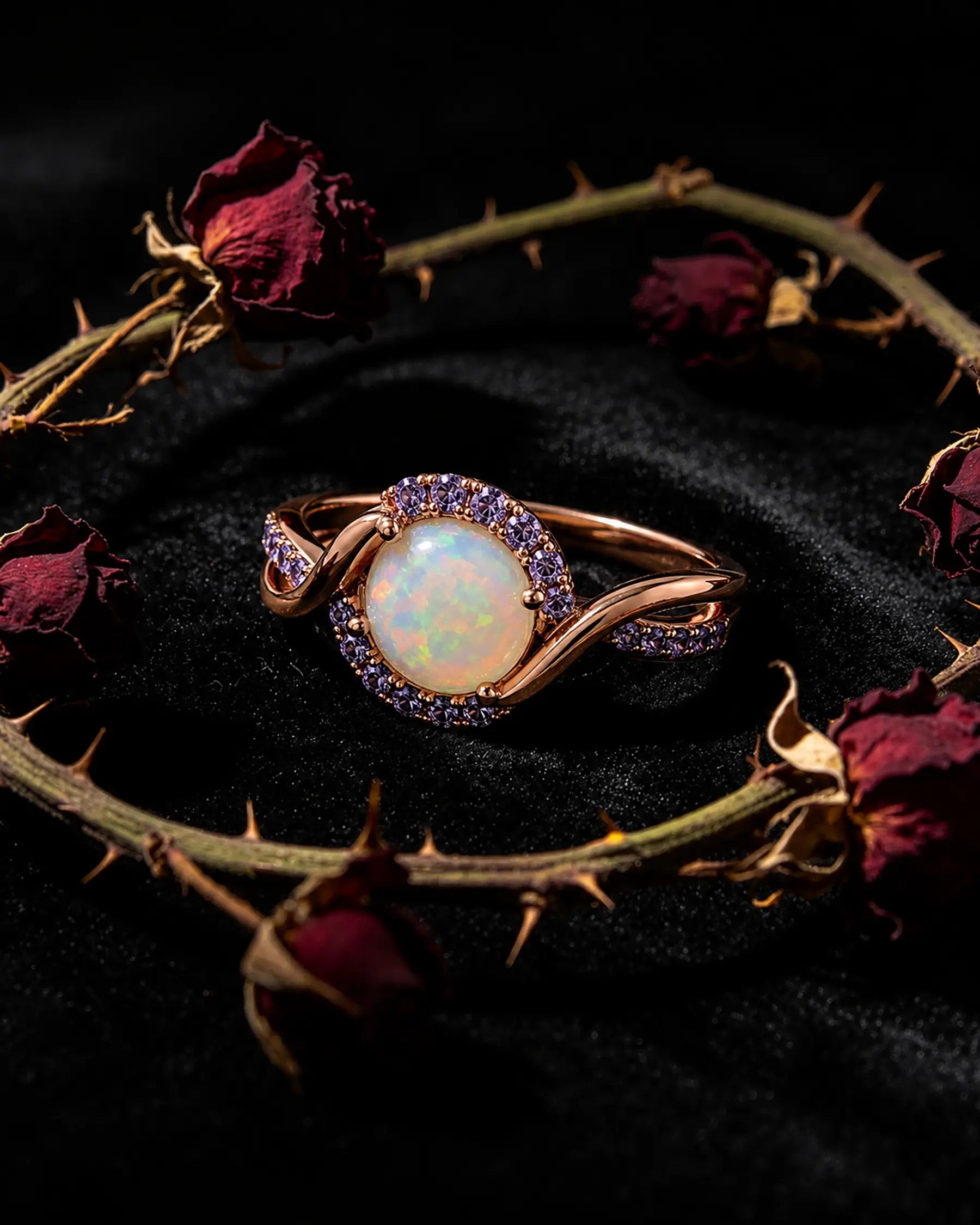

A birthstone ring sounds simple until two months offer more than one stone and the prettiest option is not always the most practical. This late summer and fall birthstone ring buying guide focuses on the decision that matters after the birthday candles are gone: which gemstone will still suit the wearer's routine, style, and reason for buying the ring?
For most shoppers comparing August, September, and October, the clearest shortlist is sapphire, opal, and tourmaline. Sapphire is the safest choice for frequent wear. Opal has the most dreamlike, personal appearance, but it needs gentler habits. Tourmaline offers a broad color range and more everyday flexibility than opal. August stones such as peridot, spinel, and sardonyx remain meaningful alternatives for someone who actively wants a less expected gem.
Quick guide: which late-summer or fall birthstone ring should you choose?
| Best for | Recommended stone | Why | Important limitation |
|---|---|---|---|
| Everyday wear | Sapphire | High scratch resistance, excellent toughness, and many colors | Treatment disclosure and color quality still matter |
| Romantic, dreamy gift | Opal | Each stone has individual play-of-color and emotional presence | More vulnerable to scratches, chips, heat, and sudden temperature change |
| Colorful, creative style | Tourmaline | Pink, green, blue, rubellite, and bicolor options support highly personal designs | Some stones are included or heat-sensitive; corners and long shapes need protection |
| Unique August birthday idea | Peridot or spinel | Both feel less conventional than the familiar blue or white bridal palette | Buy for genuine color preference, not only the calendar label |
| Engagement ring | Sapphire or tourmaline | Sapphire offers the strongest durability; tourmaline offers more unusual color | Tourmaline needs a more protective setting and realistic wear expectations |
| Occasional statement ring | Opal | Play-of-color creates a changing, one-of-a-kind focal point | It should not be treated like a sapphire or diamond ring |
This table is a starting point rather than a ranking of beauty. A careful wearer may enjoy an opal for decades, while a rough wearer can damage a poorly set sapphire. Durability combines hardness, toughness, cleavage, treatment, cut, setting, and behavior. Mohs hardness mainly describes resistance to scratching; it does not tell the whole story of whether a stone will chip when struck.

Why sapphire is the safest choice for a birthstone ring
September's birthstone is sapphire, and it is the easiest recommendation when the ring will be worn frequently. Corundum ranks 9 on the Mohs scale, has excellent toughness, and has no cleavage. Those properties do not make it indestructible, but they create a much larger safety margin than opal and a stronger everyday-wear profile than tourmaline. The GIA September birthstone guide also notes that sapphire occurs beyond classic blue, with fancy colors extending through pink, yellow, green, purple, orange, and intermediate hues.
That color range is commercially useful and emotionally useful. A September birthstone ring can be unmistakably blue, softly romantic in pink, botanical in green, or nearly neutral in pale grey-blue. The buyer does not have to accept a saturated royal blue simply because sapphire is the traditional September stone. In fact, the most wearable choice is often the color the recipient already uses in clothing and accessories.
When sapphire makes the most sense
- The wearer wants one ring for work, weekends, travel, and regular social use.
- The ring may become an engagement ring or future heirloom.
- The buyer wants colored-stone character without a delicate-stone care routine.
- The design includes exposed prongs, a raised center, or a wedding stack.
- The recipient prefers blue, pink, green, or unusual parti-color stones.
Natural, lab-grown, treated, and color quality
Natural and lab-grown sapphire share the same mineral identity and basic durability. Their differences lie in origin, inclusions, availability, price, and the documentation a buyer expects. Heat treatment is common and widely accepted in the trade, but other treatments can affect value or care. Ask whether the stone is natural or laboratory-grown, whether it has been treated, what treatment was used, and whether an independent report is included for a high-value natural stone.
Judge blue sapphire in different lighting. Very dark stones may look impressive under direct jewelry lights but nearly black indoors. Pale stones can feel airy and modern but may show a window through the center if cutting is weak. Look for a color that remains attractive in daylight, room light, and shade. For engagement use, a medium to medium-dark tone with visible life across the center is often easier to enjoy daily than a stone purchased only for maximum saturation.
Best settings for a sapphire birthstone engagement ring
Round and oval sapphires work well in classic prong, cathedral, cluster, and halo settings. Pear and marquise cuts need well-fitted protection at the point. Emerald-cut and radiant sapphires benefit from corner prongs or a bezel. A low-to-medium basket is often a practical compromise: it shows color and allows cleaning while reducing the amount of leverage created by a very tall setting.
Shoppers exploring sapphire engagement rings should compare side profiles as carefully as front views. Check prong contact, gallery rails, center-stone height, band thickness, and whether a wedding band can sit as intended.

Oval Blue Sapphire Cluster Ring
Oval lab sapphire with marquise accents and a twisted botanical band.
14K gold option: $920

Pear Sapphire Milgrain Ring Set
A vintage ring set with a protective framed edge around the pointed center.
14K gold option: $1,290
Opal rings: beautiful, emotional, but more delicate
Opal is the traditional October birthstone and the choice most likely to feel completely individual. Its appeal does not come from conventional brilliance. Tiny structural differences inside the gem diffract light into moving flashes called play-of-color. A white opal may show soft green, blue, orange, or red as the hand moves; darker body color can make those flashes look more dramatic.
The same structure that makes opal special also requires realistic care. Opal usually ranks about 5 to 6.5 on the Mohs scale and is vulnerable to scratches and chips. High heat and sudden temperature changes can cause cracking. Doublets and triplets contain assembled layers and adhesives, so they require additional caution around prolonged moisture. The GIA October birthstone guide recommends warm, soapy water as the safest cleaning method and warns that other methods may harm opal or filler material.
Who is happiest with an opal ring?
An opal ring is a strong fit for someone who values individuality over maximum hardness, rotates jewelry instead of wearing one ring continuously, and sees care as part of owning a special object. It is especially persuasive as a romantic birthday gift because no two patterns look exactly alike. Buyers searching for an opal engagement ring meaning are often drawn to ideas of creativity, hope, emotional expression, and the gem's changing appearance; the more practical meaning is that the ring rewards attention.
Choose the opal, not only the design
Ask whether the center is solid opal, a doublet, or a triplet. Examine play-of-color in diffuse daylight and confirm that the flashes remain visible from normal viewing angles. Look for surface-reaching cracks, chips near the edge, cloudy adhesive lines in assembled stones, and an extremely thin color layer. For a custom ring, approve the actual stone whenever possible because a stock photograph cannot guarantee the same pattern.
Settings that reduce regret
A low bezel, scalloped bezel, protective halo, or closely fitted prongs can reduce exposed edges. A cabochon should have even support beneath it; a pointed or faceted opal needs special attention at thin areas. Decorative claws are useful only when they make consistent contact. Very tall settings, thin unsupported galleries, and sharp exposed edges add risk without improving the stone itself.
Browse opal engagement rings for design ideas, but evaluate the stone's perimeter and side profile before choosing. The prettiest overhead photograph cannot show whether the girdle sits above the metal or whether one prong carries more pressure than the others.

Oval Opal Vine Ring
A botanical design for shoppers who want visible craftsmanship around the center stone.
14K gold option: $958

Oval Opal Classic Cluster Ring
A balanced oval center with side accents that add presence without an oversized stone.
14K gold option: $980
Tourmaline rings: October color with more everyday flexibility
Tourmaline is October's newer birthstone and the most flexible option for a buyer who begins with color rather than tradition. Its palette includes pink, red rubellite, green, blue, yellow, and striking bicolor or multicolor stones. Watermelon tourmaline typically shows pink and green zones in one crystal, making it especially attractive for custom rings where the exact color boundary can become part of the design.
Tourmaline ranks about 7 to 7.5 on the Mohs scale and is generally suitable for jewelry worn with sensible care. It resists scratching better than opal, but it is not as forgiving as sapphire. Heat can be damaging, included stones may react poorly to ultrasonic cleaning, and elongated or rectangular cuts can be vulnerable at corners. Warm soapy water and a soft brush are the conservative cleaning choice.
Opal vs tourmaline for an October birthstone ring
| Decision | Opal | Tourmaline |
|---|---|---|
| Visual identity | Changing play-of-color and soft internal light | Defined body color, zoning, and faceted brilliance |
| Daily wear | Best for careful or occasional wear | More flexible for regular wear with a protective setting |
| Best emotional angle | Dreamlike, intimate, one-of-a-kind | Creative, expressive, tailored to a favorite color |
| Engagement use | Possible for a very careful wearer | More practical than opal, though below sapphire for durability |
| Custom advantage | Approve the individual play-of-color pattern | Choose hue, saturation, zoning, cut orientation, and metal together |
How tourmaline gets its color
Tourmaline's colors arise from trace elements and color centers. Iron and sometimes titanium contribute to green and blue, while manganese is associated with red and pink and may contribute to yellow. Some pink and yellow colors can involve natural or laboratory-induced radiation. Copper-bearing tourmalines can reach vivid blue-green or violet colors. A responsible listing should identify treatment when known and avoid treating every bright blue-green stone as equivalent in rarity or price.
Best ring designs for tourmaline
Oval and cushion pink tourmalines suit vintage clusters, floral halos, and three-stone rings. Emerald-cut green tourmaline looks strong in east-west bezels or geometric side-stone designs. Watermelon tourmaline benefits from a simple setting that leaves the bicolor zoning visible; excessive accent stones can compete with the feature the buyer is paying for. Long rectangular stones need secure corner protection and a gallery rail. Rubellite can pair beautifully with rose or yellow gold, while blue-green stones often look cooler and crisper in white gold or platinum.

A practical custom brief for a tourmaline ring
- Purpose: birthday gift, regular fashion ring, or engagement ring.
- Color: pink, green, rubellite, blue-green, or bicolor; include a reference for preferred saturation.
- Size: request millimeter dimensions, not carat weight alone, because tourmaline proportions vary.
- Cut: oval or cushion for versatility; emerald or elongated rectangle for visible color zoning.
- Setting: low prongs with a gallery rail, protective corner prongs, or a bezel for active wear.
- Approval: review the actual stone under daylight and indoor light before setting.
Use the October birthstone rings page for style direction, or submit these specifications through the custom ring design service when a particular tourmaline color is the priority.
What about August birthstone rings?
August has three recognized birthstones: peridot, spinel, and sardonyx. They are beautiful but more niche in contemporary engagement-ring shopping. That does not make them inferior; it means the recipient's taste should lead the purchase. Someone who loves acid-green color may be delighted by peridot. Someone drawn to saturated red, pink, violet, or blue may prefer spinel. Sardonyx appeals to a more graphic, antique, or signet-like aesthetic because its banded chalcedony looks very different from a transparent faceted gem.
The GIA August birthstone guide confirms all three traditions. Peridot is the yellowish-green to greenish-yellow gem variety of olivine. Spinel occurs in a broad color range and ranks 8 on the Mohs scale, making it the most naturally ring-friendly of the three for frequent wear. Sardonyx is the historic August stone and is often chosen for carved or banded designs rather than conventional bridal sparkle.

How to choose by lifestyle, skin tone, and metal
Start with wear frequency
For daily use, sapphire has the widest practical margin. Tourmaline works for regular wear when the wearer removes it for impact-heavy tasks and the setting protects vulnerable edges. Opal is best for careful wear, rotation, or occasions. This distinction should be discussed before design, because a protective bezel cannot turn opal into sapphire and an open prong setting cannot erase tourmaline's natural limitations.
Use skin tone as a test, not a rule
Cooler undertones often make blue sapphire, blue-green tourmaline, white gold, and platinum feel crisp. Warmer undertones often harmonize with yellow gold, green tourmaline, warm opal flashes, peridot, and peach-pink stones. Rose gold can bridge warm and cool colors, especially pink tourmaline and white opal. These are visual tendencies, not restrictions. The recipient's wardrobe, existing jewelry, and favorite color provide better evidence than a rigid skin-tone chart.
Match metal to contrast level
White metal creates clean contrast around blue sapphire and can keep pale stones from looking overly warm. Yellow gold adds antique richness and can emphasize green, warm pink, or creamy opal tones. Rose gold softens blue and green while reinforcing pink. When color zoning is the attraction, as with watermelon tourmaline, choose a metal that supports one zone without overwhelming the other.
Can a birthstone be an engagement ring?
Yes. A birthstone can be an engagement ring when the couple chooses it for personal meaning and understands its material behavior. The calendar association does not determine suitability; the gemstone, treatment, cut, setting, and wearer do. Sapphire is the easiest birthstone engagement ring among this group. Tourmaline is a strong alternative for someone willing to use a protective setting. Opal can work for a careful wearer who accepts that maintenance and possible future repair are part of the ownership plan.
Before ordering, ask four questions: Will this be worn every day? Does the wearer remove rings for physical tasks? Is the chosen setting appropriate for the gemstone? Would the recipient still love this color if it were not their birthstone? A confident yes to all four is a stronger buying signal than tradition alone.
A no-regret order checklist
- Confirm the gemstone identity, origin category, and known treatment.
- Review color in daylight, shade, and indoor light.
- Record stone dimensions in millimeters and inspect the side profile.
- Check prongs, bezel contact, gallery rails, point protection, and center height.
- Ask whether the ring can sit with a future wedding band.
- Choose 10K, 14K, 18K gold, or 950 platinum according to budget, color, and wear needs; 14K gold is often a practical middle ground.
- Request care instructions that match the actual gemstone and treatment.
- For opal or one-of-a-kind tourmaline, approve the individual center stone rather than relying on a representative image.
Frequently asked questions
What is the best fall birthstone ring for everyday wear?
Sapphire is the best all-around choice because it combines high scratch resistance, excellent toughness, no cleavage, and a broad color range. Tourmaline is the next choice for a careful wearer. Opal needs the most caution.
Are opal and tourmaline both October birthstones?
Yes. Opal is the traditional October birthstone, while tourmaline is the newer alternative. Opal offers play-of-color; tourmaline offers defined body colors and generally greater everyday flexibility.
Is tourmaline durable enough for an engagement ring?
Tourmaline can be used in an engagement ring, especially in a low setting with protected corners or edges. It is less scratch-resistant and less forgiving than sapphire, so it suits someone who removes jewelry for impact-heavy activities.
What color sapphire is best for a September birthstone ring?
There is no single best color. Blue is traditional, but pink, green, yellow, purple, and parti-color sapphires are valid choices. Select a tone that remains attractive in ordinary lighting and suits the recipient's wardrobe.
Which October birthstone is better for daily wear?
Tourmaline is generally better for regular wear than opal. Sapphire remains stronger than either. A buyer who prefers opal should use a protective setting and remove the ring for workouts, cleaning, gardening, bathing, and manual tasks.
What are the three August birthstones?
Peridot, spinel, and sardonyx are recognized August birthstones. Peridot offers yellow-green color, spinel offers many saturated colors and good ring durability, and sardonyx offers a banded, graphic appearance.
Is a watermelon tourmaline engagement ring a practical choice?
It can be, provided the setting supports the stone and protects elongated corners. Approve the exact color zoning, check for surface-reaching inclusions, and avoid an unnecessarily tall setting. A bezel or strong corner-prong design is often more practical than delicate exposed claws.
Should I choose a birthstone or the recipient's favorite color?
Choose the favorite color when the recipient has a clear preference. Birthstone symbolism adds meaning, but a ring is more likely to be worn when its color and style already fit the person's taste. A small birthstone accent can preserve the symbolism without controlling the whole design.
The final recommendation
Sapphire is the confident recommendation for September, everyday wear, and engagement rings. Opal is the emotional recommendation for October gifts and careful wear. Tourmaline is the creative recommendation for shoppers who want an October birthstone in a particular pink, green, blue, or bicolor palette. August stones belong in the conversation, but they work best when the buyer is genuinely attracted to peridot, spinel, or sardonyx rather than trying to satisfy a calendar rule.
The best birthstone ring is not the one with the longest list of meanings. It is the one whose color still feels personal, whose setting makes sense, and whose care requirements match the life of the person wearing it.