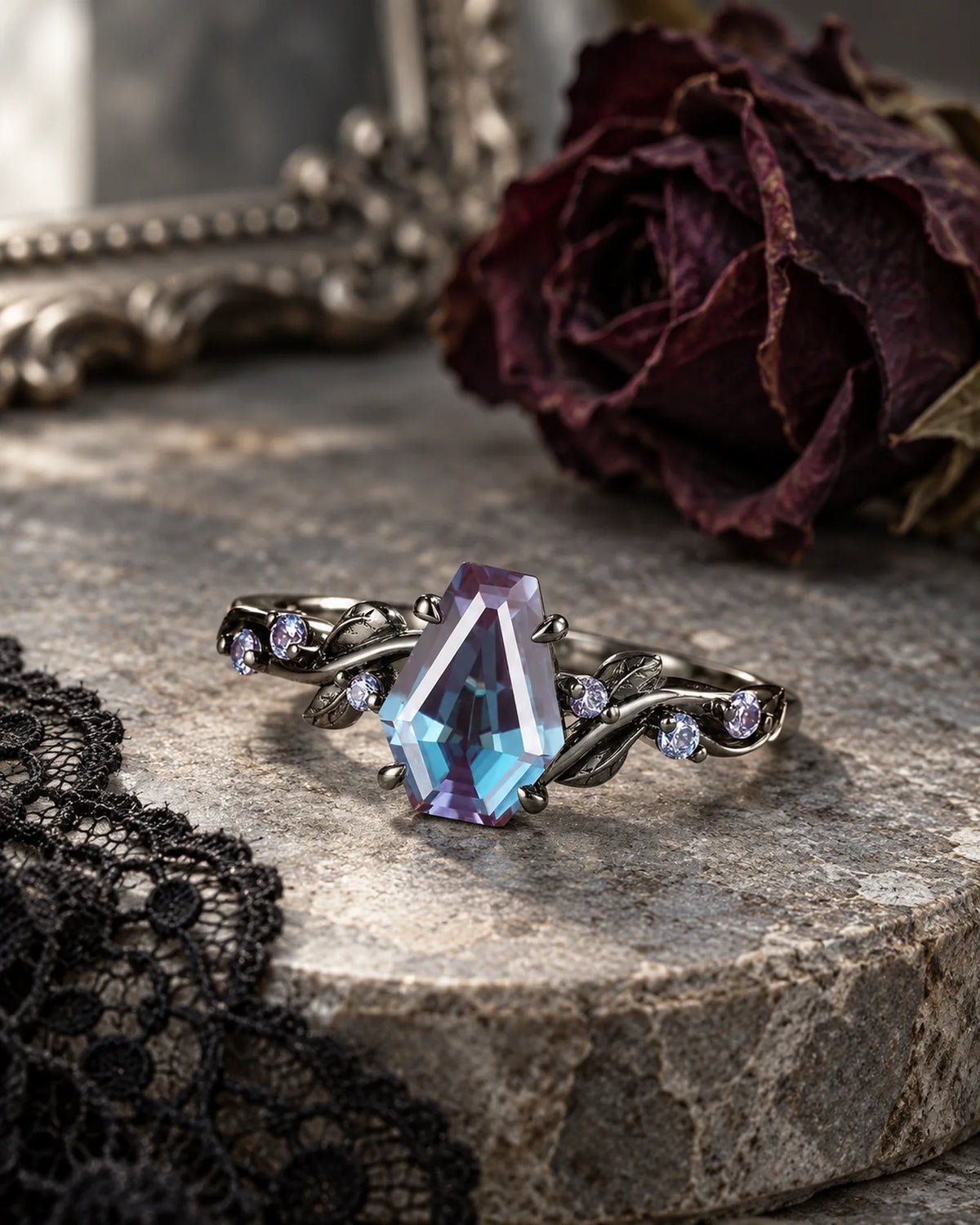

A crescent beside the center stone can say enough. It does not necessarily need a constellation on the shoulders, another moon above the halo and a sun on the wedding band. The most convincing celestial rings give your eye somewhere to settle.
Celestial engagement rings use moon, star or sun-inspired details to create a personal design, not simply a collection of symbols. Choose a leading motif, decide how the gemstone should behave in light, and leave enough visual space for both to be understood.
This is not an argument for plain jewelry. An elaborate ring can be beautifully coherent. The question is whether its details support one composition, and whether the result is comfortable enough for the life you intend to wear it through.
Choose the part of the sky you actually want to wear
Before comparing carats or metal colors, describe the feature you would miss if it disappeared. Is it the curved edge of a crescent, a tiny engraved star, or rays extending from a center stone? That is a better starting point than requesting every celestial detail together.
| Leading motif | Design character | A useful restraint |
|---|---|---|
| Moon or crescent | Curved framing, asymmetry or a quiet shoulder detail | Keep the crescent's outline readable beside the center and prongs |
| Star | A small engraving, pointed accent or constellation-like arrangement | Choose one scale of star detail rather than several competing sizes |
| Sunburst | Outward movement through rays or radiating halo stones | Let the halo lead; the shoulders can be comparatively quiet |
A moon and star engagement ring can still be restrained. The moon might be a sculpted shoulder beside the center, with a small star engraved farther down the band. They do not have to compete at equal size. A sunburst, meanwhile, can suggest sunlight without depicting a literal sun face.
These are design choices, not rules about personality or destiny. A crescent can mean a fresh beginning to you, or simply be a shape you love. Its personal significance does not need a universal symbolic explanation to justify the choice.
Look at the whole ring, then its smallest details
The celestial engagement ring collection includes different levels of ornament. The Lunavelle design used for the cover, for example, combines a listed approximately 6 by 8 mm pear moonstone, two sculpted crescents and 26 round moissanite accents, with engraved leaf-and-vine shoulders.
Its lesson is not that a halo must be removed to create clarity. The crescents frame a central pear outline, while the shoulder details continue a smaller rhythm. Adding a second large symbol above that frame would be a different composition, not automatically an improvement.
Another current design, Starbright, places crescent and star details around a listed approximately 6 by 8 mm oval lab alexandrite. Its quieter shank gives the central arrangement room to remain legible. These are catalog examples, not independently measured rings or customer case studies.

Ask to see a normal-distance photograph as well as the macro view. Enlarged engraving can be beautiful on a screen yet almost invisible on the hand. Conversely, a wide halo may feel more prominent than its center-stone dimensions suggest. Judge overall width and silhouette, not just the magnified detail.
This is the useful distinction in artistic engagement ring designs: originality can come from proportion, contrast and restraint. More components do not necessarily create a more personal ring.
Match the gemstone's light to the theme
Moonstone: a moving sheen, not a miniature lamp
Moonstone's characteristic effect is adularescence: a soft-looking light that seems to move within or across the stone as illumination and viewing angle change. It comes from light interacting with the gem's internal structure, not from the stone producing its own light.
That softer appearance can sit naturally beside crescent motifs. But do not buy a moonstone solely from the brightest blue frame of a video. Request a slow rotation in ordinary light and ask how the selected stone looks away from its strongest sheen. Translucency, internal texture and the direction of the effect can vary.
There is a practical trade-off. GIA's moonstone care and cleaning guidance gives a hardness of 6 to 6.5, notes poor toughness and cleavage, and advises against steam and ultrasonic cleaning. A protective design helps manage exposure; it cannot make the material resistant to every knock.
For moonstone engagement rings, discuss your routine honestly. Someone who removes jewelry for physical tasks may accept a different care commitment from someone who expects to wear a ring continuously. Follow the requirements of the complete piece, including accents and finishes.

Moissanite: let the facets provide some of the stars
A celestial moissanite engagement ring does not need a literal star-shaped center. A round brilliant stone and a few well-spaced accents can supply lively white reflections and colorful fire while the metalwork carries a moon motif.
Consider whether you enjoy that active sparkle beside a detailed setting. A bright center, bright halo and heavily accented wedding band may create more visual activity than you expected. This is a preference to evaluate, not a defect in either a lively or a quieter composition.
When exploring moissanite engagement rings, compare face-up and side views in more than pinpoint showroom light. Shape describes the outer outline; facet style describes how its surface is divided. Neither a shape name nor a dramatic video guarantees the exact sparkle you will see in daily wear.
Alexandrite: changing color can be the main event
An alexandrite celestial ring can feel distinctive with relatively little added ornament because the stone itself offers changing color under different illumination. A quieter shoulder or consistent halo outline can keep that effect central.
Ask whether the stone is natural or lab-grown, what material documentation is available, and which lighting is used in the selection video. Color-change sapphire is not alexandrite. An edited teal-to-purple clip is not an identification report.
Changes with viewing direction and changes between light sources are also different observations. Do not treat every shifting reflection as proof of alexandrite's color change. For alexandrite engagement rings, review the actual candidate rather than promising yourself a particular color in every room.
Some listings use names such as "Firework" for a facet style. Treat these as descriptive product terms unless a specific cutting specification is provided, not as universal quality grades. Ask to see the actual facets and light behavior instead of buying the name alone.
Negative space is part of the design, not missing decoration
Negative space is the open area that lets neighboring shapes remain distinct. It may sit between a crescent and a center setting, inside a split shoulder, or between rays around a halo. Smooth, less ornamented metal can provide a different kind of visual pause.
In a front view, check whether the crescent reads as a curve or disappears into surrounding prongs. In a sunburst, look for a clear radial outline rather than a jumble of overlapping points. From normal viewing distance, you should still recognize the main shape.
Visual openness and structural strength are separate questions. An opening is not evidence that the metal around it is sufficiently substantial, and adding metal indiscriminately can obscure the motif. Ask how the shoulders join the head and where thin sections, seats and connections sit.
- Check projecting ends. Crescent tips, star points and kite-shaped halo stones deserve suitable support and protection. A decorative point is not a handle for testing the ring.
- Review the side profile. Ask about head height and the relationship between the center, halo and shoulder. A compact front view can conceal a tall basket.
- Separate ornament from retention. A moon-shaped border is not automatically a bezel; it may be a motif beside a separate prong setting. Confirm how the actual center is held.
- Think beyond delivery day. Ask about access for cleaning, stone inspection, resizing limitations and repairs around small accents.
A repeated snag, lifted prong or moving stone warrants inspection. It is not simply the price of choosing an artistic ring. Likewise, a numerical band width on its own cannot guarantee comfort or durability without thickness, alloy, construction and ring size.
Let the wedding band add the second idea
You do not have to put the entire theme in the engagement ring. A simple solitaire with a moon-detail wedding band can be a satisfying way to keep the center clear. Alternatively, a richly detailed celestial engagement ring may need only a quiet companion.
The Golden Moonlight reference below uses small crescent details and round moissanites along a contoured band. Its listing gives an approximately 1.6 mm band width and nine approximately 1.1 mm stones. Those figures describe the listing, not a measured fit against another ring.

For a star-and-moon stack, decide which ring supplies the leading motif. You might place a star detail on the engagement ring and a quieter crescent on the band. Repeating several equally large symbols can blur both outlines when the rings sit together.
Ask for a paired side view using the intended band's width, thickness and contour. A V-shaped or curved ring does not automatically clear a halo, and a straight band is not automatically unsuitable. Identify contact with prongs, accent seats and raised edges.
An intentional gap can be preferable to forced flush contact. Also check whether the band works when worn alone and whether its point faces the direction you like. If you choose a black finish, ask about the actual coating and future maintenance where the two rings may rub.
Three current designs to compare
This shortlist puts a more recent moon-led design beside two current featured selections. It includes a sunburst-style option from the nature-inspired range, rather than pretending every ring below has literal moon and star details. Original product images are shown in full; prices are current 14K gold references. Confirm the selected variant and finish.

Lunaciel crescent sapphire ring
14K gold reference: $860 USD
A July addition with a listed 5 by 7 mm lab sapphire center and eight ruby accents. Useful for comparing a strong blue center with smaller crescent details. Confirm ruby origin and treatments separately.

Heliora moissanite sunburst
14K gold reference: $1,060 USD
A September design and current featured selection. A listed 6.5 mm round center leads the radiating halo; crossed leaf shoulders add a botanical layer. Consider a quieter wedding band if the halo is your focal point.

Solis alexandrite burst halo
14K gold reference: $1,260 USD
A current featured design listed with a 6 mm lab-grown alexandrite center and kite-shaped moissanite accents. The expansive halo is the theme. Confirm the precise center-retention structure rather than assuming its title establishes bezel protection.
Three questions worth settling
Does a celestial ring have to use moonstone?
No. The theme can come from the metalwork or halo, leaving you free to choose moissanite, verified alexandrite or another suitable stone for its own appearance and care requirements.
Can a sunburst ring be celestial without literal stars?
Yes. A radial silhouette can suggest the sun. Keep that distinction clear: a sunburst-style design is not necessarily a ring with sculpted star motifs.
Should both rings repeat every symbol?
No. Complementary details can read more clearly than duplication. Decide which ring leads, then confirm their proportions and physical fit together.
A clearer brief before you order
Try describing your choice in four parts: "I want the moon to lead, a soft-looking center, quieter shoulders and a band I can wear separately." Or: "I want the sunburst silhouette, crisp sparkle and no additional large symbols." These are useful design priorities, not instructions to copy an unrelated ring.
Then confirm the actual gemstone and treatments, stone millimeters, overall width, head height, metal and finish, ring size and proposed wedding-band fit. Review revised views and the quotation if you change the center or add motifs. Do not assume a small-looking visual change requires no structural work.
The final test is simple: without the styled photograph or its title, can you still tell what the ring is trying to say? When the answer is clear, the theme can feel personal without needing one more star.