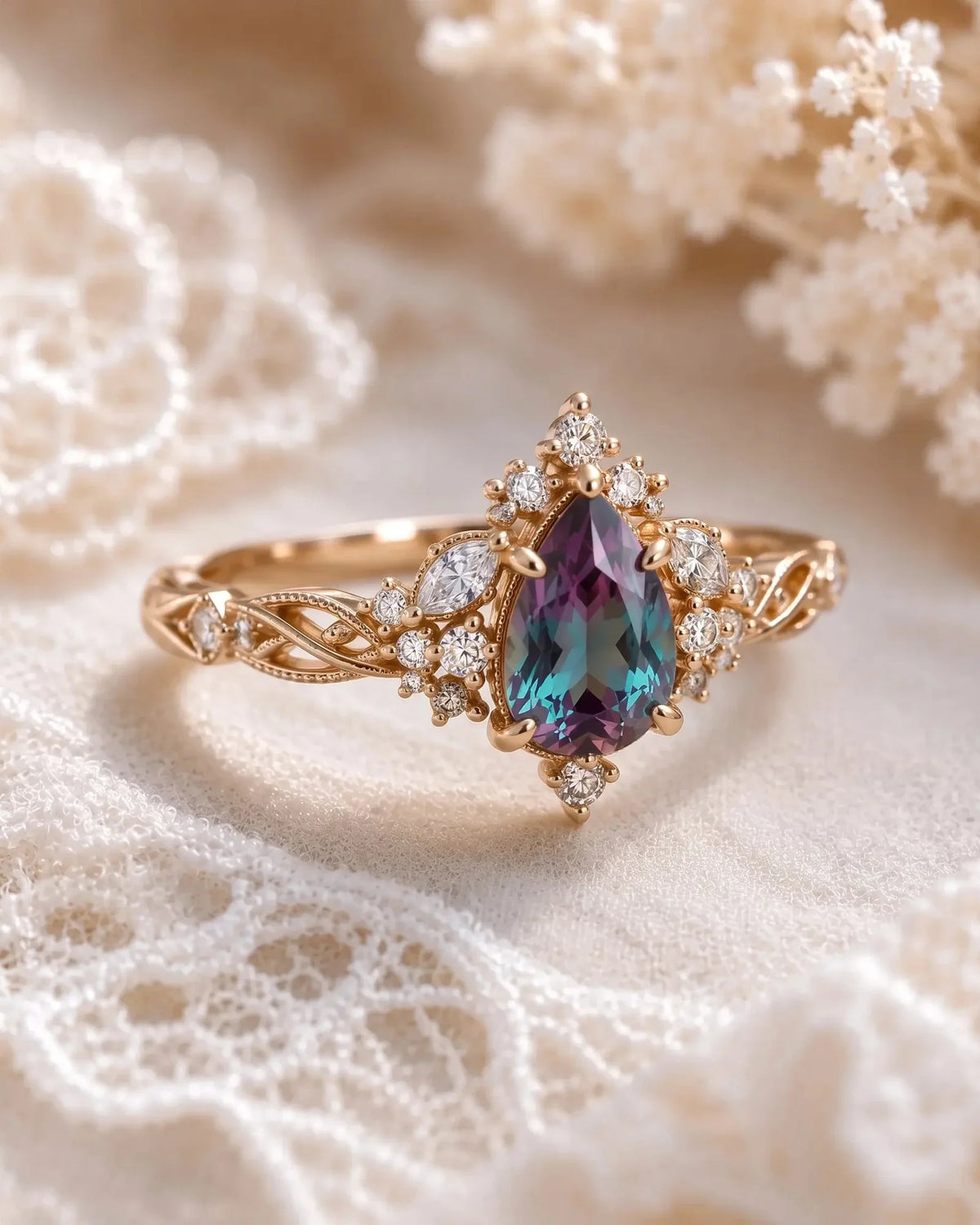

The marquise you love looks bright in one photo and almost divided in two in the next. Before you cross it off your list, ask to see what happens to the middle when the stone moves. That tells you more than either still.
A marquise moissanite bow tie is not an automatic reject. A little contrast that breaks up and brightens during small tilts can be part of an appealing facet pattern. If a broad, dark band keeps dominating the center near face-up in ordinary light, ask to see a different stone before approving it. There is no universal pass-or-fail width or darkness score here; the concern is what you will keep noticing when you wear it.
What a bow tie actually looks like
Hold the marquise in your mind with its two points at the top and bottom. A bow tie crosses its waist from side to side, roughly at right angles to the tip-to-tip line. It may read as two dark wedges, a broken row of gray facets, or a more continuous band. In an east-west setting the whole pattern turns with the stone; it isn't always horizontal in a photograph.
A bow tie in marquise moissanite is an appearance pattern, not a black mark deposited inside the gem. Facets send light toward the viewer from particular directions. The arrangement of those facets, the position of the lights and the observer's position affect which regions look bright or dark. A nearby head or phone can block part of the light or supply a dark reflection, making contrast more obvious. That doesn't mean every persistent dark area is just a camera shadow.
For background, GIA's marquise diamond guide describes the visible pattern and the effect of viewing conditions in diamonds. Its guidance is useful for recognizing what people call a bow tie, but diamond proportions and grading criteria are not moissanite cut standards. Use the appearance of the individual moissanite rather than applying a diamond chart or an ideal ratio to it.
If your marquise ring has a dark center, not every dark feature is the same. A see-through patch that shows background detail, a dark point near the tip, a fixed mark, or a hazy film is not automatically a bow tie. Ask a jeweler to examine a persistent blemish, suspected chip or unusual haze instead of diagnosing it from a phone image. This guide is about choosing a pleasing appearance, not proving the physical cause of darkness.
Why one still cannot tell you whether to reject it
A face-up photo can tell you where to look. It can't tell you how long the contrast stays there. A macro crop can make a narrow interruption look more prominent than it does on a hand. Equally, a bright exposure, a tilt toward the light or a single flattering frame can hide a center that often looks subdued. Two stills need not share the same camera position, exposure, illumination or even the individual stone.


These are original Radiance catalog views, not consecutive frames or a controlled comparison. They do not grade the pictured stone or promise the appearance of a stone supplied with an order.
When looking at marquise-cut engagement rings, confirm that the center is moissanite and that the footage shows the proposed stone. A gallery can show the style and orientation you like without showing the exact center you will receive. If the seller can only film a sample, treat it as a design preview and ask when individual stone approval becomes possible.
How to check the cut of a marquise moissanite in a rotation video
Ask for a single uncut clip in steady, diffuse light, such as indirect window light with no moving sun patches. Keep the background, camera distance and light position fixed; avoid flash, color filters and exposure shifts where possible. If comparing two candidates, ask for the same conditions and the same mounted or loose state for both. A neutral background and an in-focus, unclipped center are more useful than studio sparkle.
- Start face-up and pause. Find the waist first. Ask whether the contrast is narrow and broken or broad enough to split the face into two bright ends. Don't compare the tips' flashes with the center's darkness and call the whole stone bright.
- Watch a small left-to-right rock. Stay near the normal face-up view and come back through the starting position. See whether the dark facets exchange places with bright ones, or whether the same area stays visually flat across the useful angles.
- Watch a small tip-to-tip rock. Tilting along the other axis can reveal a pattern you miss in a turntable spin. A clip that only spins the ring in its own plane, or quickly goes edge-on, is not enough to judge how the middle behaves when you move your hand.
- Replay at ordinary size. Zoom once to locate the band, then watch the whole ring. If you're buying a ring with prominent accents, check that it is the center, not the shoulders, doing the brightening.
If the only clip is filmed with the phone nearly touching the stone, ask for a second pass with more distance. Once you have a usable comparison in one light, a separate clip in soft indoor light can help you judge whether the effect still bothers you in a room like yours. Keep the conditions consistent within each clip; do not treat changing exposure or lighting mid-turn as proof that the center recovers.
Could you film the actual stone proposed for my order in one continuous clip, face-up first, then rocking slightly side to side and tip to tip in the same diffuse light? Please show the whole center and keep the camera distance steady. If you have another similar stone, could you show it the same way and label both candidates?
No verified same-light rotation footage was available for the products shown here. The steps above describe what to request, not a test performed on these stones.
When to keep looking rather than approve
| What you see | What to do |
|---|---|
| Small patches alternate with bright facets through gentle tilts. | Keep it on the shortlist if you enjoy the contrast at normal viewing distance. |
| One dark freeze-frame, fast spins, clipped highlights or unclear lighting. | Request a steadier clip before judging the stone. Poor evidence is not a failed stone. |
| A broad band stays dominant through repeated near-face-up tilts, or clears only at an extreme angle. | Compare a second stone in the same setup. Pass on the first if the center still looks divided to you. |
| A fixed mark or possible damage rather than shifting facet contrast. | Ask for an inspection before approving or paying for a replacement. |
If you've already chosen the mounting, ask the setter to confirm a replacement's length, width, depth and outline, including fit at both tips. The same listed carat weight does not guarantee the same seat fit. If the ring is finished, check return or alteration terms and ask about resetting costs first. Don't try to loosen the prongs yourself.
If you're still choosing a loose stone, compare two candidates with similar dimensions and outlines before changing the whole brief. That makes it easier to tell whether you prefer a different pattern or simply a wider marquise. Length-to-width ratio describes the outline, not how the center looks in motion. Keep a labeled still and clip of the one you approve so your order record refers to the stone you chose, not just the ring design.
Individual stone selection, a different faceting plan or custom cutting may change a quote. Ask separately about the center, sourcing or selection charges, setting changes and any extra band. A higher price doesn't guarantee zero bow tie. Neither does a color or clarity label, or the word brilliant. Compare the actual options on video before deciding what the upgrade is worth to you.
Three settings to compare, not three cut grades
When comparing moissanite engagement rings or more detailed vintage engagement rings, decide how much surrounding sparkle you like, then ask for the center-stone video separately. The listed 14K prices below were checked November 11, 2026; the set includes a second band. These are finished-design prices, not charges for a particular bow-tie result.

Marquise Thin Band
A slim band with accent stones around an elongated center.
Listed 14K: $810 USD

Radiance Three-Stone
A vintage split shank that gives the center a wider frame.
Listed 14K: $780 USD

Vintage Marquise Bridal Set
A more decorative option; judge the center both alone and with its matching band.
Listed 14K: $1,430 USD
You don't need a stone that stays white in every frame. You need one whose center comes alive through the movements you'll actually make. If the dark band is still what you see first after a fair comparison, it's reasonable to choose another stone.