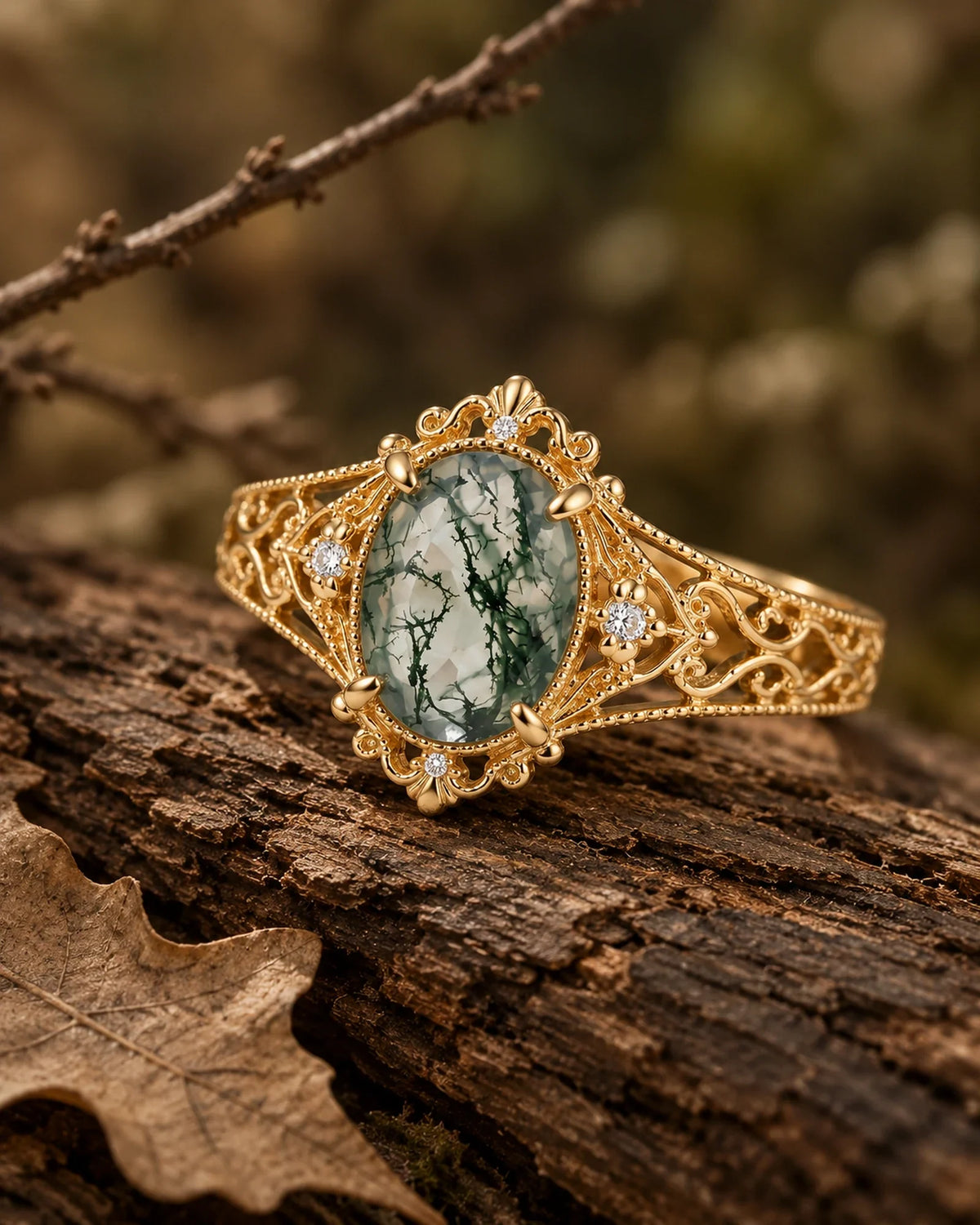

One stone looks like a branch suspended in water. Another has a soft white background, with green shapes you can read immediately. Both can be beautiful moss agate. The difficult part is knowing which one you will enjoy on your hand, rather than only in a photograph.
In translucent vs opaque moss agate, there is no universal winner. Choose translucency if you love depth, open spaces and a landscape that changes with its surroundings. Choose a milkier or denser-looking stone if you prefer a more defined background or a stronger patch of green. Neither appearance is a quality grade by itself.
When browsing moss agate engagement rings, judge the pattern and its background separately. A stone can be densely green yet have clear windows; a pale stone can look almost solid white. That distinction is more useful than sorting every ring into clear or cloudy.
First, separate the background from the branches
Moss agate belongs to the chalcedony family of fine-grained quartz. The University of Hong Kong's Stephen Hui Geological Museum explains this material and its green mineral inclusions in its quartz and chalcedony reference. The shopping labels below are descriptions of appearance, not laboratory classifications.
Translucent means light passes through, though you may not see an object sharply through the material. Transparent describes clearer see-through visibility. A search for a see through moss agate ring may bring up either look; ask for views of the actual stone rather than relying on the phrase.
Milky describes a whitish, light-scattering background. Opaque material does not transmit visible light through the thickness being assessed. In ring listings, however, the word is often used loosely for a stone that looks solid or difficult to see through face-up. A heavily included stone can look dark from above while transmitting light through thinner or less crowded areas. Milky does not necessarily mean opaque.
There are therefore two separate questions: how does the body transmit light, and how much space do the green inclusions occupy? The green patterns are mineral inclusions, not pieces of living moss. Their presence alone does not tell you whether the stone has damage.

Which look belongs in your ring?
A translucent stone rewards looking into it. Open areas can make branching inclusions feel suspended at different depths. The trade-off is that its background becomes part of the composition: skin, shadow and nearby metal may be visible through clearer areas. A beautiful loose stone against white paper can feel quieter on a hand.
A milky moss agate engagement ring offers a different pleasure. Its pale body can give dark branches a legible backdrop, like ink on mist. That is not simply a less successful version of a clear stone. If you want a soft, romantic center rather than a window, milkiness may be exactly the point.
Dense green material can create the strongest overall color impression, but overlapping inclusions may make individual branches harder to distinguish. Look at the complete outline from normal viewing distance. A dramatic macro photograph does not tell you whether the pattern still reads when the ring is at arm's length.
| The look you want | Start by considering | Check before choosing |
|---|---|---|
| Depth and open, watery space | A translucent body with visible clear windows | Whether the stone still appeals against skin and in ordinary indoor light |
| Distinct green branches on a soft background | A milky body with separated inclusions | Whether the pale area feels luminous or too dominant to you |
| A richer green focal point | Denser inclusion coverage | Whether you can still enjoy the pattern without strong backlighting |
| A subtle center within decorative goldwork | A balanced pattern with some visual breathing room | Whether the leaves, accents and center compete at actual wearing scale |
Try a useful preference test: would you still choose the stone if the seller removed the word rare? Name what you actually like: a single branching line, a pale corner, a green patch near the tip. Those details make a better selection brief than asking for the best clarity.
Three kinds of light answer three different questions
Moss agate appearance in different light is not a small detail. A stone is being viewed through changing reflections, shadows and backgrounds. That is an optical viewing effect, not proof of a color-change gemstone.

- Diffuse daylight: useful for assessing the overall green, pale areas and readable pattern without a spotlight shining through the back. Ask for a face-up view away from direct sun.
- Ordinary indoor light: useful for deciding whether you enjoy the ring where you actually spend time. A stone that needs a very bright window to look appealing may disappoint at your desk.
- Transmitted light: useful for revealing where light passes through. A lamp or flashlight behind a loose stone can reveal internal detail, but that view is not the normal appearance of a ring on a finger.
Do not compare one seller's backlit stone with another seller's front-lit ring as if the difference were entirely in the gems. Ask for the same lighting, background and approximate camera distance. Keep exposure and white balance consistent when possible, and request a short unfiltered video with a slow tilt.
The backlit view can be an extra, not the deciding picture. It cannot verify identity, reveal every treatment or prove structural soundness. For wearing expectations, the most useful view is often the least theatrical: the stone face-up, in the intended setting, under ordinary light.
The setting changes what surrounds the pattern
Prongs leave parts of the perimeter visible; a bezel frames it with a continuous metal edge. Neither label tells you how much metal lies behind the center. Ask to see the actual basket and underside rather than assuming that every prong setting is open or every bezel is closed.
Sylvaren provides a concrete design reference: its listed center is a 6 by 8 mm oval moss agate, with sculpted leaf-and-vine shoulders and no accent stones. In the close-up, the pierced shoulder and metal edge are visible. That is different from having a complete view beneath the gem.

An opening behind a stone does not guarantee extra sparkle. Moss agate is chosen for its internal landscape, not for reproducing diamond-like fire. The relevant question is whether the finished combination gives the pattern the depth or contrast you want.
Keep the cut comparable, too. Matching the outline is only the beginning: two oval stones can differ in depth, facet arrangement and the amount of material through which you are looking. A broad pale area under a central facet may look different as the ring tilts. Ask for length, width and depth rather than matching carat weight alone. Do not specify a shallower stone purely to make it look clearer; the maker still needs to assess a suitable seat, protection and overall proportions. A photograph cannot supply those measurements.
Yellow or rose gold can introduce warm surroundings; white metal can make the frame feel cooler. The effect varies with how much metal is visible or seen through the body. A metal swatch beside a loose stone is useful, but it is not identical to the finished ring.
In nature inspired engagement rings, think about visual hierarchy. An airy center can leave room for sculpted leaves. A densely patterned center may suit restrained shoulders. Neither is a rule: compare the whole silhouette, including spaces between the decoration.
Bright accents in cluster rings add another kind of contrast. Ask whether your eye goes first to the center pattern or to the surrounding sparkle. The answer is a design preference, not evidence that the moss agate needs upgrading.
Does clearer moss agate cost more?
Greater transparency does not automatically mean a higher price. A quote can reflect the appeal and placement of the pattern, the required millimeter dimensions, cutting and finishing, and the work needed to source a suitable stone. The mounting adds metal, accent stones and making costs.
A buyer seeking one fine branch through an open center has a different brief from someone seeking rich green coverage. Either brief can be restrictive at a particular size. Availability and a seller's pricing policy matter; there is no universal clear-versus-milky surcharge.
Compare like with like: the same design, metal, approximate dimensions and included services. Ask whether choosing a different stone changes the quote or delivery estimate. Comparing two completely different rings does not isolate the price of translucency.
Three design directions to compare
These catalog examples show different frames for an individual pattern, not three grades of translucency. The pictured stones are appearance references; they do not establish which exact stone is currently available for your order.

Elaris: a restrained three-stone frame
14K gold option: $830 USD
A listed 6 by 8 mm oval center and two pear moissanites. Consider this direction when you want to read the pattern without extensive ornamental shoulders.

Elowyn: an asymmetrical botanical frame
14K gold option: $840 USD
A listed 6 by 8 mm oval with sculpted leaves and five round moissanites. Check how the stone's densest green area relates to the asymmetrical leaf arrangement.

Marevora: a geometric coastal frame
14K gold option: $910 USD
A listed approximately 6.5 by 6.5 mm hexagon with two aquamarines and four moissanites. Judge green pattern, blue accents and coral-like goldwork together.
Catalog specifications and listed 14K prices in USD checked October 27, 2026. Confirm the selected configuration and current quote. These prices compare complete designs, not the value of clear versus milky stones.
A selection note worth saving before you order
Instead of requesting a stone exactly like a sample, describe the features that make that sample appealing. Use this checklist to turn a preference into something the seller can answer:
- Background: clearer windows, a soft milky body or a denser green appearance? Say which matters most and what would disappoint you.
- Pattern: identify preferred coverage, branch placement and empty areas. Ask how important inclusions will sit relative to prongs and the ring's orientation.
- Comparable views: request diffuse daylight and ordinary indoor face-up views, plus a separately labeled transmitted-light view if useful. State the backing used.
- Actual selection: ask whether the images show a sample or the stone reserved for you. Request an identifying reference and length, width and depth where available.
- Finished context: confirm the chosen metal and mounting. Distinguish a temporary placement or illustration from photographs of the completed ring.
- Written terms: confirm material and treatment disclosures, care guidance, any price or timing change, and the applicable approval and return terms before proceeding.
The actual-stone photo and approval guide explains the sample-versus-selected-stone distinction in more detail. Here, the first decision is personal: which background makes the pattern feel right to you?
You do not have to prefer the clearest stone. Choose the one whose ordinary, unshowy view still makes you pause. If you love that view, the dramatic photograph becomes a bonus rather than a promise the ring has to keep.