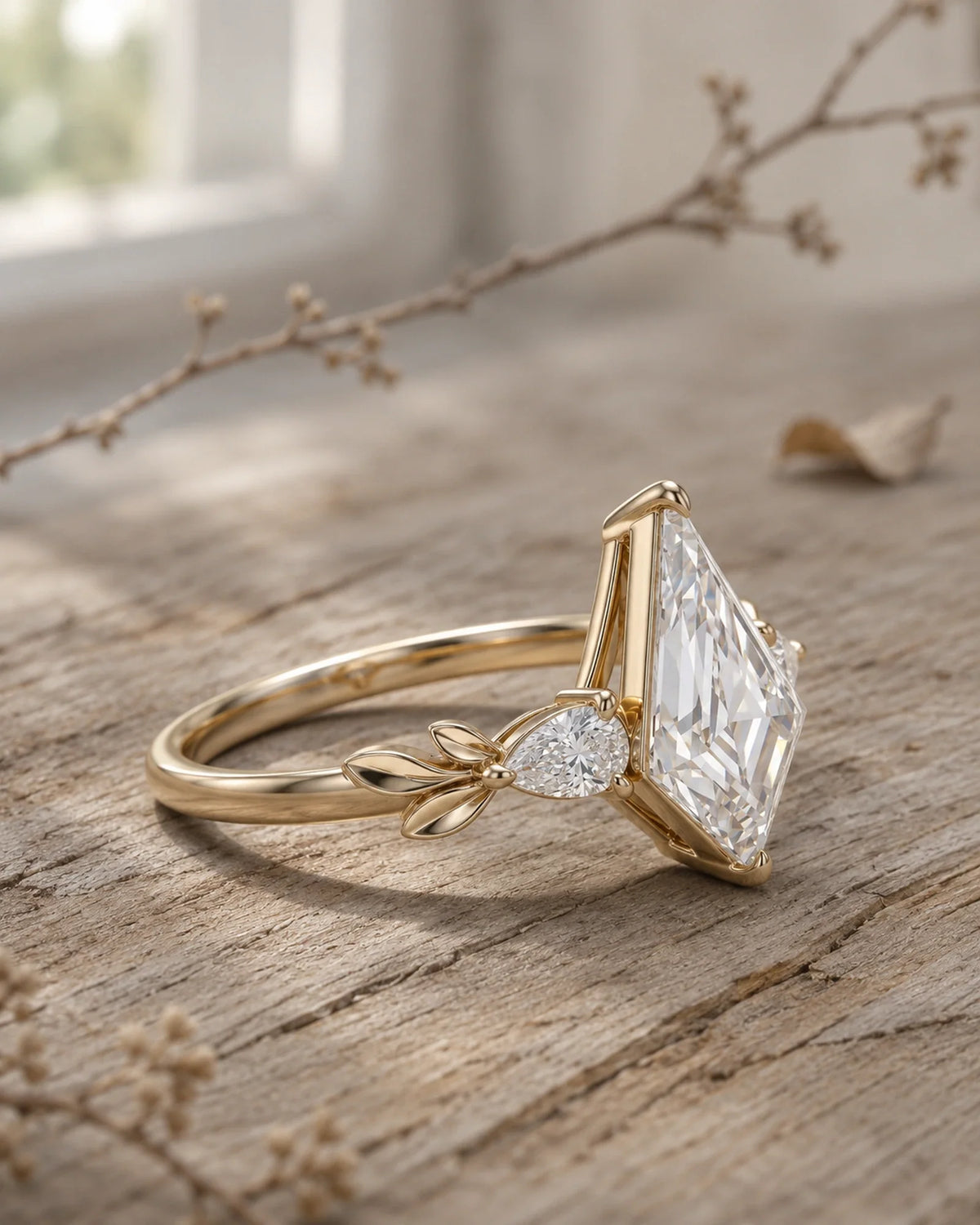

A floral halo frames a center gemstone with smaller stones in a flower-like surround. A flower cluster groups stones into a blossom or several little blooms; the grouped stones, rather than only a border, make the design. They can overlap. And some rings look floral because their petals are gold, with no halo or cluster of gemstones at all.
That last distinction is easy to miss on a small screen. White reflections on a polished petal can look like tiny stones. A scalloped edge can make a round center look flower-shaped even though the gemstone itself is round. To compare a floral halo vs flower cluster ring, start by tracing where one stone ends and the surrounding design begins. Then turn the ring sideways.
Is the flower a frame, a group of stones, or metal?
In a halo, the accents describe a perimeter around an identifiable center. The perimeter might closely follow a round or oval outline, or broaden into scallops and lobes. A flower halo engagement ring can use small rounds within petal-shaped metal frames; the accents don't all have to be marquise or pear shapes. Look for the surrounding row, not a specific stone shape.
In a petal cluster engagement ring, the stones work together as a flower. An individual pear or marquise may form a petal, or several rounds may form one small blossom. Some clusters have a dominant center, others have several similar-size stones, and others put little flowers beside a separate center. Asymmetry is possible, but it isn't a requirement. A symmetrical daisy can be a cluster too.
The terms are not mutually exclusive construction standards. The GIA guide to ring settings and styles describes both halo surrounds and grouped-stone cluster designs, including a flower cluster with a halo-like center. Think of the names as descriptions of the arrangement, not instructions for how every stone is secured. Either style can use prongs, beads or other supporting metalwork.
Now consider a flower cast or carved in gold beside a solitaire. Its petals may be dimensional, engraved or openworked, but a reflection in the metal isn't an accent gemstone. “Floral” describes the motif. It doesn't establish a halo, a cluster, a stone count or whether the detail was hand-engraved. All four questions need separate answers.

What the front view doesn't tell you
From above, follow the edge of the center and then the outermost edge of the ring head. A close halo often reads as one bright frame. Longer petals or separate small blooms create a more broken outline, with gaps that let you distinguish one element from another. The center can remain the focus in either arrangement. If you want a quieter flower, ask for a video taken in diffuse daylight as well as under small indoor lights: tiny accents can compete strongly with the center under spot lighting.
Next, look at the side and, when available, underneath. Can you distinguish the central basket from the accent-bearing surround? Are the petals attached at the shoulders or supported around the head? Are there openings beneath the small stones, or deep recesses that a brush will struggle to reach? Decorative openings and separate stone seats are different things. A flower shape on top does not establish what is connected below.
Don't use “halo” as shorthand for low profile or protection. A halo can sit high, low or at a different level from its center. A cluster can be compact or spread out across the hand. Surrounding accents don't automatically shield the center's edge, and the outermost accents may themselves be exposed. If you hope to wear a straight wedding band, ask to see it beside the actual ring from the side. A low petal, gallery rail or accent prong can block the band even when the top view looks tidy.
For a fair size comparison, request the overall head length and width in millimeters, the center dimensions and the head height. Total carat weight is not a footprint measurement, and two photographs at different magnifications cannot establish which ring covers more of your finger. More useful than “Which looks bigger?” is “Do I want the flower's outline to be the first thing I see, or the center stone?”
Three rings that make the distinction visible
The following material and count details were checked against the current catalog on November 22, 2026. Accent totals refer to the whole listed engagement ring, including its shoulders, unless a breakdown is stated. They are not counts independently established from these photographs, and a customized stone choice needs a revised specification.
Seravienne: a flower-shaped surround with a distinct center
Seravienne floral halo uses a 6.5 mm round moissanite center and lists 60 round moissanite accents. The front view shows a close surrounding row inside a scalloped, milgrain-edged outline. Small stones also appear in the garland-like shoulders. That's why “60 accents” must not be read as “60 stones in the halo.”


This is a useful reference if you like the center to remain clearly defined within an ornate border. Ask for the halo-only count and its stone sizes if those details matter to your comparison. For care, consider both the narrow space near the center's prongs and the small settings farther down the shoulders. The open-looking ornament is not evidence that every surface is easy to reach.
Aureflora: clusters and metal petals in the same ring
Aureflora floral cluster also has a 6.5 mm round moissanite center, but lists 32 round moissanite accents. Look at the little flower on the shoulder: several separate stones make that bloom. Then look beside the main center: the larger petal-like surfaces are sculpted metal, with small stones in some of the surrounding details. The catalog describes a “floral halo effect,” but that phrase alone should not be taken to mean a uniform pavé collar.


Neither “all halo” nor “every petal is a gemstone” describes this construction well. It suits someone who wants several botanical details to notice, rather than only an outline around the main stone. Before ordering, ask which accent seats have their own prongs or beads and which supports are shared. The close view helps you locate them; it doesn't prove how securely they are set.
Avelune: a floral ring with no accent stones
Avelune floral solitaire is the boundary case worth keeping in the comparison. It lists one oval lab-grown diamond and no accent stones. Its flowers and veined leaves are gold details, not a cluster of little diamonds. The catalog's approximate 6.2 × 8.3 mm center measurement is a target; the selected diamond's actual dimensions and grades belong to its individual report.


Avelune is not a lab-diamond version of the other two settings. It's a different way to express the same floral interest. It eliminates accent-stone seats from the care routine, but the leaves and recesses still need cleaning and the center's prongs still need inspection. If this is the look you prefer, browsing only halo or cluster labels may hide the right ring from you.
Cleaning the space between petals
The cleaning problem is usually the small spaces, not the word on the tag. Skin oils, soap and hand cream can collect below a center, behind a petal or around closely grouped seats. A stone may lose contrast because its back is coated while the visible top looks clean. Turn the ring over under good light and look for the access openings before deciding that the gemstone has changed.
For a secure ring with compatible materials, lukewarm water, a little mild soap and a very soft brush are a gentle starting point. Work around the back and sides without forcing bristles under prongs. Rinse over a bowl or a closed drain, then dry with a soft, lint-free cloth. Avoid polishing compounds and abrasive paste on the small details. If you cannot reach a recess gently, ask a jeweler to clean it rather than trying a needle or another sharp tool.
That routine isn't permission to soak every floral ring. A design with pearls, opals, glued components or a treatment that changes its care requirements needs advice for those materials. The durable center does not set the rules for the whole ring. Nor should a clean-looking moissanite or diamond center be used as the reason to put a detailed ring straight into an ultrasonic cleaner. See the whole-ring ultrasonic cleaning guide before choosing a machine.
While the ring is dry, compare its little prongs and bead tips from one side to the other. A new catch on fabric, visible movement, a missing tip or an unexplained gap deserves inspection. Don't deliberately pull fabric across the setting to test it, press stones with a tool or keep wearing it to see whether it settles. Repeated movement can damage the seat as well as risk the stone. Our prong maintenance guide covers the next steps.
Why the larger-looking flower may not cost more
A ring's price combines the chosen center, the accents, the metal and the work needed to make and finish the design. A larger-looking group of small stones can have a different material cost from one substantial center. More seats add setting and inspection work, but stone count by itself doesn't price the labor: access, seat size, shared supports and finishing around the ornament all matter. A stone-free sculpted flower still takes design and finishing work.
Compare the same metal alloy, ring size and included items, then record the actual center specifications and the accents by material and count. Distinguish a lab-grown diamond center from moissanite; neither can be inferred from a colorless photograph. Also distinguish center weight from total stone weight. A higher accent total doesn't tell you the total weight, and a broad face-up flower doesn't establish either value.
For a custom quote, ask what changes if you keep the center but simplify the surround, reduce the shoulder stones or turn a gemstone petal into metal. You may change the outline, the support and the finishing work together. A different center shape or depth can also require a revised head. Those are design decisions to approve, not automatic price deductions per stone.
Choose the flower you want to see
Start with floral engagement rings for the motif, then use halo ring designs when a framed center matters, cluster ring arrangements when grouped stones are the attraction, or lab-grown diamond rings when diamond itself is part of the choice. A ring can belong to more than one collection without that proving its precise structure.
Before paying, ask for a straight-on image, an angled side view, center dimensions, overall head dimensions and a complete accent list. Include the band you plan to wear beside it if you want the pair checked together. You should be able to point to what you love: the scalloped frame, the little stone-built blossom or the quiet gold petals. That is a much clearer starting point than asking for a ring that is simply “more floral.”