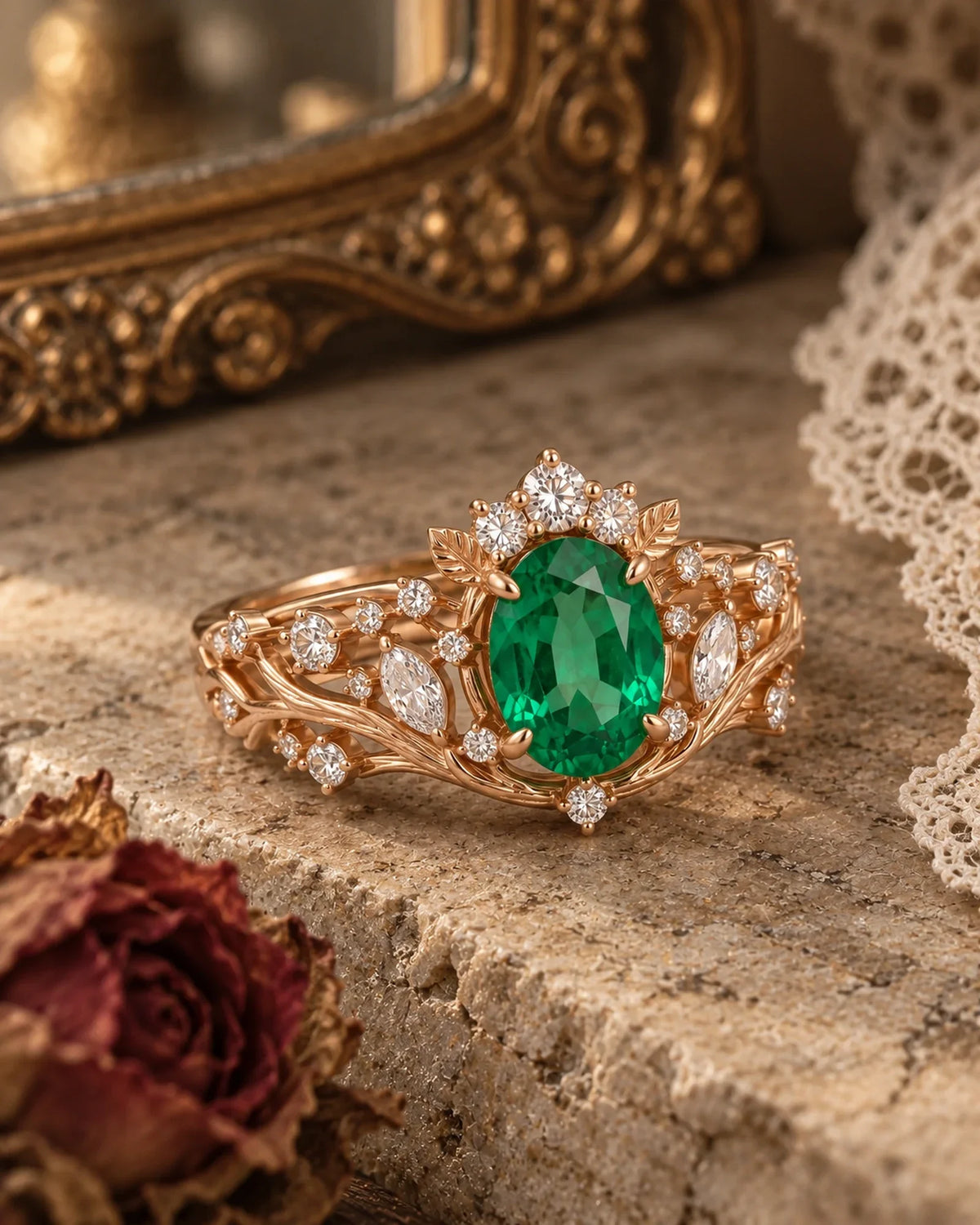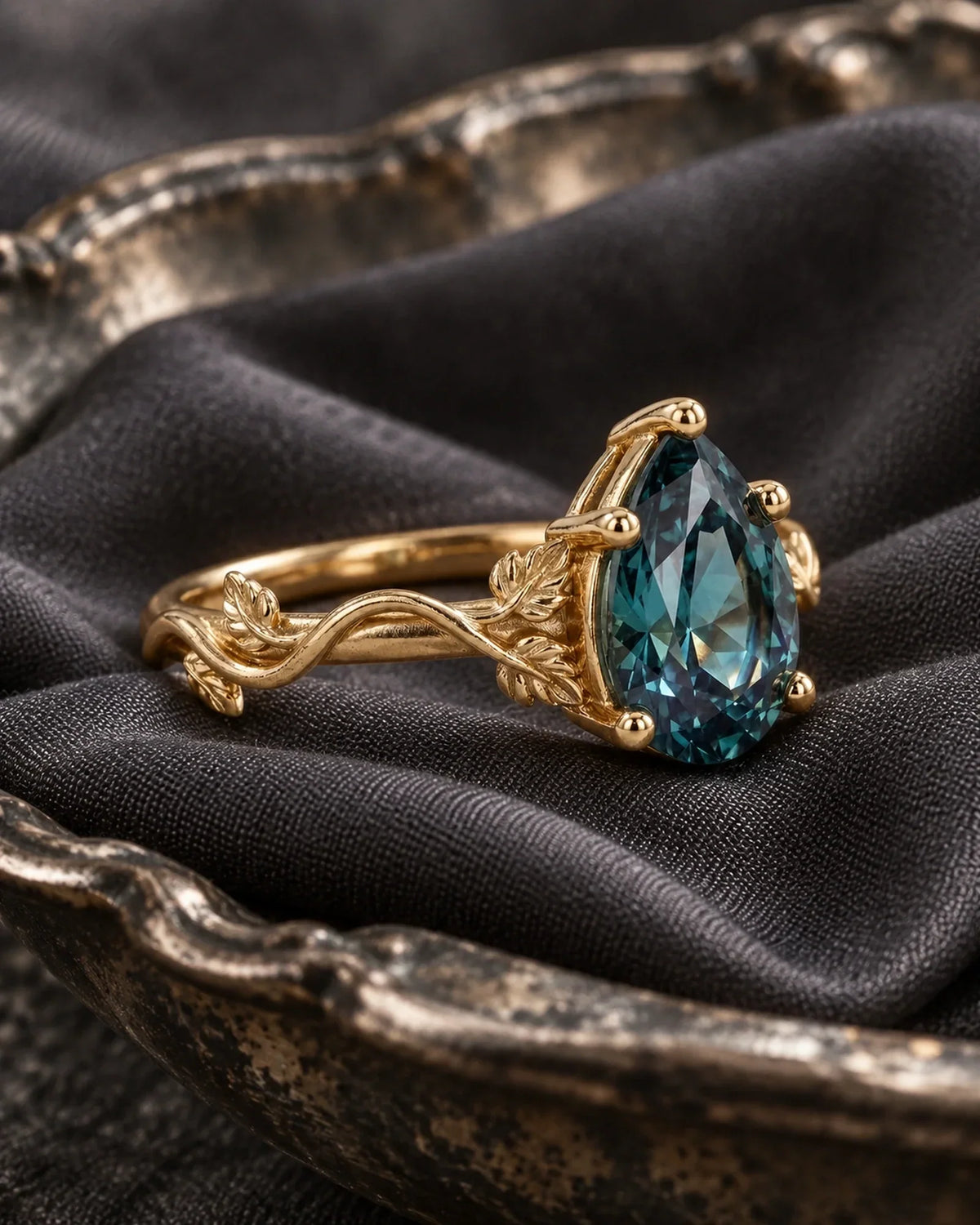

The first thing you notice about a kite cut engagement ring is its direction. The stone draws your eye along the finger, with a silhouette that feels a little architectural, a little unexpected. The question often comes later: will that long point catch my sleeve, and where will a wedding band go?
Those are good questions to ask before the ring is made. A kite's length and width help predict its appearance; its point protection and side profile help predict how it will fit into your life. A graceful outline does not have to mean an awkward stack. But a beautiful front photograph cannot answer the whole buying decision.
Start with the shape you enjoy, then look beneath it. That order leaves room for a distinctive ring without asking you to accept a setting or wedding band that never feels quite right.
Not every kite has the same silhouette
A typical kite outline has four straight sides, left-right symmetry, broad shoulders above the midpoint and a longer taper toward one end. It differs from a conventional equal-sided diamond-shaped lozenge and from the wider, more shield-like outlines sometimes sold alongside it. Trade names are not perfectly consistent. Compare the actual outline rather than expecting every item labeled "kite" to have identical geometry.
A broader, shorter kite can feel balanced and compact. It gives a patterned gem room across the middle and can sit comfortably within a floral or vintage composition. A slender kite emphasizes the long axis more strongly. That may be exactly the appeal, but it also makes the tip's position relative to your knuckle and other rings worth checking.

Length-to-width ratio is useful, but incomplete. Two stones with the same ratio can place their widest corners at different heights or have different point angles. Those details change the character of the ring and the contour a band must follow. When browsing kite cut engagement rings, compare the full outline, including any metal frame, not only the center stone.
Read the millimeters before the carat label
For ratio calculations, use the longer tip-to-tip measurement as length and the maximum side-to-side measurement as width. Listings may write these dimensions in either order. A stone described as 6 x 8 mm therefore has a length-to-width ratio of 8 divided by 6, approximately 1.33.
| Listed center size | Length / width | Catalog example | What to compare |
|---|---|---|---|
| 6 x 8 mm | 1.33 | Noctua moss agate | A broader footprint before adding side accents |
| 6 x 9 mm | 1.50 | Verdant Aura moss agate | Extra length plus the cluster's total width |
| 5 x 8 mm | 1.60 | Elyndra moissanite | A narrower center within an antique cluster |
| 4 x 8 mm | 2.00 | Azurielle lab sapphire | A slender center inside a larger geometric halo |
These are listed product dimensions reviewed October 6, 2026, not universal ideal proportions or cut-quality grades. The examples use different materials and mountings; they are not controlled brightness comparisons. Ask for the dimensions of the actual selected center if it differs from the sample.
Carat weight measures mass, not finger coverage. Moss agate, moissanite and alexandrite have different densities, and pavilion depth also changes weight. A moissanite's diamond-equivalent weight is another convention, not necessarily its actual mass. Millimeters are the clearer starting point for comparing the space the ring occupies.
Request both the stone dimensions and the complete setting's length and width. A halo or leafy cluster can make a small center into a substantial ring. For a short finger, check available space between the knuckle and the base of the finger, especially with a band added. For a long finger, try a broader option as well as an elongated one. Neither hand shape creates a rule you must follow.
Ask what covers the point, not just how many prongs there are
A sharp corner concentrates exposure in a small area. Mohs hardness describes resistance to scratching, not immunity to chipping. Even diamond points can be damaged. GIA's guidance on protecting pointed stones identifies thin girdles, exposed corners and damaged prongs as concerns, and discusses bezels and V-shaped prongs as protective options. Its examples concern diamonds; the exact risk and setting requirements still depend on your gemstone.
A V-prong wraps around a pointed end. A full bezel follows the perimeter, while a partial bezel protects selected areas. A small claw can secure a stone without covering the same area as a V-shaped cap. Judge what the metal actually shelters rather than assuming every four-prong kite has equivalent protection.

Protection also depends on fit and finish. The stone needs a properly shaped seat; a cap should not be an oversized decoration pressing on a vulnerable tip. GIA's V-prong workmanship benchmarks show how poorly fitted bearings can leave gaps and how raised edges can snag. A kite is a different outline, but the practical questions about secure contact and smooth finishing remain useful.
Request focused photographs of both end points and the two side corners. Ask whether a visible rim is a continuous bezel or a decorative frame with separate prongs; they are not automatically equivalent. Tiny images can hide that distinction. A halo may surround the center without shielding every edge from a side impact.
If a finished ring begins catching fabric more than it did before, or a stone rattles or moves, stop wearing it and have the setting checked. Do not bend a claw, tighten a bezel or probe under a tip at home. Remove the ring for lifting weights, heavy cleaning and other work likely to knock its exposed ends.
The gemstone changes what you should inspect
A kite moss agate engagement ring: pattern before sparkle
A branching inclusion can sit beautifully inside the long taper, while a denser cloud may make the same outline look broader or darker. Look at the actual stone straight on and slightly tilted. Check where the visible pattern lies and whether a bezel or tip cap will cover an area you especially love. A clear center can also reveal more of the setting beneath it.
Moss agate is chalcedony, generally around 6.5-7 on the Mohs scale. It needs more consideration about surface wear than moissanite. Its attractive moss-like inclusions are not, by themselves, evidence that the stone is cracked. Ask separately about chips, fractures and any treatment affecting care. The moss agate engagement rings collection offers design options; individual stone approval is what resolves a pattern preference.
A kite alexandrite engagement ring: identity and ordinary light
Ask for views of the allocated stone under described daylight-type, warm and ordinary indoor lighting. A long pointed area may look darker than the center in some positions; a dramatic color-change clip will not tell you whether you enjoy its everyday appearance.
For a ring listed as lab alexandrite, confirm whether the center is laboratory-grown chrysoberyl or another color-change material. True alexandrite has a Mohs hardness of about 8.5, but that figure should not be assigned to a stone whose identity is unconfirmed. Our lab alexandrite and color-change sapphire comparison explains the documentation question. When considering alexandrite engagement rings, resolve material disclosure as well as color preference.
Kite moissanite: examine movement, not one flash
Moissanite has high scratch resistance, approximately 9.25 Mohs, but a pointed end still deserves suitable protection. Kite describes its outline, not a universal faceting pattern. Ask whether the stone has brilliant-style, step-like or another facet arrangement, then request a slow video that includes a face-up pause.
Look for whether brightness remains appealing across the stone, whether a broad dark area stays in place as it moves, and whether you enjoy its rainbow flashes in ordinary light. Rose-style cuts have a different light character; they should not be judged as if they promised brilliant-style sparkle. Among moissanite engagement rings, the particular cut and mounting matter more than assuming all kites perform alike.
A wedding band for a kite engagement ring must fit underneath, too
Imagine finding two rings you love, then discovering that the wedding band stops against the basket instead of reaching the engagement band. That is a geometry problem, not a failure of taste. The long point, pavilion, basket and side accents can each occupy space the second ring needs.
Check overall ring height, but also ask for the basket's position and the usable space beside the shank. A high center does not automatically create clearance if the basket flares outward. A low setting does not automatically rule out a comfortable pairing if the band curves around it. There is no single height that guarantees a flush fit with every wedding band.

Chevron and contour bands
A chevron's V can echo the kite's lower taper. Compare the V's angle, internal depth and accent-stone positions with the complete setting, including the tip cap. A shallow V may stop too early. A deeper one can surround the point but create a larger stack than you want. A contour band follows a more specific outline, which can suit an asymmetrical cluster better than a simple V.
Ask to see both rings together from the front and side, then worn on a finger. They should not rely on pressure against a stone or prong to stay aligned. Confirm whether the wedding band remains attractive worn alone, and whether a later change in the engagement ring's size or design would affect the pairing.
Open bands and straight bands
An open band offers a gap for a projecting setting, but the opening must suit the basket as well as the visible point. Check both terminals' thickness, finish and position when the rings rotate slightly. Rounded ends can still contact a prong or gemstone if the opening is wrong. An open design is not necessarily adjustable; ask about resizing rather than squeezing it.
A straight band can work when the actual setting permits it, or with an intentional gap that you like. A spacer may change where contact occurs, but adds width and is not a cure for every collision. When exploring matching wedding bands, send the engagement ring's measurements and side views instead of selecting by the front silhouette alone.
Six designs, six different questions to ask
These examples use listed center dimensions and available 14K prices, not measured clearance tests. Recent additions lead the selection; an earlier alexandrite set adds a relevant material and profile comparison. Sample photographs cannot establish the identity or pattern of your allocated stone.

Elyndra antique cluster
5 x 8 mm moissanite. Compare the narrow center with the cluster's complete width and finished tip coverage.
14K solid gold options from $1,080 USD.

Azurielle geometric halo
4 x 8 mm lab sapphire. A slender-center reference: ask for the outer halo dimensions before judging finger coverage.
14K solid gold options from $1,020 USD.

Verdelune floral set
6 x 9 mm moissanite with emerald accents. Review the whole stack and the care needs of its smaller stones.
14K solid gold options from $1,320 USD.

Verdant Aura cluster
6 x 9 mm moss agate. Compare the actual inclusion placement and the space around its pointed center and accents.
14K solid gold options from $820 USD.

Noctivra gothic set
6 x 9 mm black moissanite. Judge the layered cluster's total footprint, side clearance and comfort as two rings.
14K solid gold options from $1,580 USD.

Sylvae branch set
6 x 8 mm center listed as Lab Alexandrite. Confirm mineral identity, indoor appearance and the curved band's fit.
14K solid gold options from $1,480 USD.
Available 14K variant prices reviewed October 6, 2026. Metal color, size and customization can affect the final quote. Request confirmation of the exact materials and completed design.
Before approving your kite ring
- Confirm the outline: actual length, maximum width, upper and lower taper, and the full setting's dimensions.
- Approve the stone: material and origin disclosure, actual pattern or color views, and any known treatments.
- Review every corner: focused end-point photographs, side corners, stone seats and finished prong or bezel edges.
- Plan the pair: both rings' widths and thicknesses, front and side views together, and clearance during normal small movements.
- Keep future options open: ask about resizing, independent wear of the wedding band, maintenance and replacing a damaged center.
For cleaning, follow the instructions for the least tolerant gemstone in the entire ring or set. Use gentle soap, lukewarm water and a soft brush only when compatible with its materials and treatments; avoid forcing a brush under pointed seats. Dry and inspect the ring without pulling on its claws. A protected center does not remove the need to maintain the smaller accents.
A kite ring should feel like a choice you made because you love its shape, not a compromise you keep accommodating. The right proportions, a thoughtfully protected point and a band planned around the real side profile make that distinctive silhouette easier to enjoy every day.