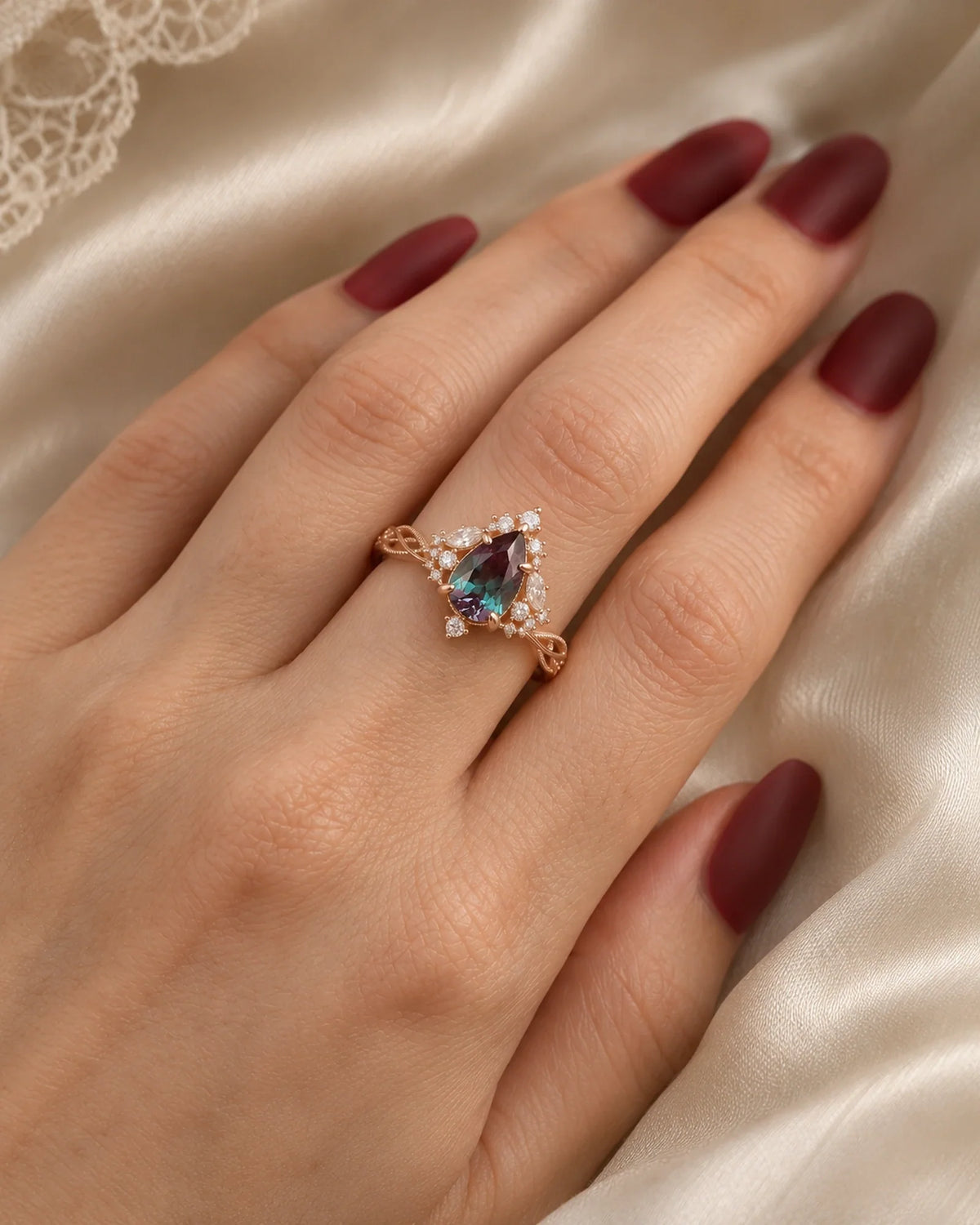

You want to see the little forest inside the stone. You do not necessarily want a bigger ring. Those are different wishes, and a close-up product photograph can make them surprisingly difficult to separate.
For moss agate engagement ring size, a 6 by 8 mm center is a useful starting point for comparison, not a universal best size. A distinct branch against an open background can remain readable in a smaller stone; a larger, densely included stone may read mainly as green. Choose the actual pattern, then check how its millimeter dimensions work with the complete setting.
This moss agate mm size guide uses catalog-listed dimensions and existing product photographs. They are not our independent measurements or a controlled same-finger photography study. The cover is an illustrative loose-stone arrangement, not a calibrated size chart or a selection of reserved inventory.
Start with millimeters, not a carat target
Here, size means the gemstone's dimensions, not the ring size that fits your finger. Ask for width, length and depth in millimeters. Confirm which number is which: a listing may write 6 by 8 or 8 by 6 for the same oval, while a hexagon's quoted width may need clarification about where it was measured.
Carats measure weight. They do not tell you how much patterned surface you will see from above. GIA explains the distinction between weight and apparent size in its guide to carat weight. For moss agate, do not use a diamond carat-to-millimeter chart as a reliable conversion: material, outline and depth all matter.
A deep stone can carry weight below the visible face. A long kite can use much of its length in narrow tips. Neither necessarily offers a broader view of the inclusions than a shorter, fuller oval. When browsing moss agate engagement rings, save the dimensions alongside the photograph instead of comparing the images alone.
What changes between 6 by 8 and 8 by 10 mm?
For two similarly proportioned ovals, moving from 6 by 8 to 8 by 10 mm adds 2 mm in each direction. As an idealized oval outline, the second has about 67% more area. That is a geometric comparison, not 67% more visible detail, more finger coverage, more weight or a predictable price increase.
If you are searching for 6x8 vs 8x10 moss agate on hand, ask for the actual stones photographed at the same distance on a documented finger size. Enlarging two separate photographs until the rings look equally prominent defeats the comparison. An 8 by 10 mm center was not confirmed in the catalog review for this guide; treat it as a dimensional reference, not an availability promise.
A readable pattern needs contrast, not just room
Think of the center as a small picture. Its appeal may come from a single dark branch, a bank of green across one edge, or a cloudy area that gives the inclusions depth. More material is only helpful if it gives you more of the picture you actually enjoy.
To judge whether a moss agate pattern is visible in a small stone, look for separation between the inclusions and their background. Fine branching can disappear at ordinary viewing distance, while a bolder feature remains recognizable. A clear patch beside the moss can help define its silhouette; dense inclusions can create a stronger green impression but conceal individual branches.
Ask to see the stone both close up and at the distance you normally see your own hand. A dramatic macro can show structures that will not remain individually legible across a dinner table. That does not make the stone disappointing; it means its everyday character may be a soft green landscape rather than a sharply drawn tree.

In Sylmora, the white side stones make the composition wider and brighter than the agate alone. The photograph is useful for identifying that relationship, not for measuring your own finger. Its photographed stone pattern also should not be treated as the exact pattern of a future order.
Transparency adds another variable. Skin, metal and the background beneath an open mounting can change how pale areas read. Our translucent and opaque moss agate comparison explores that choice; increasing millimeters will not by itself resolve it.
Oval, kite or hexagon: the same numbers tell different stories
An oval gives much of its face to a continuous, rounded field. It can suit someone who wants the pattern to feel contained and easy to read. A pear narrows toward one end, so ask whether your favorite inclusion sits in the broad body or disappears beneath the point protection.
With kite-cut engagement rings, consider usable width as carefully as tip-to-tip length. An elongated silhouette can look striking while remaining narrow through the middle. Check the actual outline, the location of the moss and the metal protecting the tips rather than ordering a longer stone simply to see more green.

The Solstice photograph also shows why the center's length is not the whole design. Marquise accents continue the botanical silhouette beyond the gemstone. Someone choosing a modest center to keep the ring discreet should still look at the complete head width.
For hexagon-cut engagement rings, a wider, compact outline may give a different impression from a kite with a greater listed length. Confirm whether dimensions run across opposing flats or corners, and request an outline view if the proportions are important to you. Shape names alone do not define a standard face-up area.
Decide what must fit: a stone, a setting or a whole stack
Your finger has both width and usable length between the knuckle and base. Neither is captured by ring circumference alone. A narrow finger with a long segment may accommodate a long silhouette differently from a similarly sized finger with less room for a bridal stack.
Make simple paper outlines from the stated dimensions using a physical ruler. Hold them on the intended finger to compare the approximate footprint. Do not trust an onscreen image to be life size. Paper cannot simulate depth, curved shoulders, prongs or comfort, but it can reveal that your preferred outline is wider than expected.
Then add the mounting. In leaf engagement rings, botanical shoulders can make a small center feel substantial. A halo adds a perimeter; a curved band adds length along the finger. Ask for the finished head's width and length, plus its height above the finger, rather than only the center measurements.

The three worn images show different designs and photographic conditions. They are not a smallest-to-largest scale test. Use them to notice structure, then request matched views if you need to compare how two sizes would look on the same hand.
For gloves, knitwear or frequent hands-on work, ask about profile and exposed points as well as footprint. A smaller center in a tall mounting is not automatically the less intrusive option. A low setting is not automatically compatible with a straight wedding band either; the basket may occupy that space.
Choose around the problem you actually want to solve
| Your priority | Look for | Check before approval |
|---|---|---|
| A delicate ring with readable moss | A distinct feature with open space around it | Normal-distance view, not only a macro |
| A fuller miniature landscape | A broader face with a composition you enjoy | Whether dense areas obscure the detail you wanted |
| A long, elegant silhouette | A pear or kite with suitable proportions | Central width, tip protection and inclusion placement |
| Botanical detail without excessive spread | Shoulders that stay close to the center | Total head width and side profile |
| A coordinated bridal stack | A matching band that clears the setting | Combined length, contact points and separate wear |
If two choices both fit, let the individual pattern decide. You may prefer a smaller stone with a clear, balanced composition over a larger one that becomes an uninterrupted green patch. Equally, a dense, misty stone may be exactly what you want. There is no universal clarity score that settles that preference.
Three designs with different ways of framing the moss
These catalog examples are alternatives, not a same-shape size ladder. Dimensions describe the listed center and are not independent measurements of the photographed specimen. Prices below are listed 14K options checked on November 6, 2026; confirm the selected variant and current quotation before ordering.

Lunavelle Pear
Approximately 6 by 8 mm reference center. A newer design to consider when you prefer a rounded pattern field with a pointed finish and a decorative cluster.
Listed 14K option: $980 USD

Marevora Hexagon
Approximately 6.5 by 6.5 mm center. A compact geometric alternative, with coral-inspired shoulders and blue accents that also contribute to the overall footprint.
Listed 14K option: $910 USD

Verdantia Kite Set
7 by 11 mm kite center with a matching curved band. Consider the complete set's space on your finger, not just the elongated center.
Listed 14K set: $1,860 USD
Do not read the difference between these prices as a cost-per-millimeter rule. One is a complete set; the shapes, metal requirements, accent layouts and construction differ. A larger center can require a different basket or head, while a more elaborate smaller ring can involve more metal and setting work.
The message to send before you choose
Once you have narrowed down the outline, ask for information that belongs to the actual proposed stone and design. A concise request is more useful than asking whether it looks big:
Ask whether actual-stone selection is available for your order and whether the approval applies to that individual stone or to a reference appearance. If you need an 8 by 10 mm oval or another unlisted size, confirm sourcing and design feasibility before treating it as an option.
Can a smaller stone still look like a miniature landscape?
Yes, but choose a composition you can recognize without zooming. A smaller stone with one strong branch and a pale window may communicate the forest feeling more clearly than a larger stone filled edge to edge. Request an unedited, normal-distance view before deciding that a macro photograph represents everyday visibility.
Should I enlarge the center or simplify the shoulders?
If the pattern feels lost, first establish why. Busy white accents can draw attention away from the agate; a broad metal edge can reduce the visible outline. A simpler mounting may let the existing size become the focus without increasing its dimensions. Ask for a design comparison before committing to a larger center and a revised head.
The most satisfying choice is not necessarily the largest stone you can accommodate. It is the one whose pattern still appeals at ordinary viewing distance, whose outline fits your hand, and whose complete setting suits the way you intend to wear it.