
You may notice the tiny beaded edge before you notice the stone. Or prefer a ring because light passes through its scrolling shoulders. Both can look vintage, but they are different details, and they deserve different questions before you buy.
The short answer to milgrain vs filigree: milgrain is a bead-like border; traditional filigree is fine metal-wire ornament. Engraving cuts a pattern into a surface. A ring can combine all three. Their presence does not, by itself, tell you whether the decoration was worked by hand, formed during casting or finished through several processes.
That distinction matters more than a romantic description. You should be able to choose the look you love without having to guess what the craftsmanship claim means.
Follow the edge: that is where milgrain usually appears
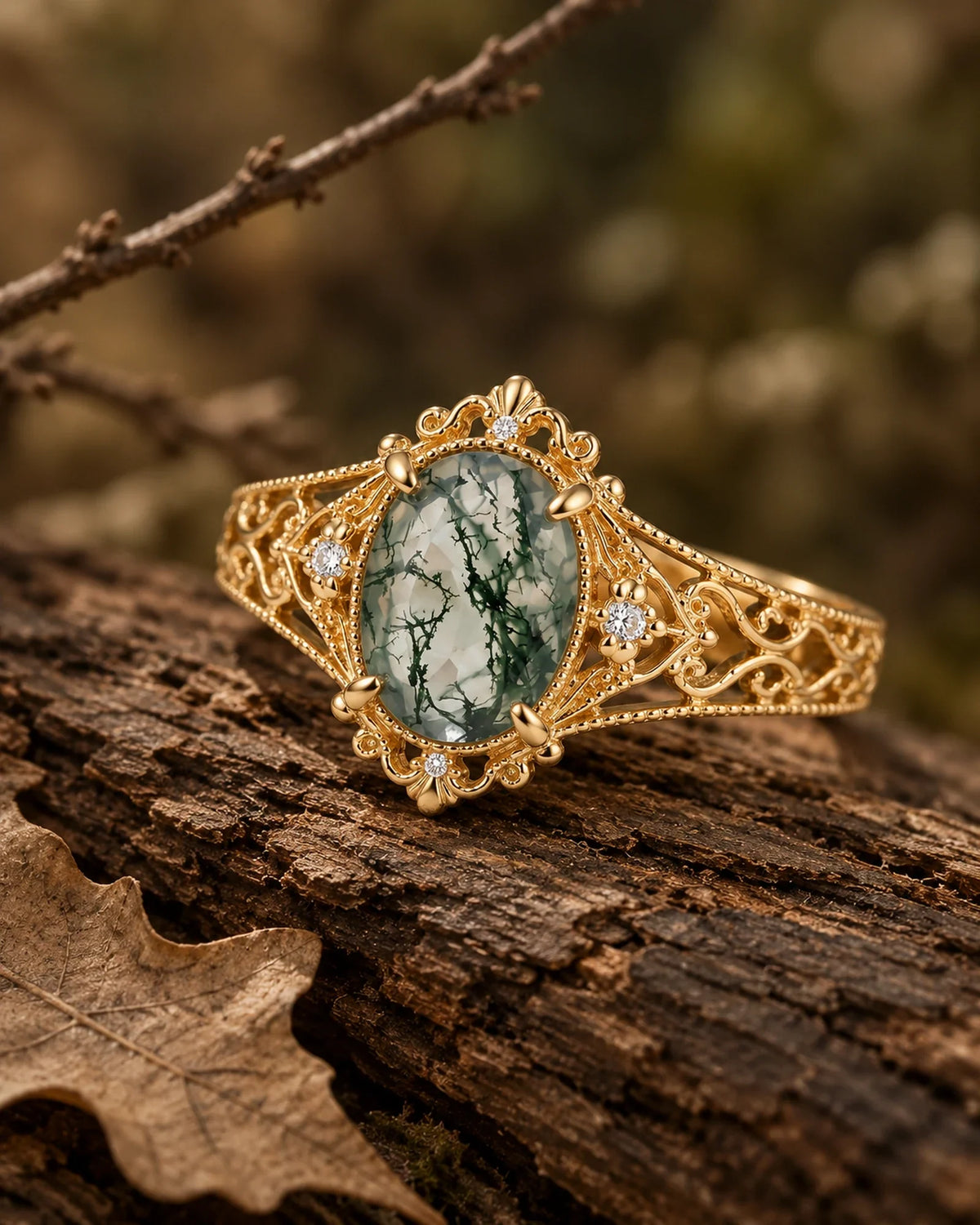
Look for a closely spaced row of small metal beads around a stone, along a band or bordering a decorative panel. Unlike a line of tiny diamonds, the beads are metal. They break up a hard polished outline and give it a finer, textured rhythm.
On an enlarged photograph, follow that line past a corner. Does the bead scale remain consistent? Does it stop deliberately, or blur into an indistinct ridge? These are useful appearance questions. They are not a reliable way to identify the tool or prove that every bead was individually finished.

Milgrain can be worked with specialist tools, while a similar beaded appearance can also be incorporated into a cast design. Ask which description applies to the chosen ring. A neat cast border need not be dismissed; it simply should not be sold as a different process without evidence.
Also separate decorative beads from stone-setting beads. They may sit close together in a pavé design, but a decorative border does not automatically secure the stones. Assess the actual setting rather than treating a vintage-looking edge as extra protection.
Look through the pattern: openwork and filigree are not interchangeable
Openwork describes a pattern with spaces through the metal. Traditional filigree is made with fine metal wires arranged and joined into ornament. It can be supported by a backing or made as an open, lace-like structure. Not all filigree is see-through, and not every see-through pattern is traditional wire filigree.
A modern ring may have cast openwork scrolls, pierced shapes, separately assembled elements, or a combination. In photographs, these can share a similar silhouette. Calling them all hand-fabricated filigree skips the information a buyer actually needs.

Orlevienne, introduced in October 2026, uses an approximately 5 by 9 mm elongated hexagon moissanite with openwork gold shoulders and no accent stones. The metal pattern supplies the detail that another design might obtain from side gems. That is a useful design comparison, without inventing a workshop story.
If the distinction interests you, GIA's guide to decorative metalwork illustrates filigree, openwork and hand engraving as separate techniques. For your purchase, request a specific explanation of the selected design rather than relying on a broad style label.
Look into the surface: engraving is not simply any leaf pattern
Engraving incises lines or shapes into metal. Hand engraving uses a cutting tool under the engraver's control; machine and laser methods are different ways of producing engraved marks. A flower or leaf motif alone tells you none of this.
A raised botanical pattern may be sculpted into the original model and reproduced through casting. A cast part may later receive hand-cut detail or other finishing. Chasing displaces metal rather than removing it. These processes can coexist, but their names are not interchangeable.

When comparing an engraved botanical engagement ring, ask: Are these lines cut into the finished metal, or is this a reproduced surface motif? Which stages, if any, are done by hand? A clear answer is more valuable than attaching the word handcrafted to every visible feature.
There is no need to create a hierarchy in which one method is always good and another always disappointing. Compare definition, proportion, finishing, structural suitability and the accuracy of the description. Pay for the work being offered, not an assumed process.
Which detail will you notice when the ring is on your hand?
Macro photographs make a fine border look substantial. At normal distance, that same border may read as a soft outline rather than individual beads. Ask for an unzoomed hand photograph as well as the close-up. The two views answer different questions.
The Virelle cover design pairs a rectangular emerald-cut lab diamond with scrolling gold shoulders and beaded edging. Its broad step-cut reflections contrast with the smaller metal pattern. You can like that contrast without needing every scroll to be visible from across a room.
For a richly patterned moss agate or a labradorite with shifting flash, a restrained edge can leave room for the stone's character. A dense halo, busy shoulder and strongly patterned center can also work, but ask which element you want to notice first. Adding detail everywhere is not the only route to an individual ring.
When comparing quotes, keep the stone, metal and dimensions as similar as possible. Otherwise, a higher price may reflect a different center gem rather than extra work in the border. For a custom design, ask what simplifying one decorative area would change in the quote and appearance. You might keep the scrolls you love beside the center and choose a quieter lower shank, subject to the maker's assessment. That is a more useful budget conversation than asking for the maximum possible ornament, then discovering that the detail you paid for sits where you rarely see it.
In leaf engagement rings, distinguish leaves made from metal from marquise gemstones arranged to suggest foliage. Then decide whether you prefer the impression of a leaf, readable veins, or an open branching outline. Those are different requests to take into a custom discussion.
Milgrain engagement ring durability: what wears, and what needs checking?
Raised borders can gradually lose definition through rubbing and repeated polishing. Recessed lines may also soften as surrounding metal is removed during refinishing. There is no responsible universal promise that a particular bead pattern will stay crisp for a set number of years.
Ask where the ornament sits. An edge beside a wedding band may experience different contact from decoration protected between the shoulders. A slender projecting scroll needs a different assessment from the same motif supported on solid metal. Alloy, section thickness, workmanship and how you use the ring all matter.
Do not test delicate ornament by bending it or pulling fabric across it. If a detail begins catching when it did not before, a prong looks displaced or a fine section appears cracked, stop wearing the ring and have it examined. An inspection should distinguish surface wear from damage to a setting or structural connection.
Before routine polishing, tell the jeweler which details you want preserved. Ask whether local treatment is possible and what definition may be lost. Restoration or reapplication of a border depends on the remaining metal and construction; it should not be promised from a photograph.
Resizing also deserves a conversation. Decoration continuing around the lower shank can make a sizing join harder to disguise, and patterned openwork may limit the adjustment. The ring resizing guide by setting and band style explains why the safe range must be assessed for the individual ring.
Filigree ring cleaning: reach the dirt without stressing the detail
Lotion can collect behind scrolls and beside beaded edges. That does not mean a stronger cleaner is the answer. First identify every gemstone, any treatment and the metal finish. A cleaning method suitable for a diamond may not be suitable for a neighboring opal, pearl or treated gem.
For a secure ring whose complete materials and finish allow it, the maker may recommend lukewarm water, mild soap and a very soft brush. Work lightly where you can reach. Do not force bristles through a narrow opening, lever a fine scroll, or use a needle to lift deposits. Avoid toothpaste and abrasive polishing pastes.
If the materials are uncertain, ask before soaking or using a jewelry solution. Ultrasonic and steam cleaning are not default treatments for every ornate ring. A jeweler should assess both the gems and the security of small settings before choosing a method.
Persistent dirt in an inaccessible gallery is a service question, not a challenge to scrub harder. Mention loose stones, recent knocks or new snagging before professional cleaning. Clean-looking metal is not proof that all the small connections are sound.
Three recent designs, with different amounts of ornament
These October 2026 introductions provide a useful comparison within vintage engagement rings and the broader artistic ring collection. They are catalog examples, not customer wear tests or independently verified production records. Listed 14K prices in USD were checked October 23, 2026; confirm the selected configuration and current quote.

Evangeline: a beaded, openwork cluster
14K gold option: $960 USD
A listed approximately 6 by 9 mm kite moissanite, two marquise and six round moissanite accents. Compare how the shoulder pattern continues the cluster.

Avelune: flowers in the metal
14K gold option: $1,980 USD
An oval lab diamond solitaire with sculpted flowers and leaf-vein texture, without accent stones. Botanical ornament is the point; hand engraving is not established by that description.

Florielle: floral accents and fine edging
14K gold option: $1,790 USD
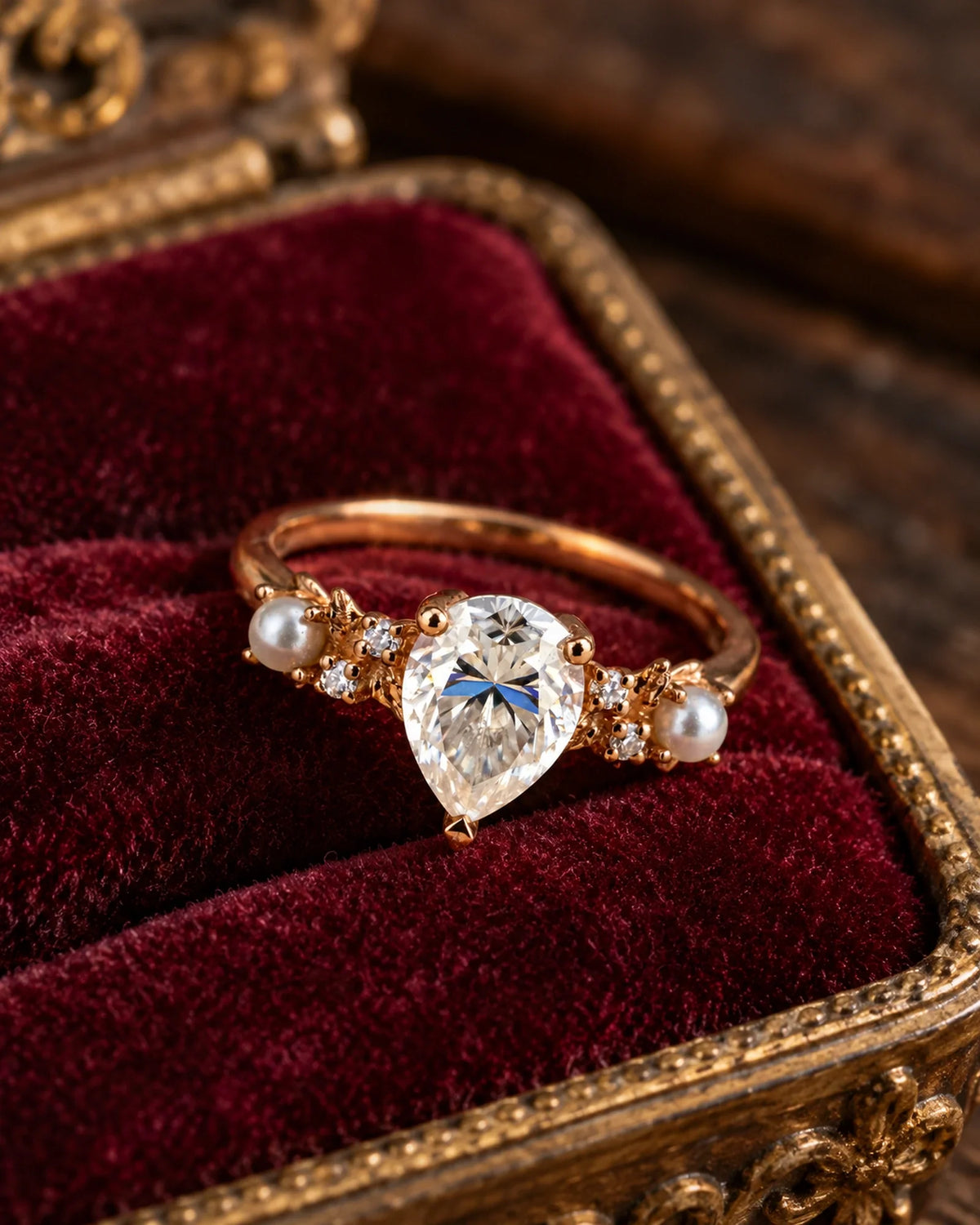
An oval lab-grown center with two listed natural-diamond floral accents. Compare the balance of gemstone sparkle, sculpted foliage and milgrain-style edges.
The center-diamond sizes and grades on the lab-diamond listings are reference or target specifications. Confirm the selected diamond and its report rather than treating a catalog estimate as the finished ring's guaranteed measurement.
Five questions before you choose
- What am I looking at? Ask the seller to identify the beaded border, pierced or open areas, raised motifs and incised lines separately.
- How is this particular detail made? Request a specific answer about casting, wire assembly, cutting and finishing. If a stage is described as handwork, ask which stage.
- What will it look like without magnification? Request normal-distance, side and underside views of the intended design.
- Where will the wedding band touch? Check the decoration and stones, not just whether the two outlines appear to match.
- What happens at the first service? Confirm suitable cleaning, inspection, resizing limits and the approach to preserving fine detail during refinishing.
You do not have to choose the most complicated ring, or reject a beautiful one because its decoration uses modern methods. Choose the detail you genuinely enjoy, make sure the description is honest, and understand what looking after it involves. The ornament should still please you after the close-up photograph has done its job.