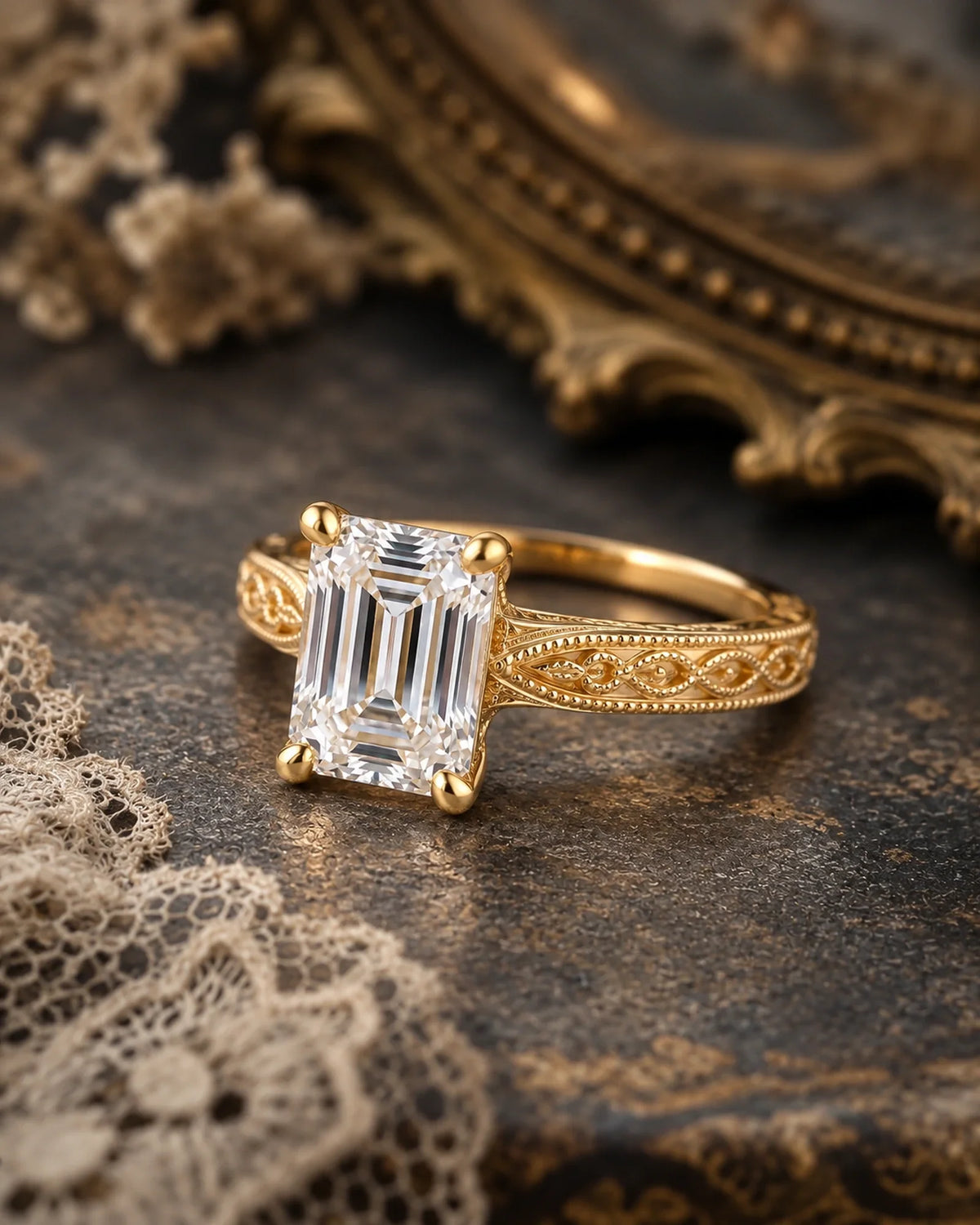

The cleaner is on the counter. Your ring has lost a little brightness. Before you put it in the basket, there is one question more useful than whether the center stone is hard: what else is going into that liquid with it?
An ultrasonic cleaner may suit some gemstone engagement rings, but not every ring containing a durable gemstone. Check every stone, its treatments, the metal finish, any adhesive or assembled material, and the condition of the settings. One incompatible component can rule out the method for the complete ring.
Ultrasonic cleaning uses sound waves in liquid to dislodge deposits. That action is useful in suitable jewelry, but it is not a security check, a repair or a universal cure for a cloudy stone. The solution and any heat matter alongside the vibration.
Before the machine: four things to establish
- The complete materials list. Identify the center, every accent, and the metal and finish. Check companion wedding bands separately. A small white accent might be moissanite, pearl, opal or another material.
- Relevant treatments and construction. Ask about fracture or cavity filling, dye, coatings, impregnation, layered gems and adhesive attachment. A gemstone name alone does not answer these questions.
- The ring's current condition. Consider recent knocks, new catching, a changed prong, visible damage or movement. Do not press, twist or shake stones to test them.
- Approval for this method. Ask whether the maker considers the complete ring compatible with the intended machine and solution. General instructions supplied with a cleaner are not an inspection of your jewelry.
Stop before cleaning if anything appears loose or damaged. Keep the ring in a separate soft-lined container and arrange examination. A short cycle is not a safe experiment on a suspect setting.
If a material or treatment is unknown, that is a reason to ask, not evidence that the ring is defective. It also is not permission to assume the most convenient answer.
A metal label is only part of the answer. White gold may have a rhodium finish, while a dark appearance may come from a separate surface treatment. Ask what is actually on the selected piece and whether the proposed solution is compatible with it. This does not mean every plated ring has the same restriction, or that unplated gold needs no assessment. The alloy, surface, stones and connections travel into the cleaner together; a statement about one of them should not stand in for instructions covering the rest.
A whole-ring ultrasonic cleaning decision table
Read the applicable rows together. Potentially suitable means all material, condition and device checks still need to pass. Hold means obtain information or assessment first. Avoid means do not put that combination in a home ultrasonic cleaner.
| Gem or ring feature | What changes the decision | Practical action |
|---|---|---|
| Diamond, natural or lab-grown | Filling, coatings, fractures, delicate companions or insecure settings | Potentially suitable. Confirm the actual stone and complete mounting, not just diamond identity. |
| Moissanite | Other gems, surface treatments, finish, setting condition and solution compatibility | Potentially suitable. Ordinary moissanite compatibility is not whole-ring approval. |
| Ruby or sapphire | Distinguish ordinary heat treatment from fracture/cavity filling, dye and other relevant treatments | Potentially suitable for suitable material. Avoid filled or dyed material; confirm treatment first. |
| Alexandrite | Verified identity, fracture filling or damage, and the accompanying stones | Potentially suitable when the material and ring qualify. Opal or pearl companions override that possibility. |
| Moss agate | Individual condition, any treatment, accents and construction | Hold. Do not infer permission simply because agate belongs to the quartz family. |
| Emerald | Fractures and commonly encountered clarity-enhancement treatments | Avoid as a home default. Ask a jeweler for stone-specific care rather than assuming untreated material. |
| Pearl, even a tiny accent | Pearl material itself, plus any treatment or attachment | Avoid. A diamond, ruby or moissanite center does not change this restriction. |
| Opal or moonstone | The gem's sensitivity; opal construction and treatment may add restrictions | Avoid. Choose a compatible alternative for the complete ring. |
| Other gems, such as aquamarine, morganite, garnet, tourmaline, amethyst or onyx | Material-specific guidance, treatments, inclusions and condition not resolved by another gemstone's row | Hold until the relevant checks are complete. This is not an automatic ban on all unlisted gems. |
| Unknown coating, finish, adhesive or layered material | Unconfirmed response to the liquid, heat or vibration | Hold. Request maker-specific instructions; do not assume all finishes behave alike. |
| Loose, damaged, recently impacted or uncertain settings | Security of the stone seats, prongs and small connections | Inspect first. This overrides any potentially suitable gemstone row. |
These are screening decisions, not a diagnosis from a photograph. GIA's ultrasonic cleaning precautions explain why sensitive materials, treatments and mounting security belong in the same assessment. Ordinary heat treatment is not interchangeable with fracture filling; avoid treating every treated gem as one category.
The small accents can settle the answer
A search for an ultrasonic cleaner for a moissanite ring can lead to advice about moissanite alone. That advice becomes incomplete as soon as pearls or opals join the design. The machine cannot clean only the center while leaving its neighbors unaffected.
Moonlit Bloom illustrates the distinction. Its current specification lists an approximately 6 by 8 mm pear lab alexandrite with approximately 3 by 1.5 mm marquise natural white opals. Even if the center qualifies for a method, the opal petals remain part of the ring.

Can a pearl-accent ring go in an ultrasonic cleaner? No: do not overlook a pearl because it is small or sits on a companion band. The Enchante example below combines a lab ruby center with freshwater pearls, moonstone and moissanite; its matching band also includes pearls.
The mixed-gemstone ring care guide explains the wearing implications. Here, the immediate decision is simpler: do not substitute the main stone's cleaning advice for the complete composition.
Moss agate needs an individual answer, not a hardness shortcut
If you are considering an ultrasonic cleaner for a moss agate ring, ask about the selected stone and finished setting. Its quartz-family identity does not reveal all treatments, the condition of surface-reaching features or the compatibility of neighboring materials.
Equally, the natural moss-like inclusions are not automatically cracks. Do not diagnose damage by comparing a green pattern with a fracture photograph online. A maker or jeweler needs to distinguish the stone's normal appearance from a condition relevant to cleaning.
Ask for a written care recommendation for that ring. If the information is incomplete, choose a confirmed gentle alternative or professional cleaning. This is a conservative decision under uncertainty, not a claim that every moss agate ring is damaged or that none can ever tolerate the method.
A secure-looking head is not an inspection
Cluster designs have multiple small seats to assess. A leaf ring may combine sculpted metal, pointed accents and fine connections. Neither style is automatically unsafe, but counting only the center prongs misses much of the piece.
A bezel does not automatically approve ultrasonic cleaning either. Its material and condition still need checking, as do any side settings. In leaf engagement rings, separate decorative leaves from the parts actually retaining the stones.

New rattling, a lifted prong, unexpected catching or a change after impact warrants examination before any cleaning method. Do not use a cycle to see whether the ring will survive. The prong maintenance and warning-sign guide covers those checks in more detail.
What to do instead of reaching for the machine
Start with the method approved for the complete ring. For some pieces, that may be a very soft clean cloth lightly dampened as instructed. For others, a maker may permit lukewarm water, mild soap and a soft brush. Even a gentle wash is not a universal instruction for every treated, coated or assembled material.

For a permitted wash, work over a bowl or catch tray rather than an open drain. Use light contact where a soft brush can reach comfortably. Do not scrub pearls, force bristles through narrow openings or pick deposits out with a needle. Follow the maker's rinsing and drying instructions.
If the back of a stone is inaccessible, leave the deposit for a jeweler to assess. Cleaning an ornate setting should not require bending its decoration or pushing a tool against a gem. Avoid toothpaste, abrasive pastes and improvised household chemical mixtures.
When appropriate cleaning leaves haze or a rainbow-looking patch, stop escalating. The cloudy moissanite troubleshooting guide separates residue, oil-slick appearance and faceting effects. This article decides whether a method is appropriate; that guide investigates why the appearance changed.
If the ring is cleared for ultrasonic cleaning
Obtain instructions that address the particular machine and solution as well as the jewelry. Do not copy a stranger's temperature, cycle length or cleaning mixture. A lower setting or shorter cycle does not cancel an incompatible material.
Follow the device and solution instructions and the maker's ring-specific restrictions. Avoid loading pieces so that they can strike or rub against one another. Do not continue running extra cycles because the first one disappointed you; persistent residue or a changed appearance needs reassessment.
After cleaning, look for unexpected changes without pressing or manipulating the stones. If something seems different, stop wearing the ring and contact a jeweler. Cleanliness and setting security are separate questions.
Three designs, three care conversations
These current examples span moissanite engagement rings, moss agate rings and mixed-stone cluster designs. They are not ultrasonic-approved recommendations. Vinelora and Verdessa were introduced in October 2026; Enchante is included for its relevant mixed materials, not presented as a new arrival.

Vinelora: moissanite and multiple settings
14K gold option: $990 USD
A 6.5 mm round moissanite and two triangle moissanite accents. Check the whole mounting and finish; a bezel center alone is not clearance.

Verdessa: ask about the selected agate
14K gold option: $990 USD
Listed 6 by 8 mm natural moss agate with baguette and round moissanites. The center's condition and treatment still need a ring-specific answer.

Enchante: the accents rule it out
14K gold option: $1,350 USD
Lab ruby with pearl, moonstone and moissanite details, plus a pearl-bearing companion band. Do not put this combination in a home ultrasonic cleaner.
Catalog specifications and listed 14K prices in USD checked October 25, 2026. Confirm the selected configuration and current quote. These are design examples, not physical inspections or cleaning trials.
Give the jeweler enough information to choose a method
Bring the material specification, any grading or treatment documents, repair history and the maker's care instructions. Mention recent impacts, catching or movement. If already cleaned, name the device, solution and method used, and explain what changed.
A professional may choose manual cleaning rather than a machine, or recommend repair before either. The useful result is a cleaner ring that remains suitable to wear, not proof that the strongest available method was used.
If you cannot confirm everything going into the basket, leave the ring out. You can always ask another question before cleaning; replacing a small pearl, damaged opal or lost accent is a much less convenient way to learn what was there.