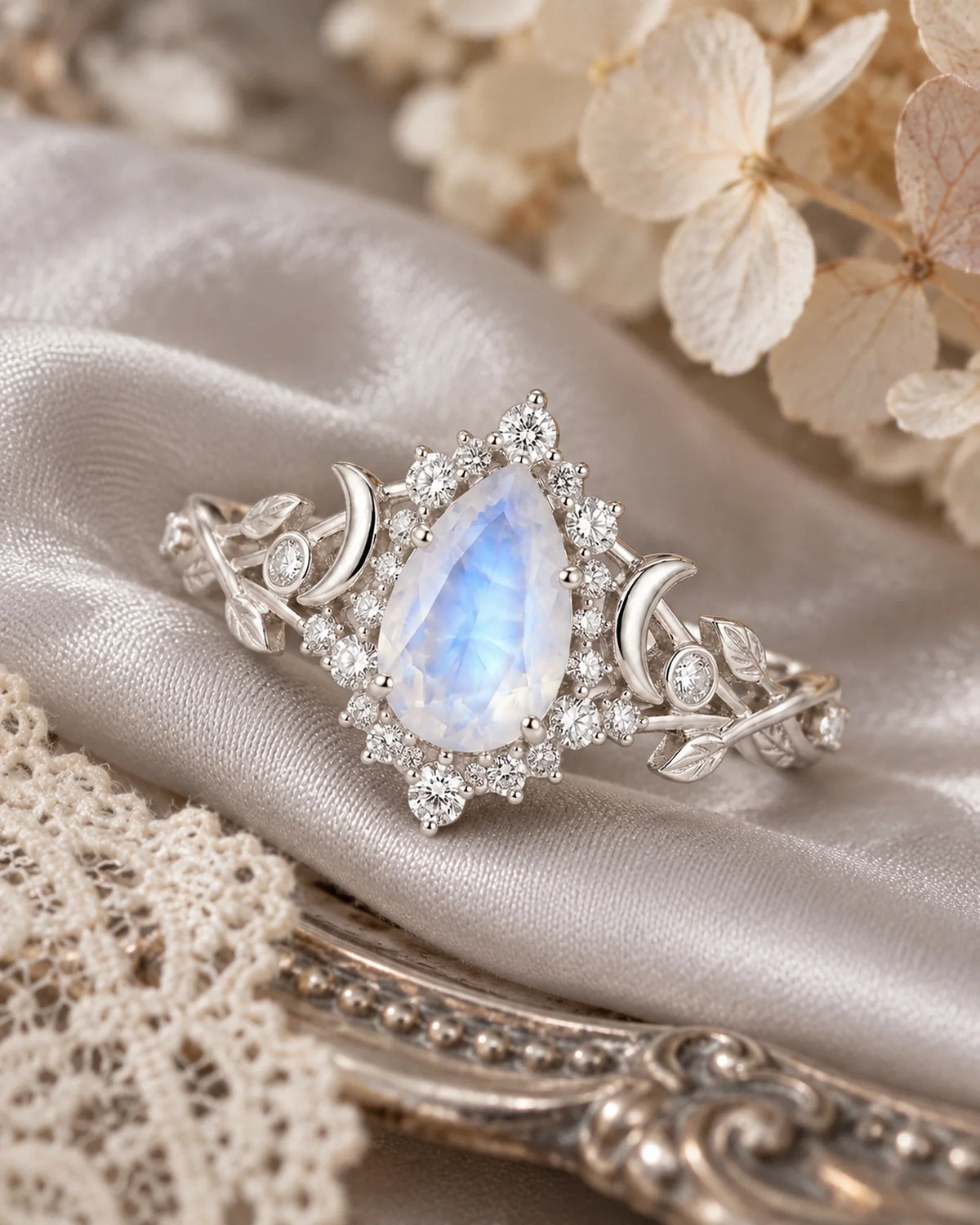

It is often the tiny pearl, not the large center stone, that makes a ring feel like yours. Or the pale opal petals around a color-changing gem. Those details are not a mistake to avoid. They are simply a part of the purchase that deserves the same attention as the center.
A mixed gemstone engagement ring needs a care routine compatible with every material, its setting and its condition. A scratch-resistant moissanite center does not protect neighboring pearls from abrasion. An alexandrite center does not make opal accents heat-resistant. Read the whole composition before deciding what everyday wear will mean.
First, name everything you are buying
Start with a written inventory: center stone, each type of accent, metal alloy, and any surface finish. For a bridal set, make a separate list for each ring. Small white stones can look similar in a photograph while requiring different treatment.
Ask whether each material is natural, laboratory-grown, cultured, simulated or assembled, as applicable. These terms answer different questions. A freshwater pearl description should not be read as proof that the pearl formed without cultivation. Equally, an opal's appearance cannot establish whether it is solid or a layered doublet or triplet.
Request treatment and attachment information where it affects care. A photograph cannot confirm whether a pearl has adhesive beneath it, how a concealed seat is built, or whether a gem has a filling or coating. Do not guess from a smooth surface or a few visible prongs.

The Blossom design illustrates this buying question well. Its listing specifies an approximately 6 by 8 mm oval moissanite and freshwater pearl accents, while the small round accents have moissanite or natural-diamond options. The order specification should resolve that choice, rather than leaving it as an ambiguous slash in a description.
Why the accent can change the daily-wear decision
Hardness describes resistance to scratching, not immunity to impact. Toughness concerns resistance to breaking; stability includes responses to heat, chemicals and other environmental conditions. The metal and the security of every small setting matter too. There is no meaningful single durability score for an entire mixed-material ring.
A moissanite ring with pearl accents
Moissanite supplies crisp reflections and rainbow flashes; pearls supply softer luster. That contrast is the appeal. But pearl nacre is easily abraded, and perfume, cosmetics and harsh chemicals can damage it. Tiny pearls are not exempt because they are decorative rather than central.
For a moissanite ring with pearl accents, consider your willingness to remove the ring for rough work and wipe it after wearing. Someone happy with that ritual may enjoy the combination enormously. Someone who needs to leave a ring on through cleaning, exercise and frequent glove changes should discuss a less delicate accent arrangement.
Compare within moissanite engagement rings by the complete materials list, not the center alone. Choosing all-moissanite accents can simplify material compatibility, but still leaves prongs, slender details and the metal to maintain.
An alexandrite and opal engagement ring
Alexandrite can offer a relatively durable center; opal brings a different kind of beauty through play-of-color. Opal's lower scratch resistance, variable toughness and sensitivity to strong heat or sudden temperature changes remain relevant in a small accent.
Moonlit Bloom is a specific example: its listed approximately 6 by 8 mm pear lab alexandrite is surrounded by approximately 3 by 1.5 mm marquise natural white opals. The opals create the petal effect. They also mean this is not a ring to treat as though every stone were alexandrite.
An alexandrite engagement ring with different accents may call for a different routine. Confirm the material identity from the order documentation; a color-change video alone is not verification. For the opals, ask about treatment and construction before choosing a cleaning method.
Look where the small stones sit
After identifying materials, inspect the outline from above and the height from the side. A pearl projecting beyond the shoulders or an opal petal at the outer edge can meet a desk, door frame or neighboring ring before the center does. Actual exposure depends on the individual design, fit and movement, not just whether its description says low-profile.
In floral engagement rings, trace the outermost petals. Are pointed tips covered by suitable metal? Does a supporting rail stand near the stone edge? Are the softer accents recessed, or do they rise beyond surrounding metal? Ask for close-up side views when the main photograph cannot answer.

Prongs and bezels can reduce some exposure when correctly designed, but no setting makes a pearl abrasion-proof or opal immune to a knock. More metal is not automatically better if it hides damage, leaves unsuitable pressure on a stone, or prevents maintenance access.
For mixed-stone cluster rings, count the separate seats rather than assuming the stones form one protected unit. Ask how a jeweler would inspect, clean or replace an individual accent. A beautiful dense arrangement can be practical, but service access deserves discussion before purchase.
The wedding band belongs in the same assessment
Sylvara makes this especially clear. Its current trio-set listing places an approximately 6 by 8 mm lab alexandrite in the engagement ring, moissanite in one companion band, and moissanite plus pearls in the other. The pearl-bearing component is a separate ring, not a feature that can be attributed indiscriminately to all three.
If the design and fit permit, wearing fewer components on a busy day may be useful. It does not establish that the remaining ring is suitable for every activity. When stacking, ask whether a pearl can rub against a metal edge or whether an adjacent stone can touch it as the rings rotate.

A coordinating contour is an aesthetic match, not evidence of abrasion-free contact. A spacer may help in some combinations, but its own edges and position must also be checked. The bridal-stack fit guide explains the difference between a comfortable intentional gap and forcing rings together.
Think through an ordinary Tuesday rather than only the wedding photograph. At a desk, the relevant issue may be a low pearl rubbing beside another ring. In a job with repeated glove changes or frequent handwashing, removals and secure storage may be inconvenient. If a workplace prohibits jewelry, that rule comes first. None of these situations requires abandoning the design; they help you decide whether to wear it selectively or choose a simpler everyday companion.
Mixed gemstone ring care: clean the composition, not just the sparkle
The aim is not to find the strongest cleaner that makes the center shine. It is to choose the mildest effective method suitable for everything present. With pearl or opal components, do not default to ultrasonic or steam cleaning. GIA's ultrasonic-cleaner precautions also highlight the importance of treatments and setting security.
| Composition or condition | Practical starting point | Do not assume |
|---|---|---|
| Moissanite plus pearl | Wipe gently with a very soft clean cloth after wear; request ring-specific washing instructions | A moissanite cleaning routine is suitable for the pearls or their attachment |
| Alexandrite plus opal | Confirm opal construction and treatment; use only an approved gentle method | A durable center permits steam, ultrasonic cleaning or prolonged soaking |
| Pearls in a separate wedding band | Assess and care for each ring separately; check contact when stacked | The main ring's care instructions cover the whole set |
| Unknown treatment, coating or attachment | Ask the maker before wet cleaning or using jewelry solutions | White appearance or solid-gold base establishes cleaning compatibility |
| Movement, new snagging or visible damage | Stop wearing and arrange inspection | A deeper clean will solve a structural problem |
Routine wiping is different from washing. When the maker approves wet cleaning for the complete ring, follow their instructions for mild soap, water temperature, contact time and drying. Do not turn advice for a loose gem into permission to soak an assembled ring. Never scrub pearl surfaces, push a brush beneath a pearl, or pick deposits out with a needle.
If the underside of a faceted center collects lotion, do not force a tool through a narrow gallery beside softer accents. A jeweler can assess access and choose an appropriate method. If haze persists, arrange inspection rather than escalating to abrasives or stronger chemicals.
Keep the ring off for household cleaning, lifting weights, gardening and other impact-heavy tasks. Apply cosmetics before putting it on. Store it separately so harder stones and metal edges cannot scrape pearls or opals. For pearl-specific considerations, see the pearl ring everyday-wear guide.
New rattling, a changed prong position, repeated catching, a chipped edge or a pearl that appears to move deserves professional attention. Do not twist or press stones to test them. Keep a suspect ring in a separate soft-lined container, and tell the jeweler about every material before any repair, heat or cleaning.
Three designs to compare with these questions in mind
These are current catalog examples, not independently measured rings or customer wear-test cases. Blossom is a Featured selection; Sylvara is the more recently introduced set among these three. Prices below are listed 14K options in USD, checked October 19, 2026; confirm the selected configuration and current quote.

Blossom: moissanite and pearls
14K gold option: $930 USD
Compare the pearl placement and confirm whether the small round accents in your order are moissanite or natural diamond.

Moonlit Bloom: alexandrite and opal
14K gold option: $810 USD
For the floral contrast, with an opal-specific care discussion. Request side views and confirm the accent construction and treatment.

Sylvara: assess all three rings
14K gold option: $2,320 USD
Ask about each band's materials and contact points. The pearl-bearing companion needs its own care assessment.
Before you approve the design
Send a short, specific request: "Please confirm every gemstone and accent option, relevant treatments, the pearl attachment or opal construction, and cleaning instructions for the complete ring. Show the side profile and how my wedding band will sit beside it. What would replacing one small accent involve?"
If lower maintenance matters more than a particular material, discuss replacing some delicate accents with suitable faceted stones. Preserve the floral rhythm through shape and placement rather than assuming the substitute will look identical or fit the same seats. Revised dimensions, setting details, price and proportions need approval.
Also ask what future service would involve. Is the accent a standard size, or would a replacement need to be sourced or cut to fit? Could matching an opal's body color and play-of-color, or a pearl's luster, take additional selection? Ask about likely costs and shipping arrangements without assuming accidental damage is covered. Save the final material specification and care instructions with your order: those details are more useful to a future repairer than a product nickname alone.
A few questions worth answering plainly
Can a mixed gemstone engagement ring be worn every day?
Sometimes, with deliberate removals and maintenance. Whether it suits you depends on all its materials, construction, condition and your activities. Daily wear should not mean uninterrupted wear, especially with pearl or opal accents.
Do tiny accents matter as much as the center?
They matter differently. A small exposed pearl or opal can set the cleaning limits, and its loss can change the design. Size alone does not establish protection or make replacement straightforward.
Should I avoid pearl and opal combinations?
No. If their softer light is what you love, choose knowingly: suitable placement, clear material disclosure, realistic wearing habits and an agreed maintenance route. The right ring is not necessarily the one needing the least care. It is the one whose beauty and requirements both fit your life.