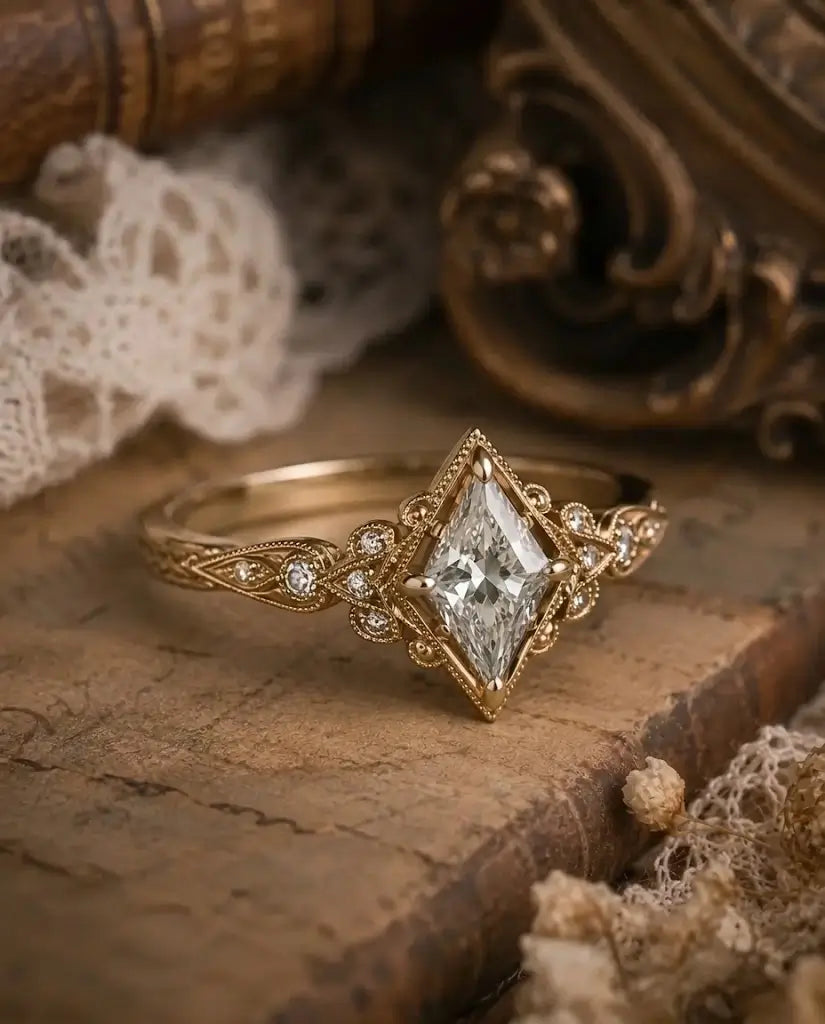

You can love the look of a tiny forest inside a gemstone and still wonder whether it belongs on your hand every day. That hesitation is not a reason to abandon a green engagement ring. It is a reason to choose the stone and setting together.
In the moss agate vs emerald decision, neither stone is simply the upgraded version of the other. Moss agate offers a landscape; emerald offers concentrated green color. Green sapphire offers another route: faceted color with generally stronger resistance to everyday abrasion. What you gain in one quality may not replace the feature you first fell in love with.
Choose moss agate for individual patterns, emerald for its particular green, and green sapphire when frequent wear is the priority. Then check the actual stone's condition, treatments and mounting. None is a wear-it-through-everything ring.
Three greens, three different reasons to fall in love
Moss agate: the interest is inside the stone
Moss agate is chalcedony with mineral inclusions that resemble moss, branches or drifting clouds. There is no living moss trapped inside. Clear areas, milky patches and the position of the inclusions create its landscape. One stone may look like a sparse woodland; another may show a dense, almost opaque green scene.
That variation is part of the appeal of moss agate engagement rings, but it also makes actual-stone selection important. Ask to see the available center, not only a sample ring. A dense pattern can hide the background; a clearer stone may let skin, metal and shadows influence its appearance once set. Cloudiness alone does not establish that a stone is fractured.
Emerald: a green gemstone, not an emerald-shaped gemstone
Emerald is a green variety of beryl. The name identifies a material; an emerald cut identifies a faceting style. An emerald-cut moss agate is still moss agate. An oval lab-grown emerald is still emerald, not a different material because it lacks rectangular steps.
Emerald's appeal is often a richer, more continuous green field than moss agate's clear-and-included landscape. Natural stones can have visible inclusions, traditionally called jardin, but that is not the same texture as moss agate. Lab-grown emerald can offer the material's green without natural origin; its individual appearance and condition still need checking. The emerald recommendations below are listed as lab-grown, not mined emeralds.
Green sapphire: color expressed through moving facets
Sapphire is corundum. Green examples may lean olive, yellow-green or cooler green; teal stones mix blue and green and should not be treated as an exact synonym. Some sapphires have distinct color zones. A dark stone may show less lively color indoors than in a bright listing photograph.
When comparing moss agate vs green sapphire, the important difference is not simply how green each looks. Sapphire's appeal is often its changing facet contrast as the hand moves. It will not reproduce moss agate's branching landscape. Request ordinary daylight and indoor footage before deciding whether its color gives you the forest feeling you want.

The durability question has three separate answers
A ring meets grit, door handles, lotion, heat and the neighboring wedding band. Those are different stresses. Hardness concerns scratching; toughness concerns breaking and chipping; stability concerns changes from heat, chemicals or treatments. A single number cannot describe all three.
| Material | Typical Mohs hardness | What deserves attention | Before buying |
|---|---|---|---|
| Moss agate | About 6.5-7 | Surface abrasion, exposed points and the condition of the individual stone | See the selected pattern; ask about fractures and any color or clarity treatment |
| Emerald | 7.5-8 | Fractures and possible clarity enhancement can limit handling and cleaning | Confirm natural or lab-grown origin, treatment disclosure and care instructions |
| Green sapphire | 9 | Usually a strong daily-wear option, but edges, fractures and unusual treatments still matter | Confirm corundum identity, origin type and treatments; review the actual green |
These are material reference ranges, not grades for a particular ring. Mohs values are not evenly spaced. Emerald is more resistant to scratching than moss agate, yet an emerald with significant fractures may require greater caution around impacts. Sapphire's advantage is broader daily-wear suitability, not immunity to damage.
The word "natural" does not answer the treatment question
Many natural emeralds have surface-reaching fractures filled with oil or resin to improve their appearance. That can change cleaning requirements. GIA's emerald care and cleaning guidance recommends gentle warm soapy water and warns about ultrasonic and steam cleaning. Ask for the treatment information that applies to the specific stone rather than assuming every emerald is treated identically.
Likewise, "lab-grown" describes how a gemstone formed, not a promise that it is fracture-free or untreated. The lab-grown emerald listings reviewed for this guide do not establish each center's enhancement history. Request that disclosure before purchase; do not infer it from a clean-looking photograph.
For sapphire, ordinary heat treatment is different from fracture filling or dyeing. GIA's sapphire care guidance distinguishes durable untreated and heat-treated material from treatments requiring extra care. Ask about your stone before choosing a cleaning method. The same principle applies to moss agate: a natural-material label is not, by itself, an untreated-color declaration.
Choose for the Tuesday you actually have
A woodland wedding is one day. Your ring also has to live through commuting, typing, carrying bags and getting dressed. The following situations are buying examples, not customer testimonials or promises about an individual design.
| Your priority | Reasonable starting point | The trade-off to accept |
|---|---|---|
| Frequent office wear; little tolerance for complicated care | Green sapphire with disclosed treatments and a secure, comfortable setting | Faceted green color replaces the moss-like landscape |
| The individual woodland pattern matters most | Moss agate, selected from actual-stone images | Accept removal for rough tasks and greater attention to abrasion |
| Rich emerald green is non-negotiable | Emerald with documented identity, condition and care requirements | Plan for careful handling, even with a protective mounting |
| Frequent glove use or sleeves that catch jewelry | First compare low, smooth profiles in any material | Stone hardness does not determine snagging or glove fit |
| Manual work, weightlifting or gardening | Remove the gemstone ring; consider a separate task-appropriate band | No green gemstone makes a delicate setting safe under pressure |
| Occasional wear and a strong emotional preference | Choose the appearance you genuinely love | Build gentle storage and handling into the routine |
Imagine someone who loves moss agate but forgets to remove jewelry before carrying heavy equipment. A bezel may shelter an edge, but it will not solve that habit. A more durable stone, plus a reliable removal routine, is a better conversation than simply increasing the number of prongs.
Now imagine someone who enjoys choosing a distinctive pattern and already removes rings for exercise and cleaning. Moss agate may be a satisfying choice rather than a compromise. The question is whether the care routine is one you will actually follow, not one you reluctantly promise during checkout.
Keep the forest. Change where it lives.
If you are exploring durable alternatives to moss agate, separate the stone's appearance from the ring's design language. Leaf shoulders, engraved vines, small floral accents and gently textured metal can carry the botanical mood even when the center is a different material.
That is the useful starting point in nature inspired engagement rings: identify which detail creates the feeling for you. Is it the mineral landscape, the green color, or the way the gold curves around the finger? If the landscape is essential, a plain green gem may disappoint. If the carved leaves are essential, changing the center may preserve most of what you love.

Protection should be visible, not assumed
A full bezel follows the stone's edge and can shelter vulnerable corners. For a pear or kite, ask specifically what covers the point. A decorative halo is not automatically a protective rim; the center may still project beyond it. A low setting can reduce leverage and some catching, but its actual height and surface finish matter more than the label.

For delicate leafwork, request a side view as well as a front view. Look for protruding tips, tall accent settings and places where another ring could rub. Ask the maker about smooth finishing, stone seating and access for future maintenance. A protective bezel does not turn moss agate or emerald into sapphire.
Metal color is an aesthetic choice, not a gemstone durability upgrade. Yellow gold can reinforce a woodland or antique mood; white metal can create cooler contrast; rose gold can soften the composition. Compare the actual stone beside the intended metal, especially if it has clear areas or a yellow-green tone.
What is available, and what needs a separate conversation?
Current emerald engagement rings include lab-grown centers in leafy and vintage designs. The sapphire ring collection should not be read as a guarantee that every design comes in green.
Availability reviewed October 6, 2026: the verified green sapphire option below is a lab-grown green sapphire open wedding band. A green sapphire center-stone engagement ring was not confirmed among the reviewed active listings and variants. Green-center designs discussed here are material-comparison or possible custom-design ideas, not confirmed catalog options. Ask about sourcing, identity, treatments, dimensions, price and feasibility before assuming a substitution is available.
A green sapphire band can introduce green into a stack, but it does not improve the durability of the engagement ring's center. The fit must also be checked: an open band is not universally compatible with every basket or leaf arrangement.
Six designs to compare with those questions in mind
These are different starting points, not six equally durable rings. Five are engagement-ring designs; the last is a wedding band. Several newer listings are included, with one older emerald design and the green sapphire band retained for their relevance. Prices shown are reviewed 14K gold options in USD; confirm the selected variant and any custom quote.

Elowyn Leaf Moss Agate
14K gold options · $840 USD
For an organic, asymmetric leaf composition. Confirm the actual pattern and the profile of the projecting leaf details.

Evelisse Filigree Moss Agate
14K gold options · $1,260 USD
For forest texture inside a vintage setting. Ask about access for gentle cleaning around the openwork.

Sylmira Pear Moss Agate
14K gold options · $960 USD
For a tapered woodland silhouette. Request a close-up of the pointed end and check wedding-band clearance.

Emerielle Three-Stone Lab Emerald
14K gold options · $940 USD
For green color with a simpler classic frame. Confirm treatment disclosures and whether a separate botanical band fits.

Verdelisse Lab Emerald
14K gold options · $1,210 USD
For green color in an architectural rather than leafy frame. Useful when color, not botanical metalwork, is the priority.

Verdant Cascade Sapphire Band
14K gold options · $520 USD
A verified green sapphire wedding-band option, not a green-center engagement ring. Confirm stacking fit separately.
Before you approve the stone
- Identify the material. Get the gemstone name and natural or lab-grown status in writing. A color name is not mineral identification.
- Identify the actual stone. Request its dimensions, pattern or color, and ordinary daylight and indoor videos. Confirm whether the sample is the stone you will receive.
- Ask about treatments. Obtain known enhancement disclosures and stone-specific cleaning instructions. Discuss an independent report when appropriate; do not assume one is included.
- Review the mounting. Ask for side and point details, overall height, wedding-band fit and the treatment of exposed leaf tips.
- Plan the routine. Remove the ring for impact-prone work. Store it separately from harder gems, and confirm inspection, repair and replacement arrangements.
For routine care, use the maker's instructions for the most delicate component. Avoid experimenting with steam, ultrasonic cleaners or household chemicals when treatment information is missing. If a stone moves, rattles or the setting starts catching unexpectedly, stop wearing the ring and arrange an inspection rather than adjusting the metal yourself.
The right green ring is not necessarily the hardest one. It is the one whose appearance you still love after you understand its care, and whose care fits a life you can realistically maintain.