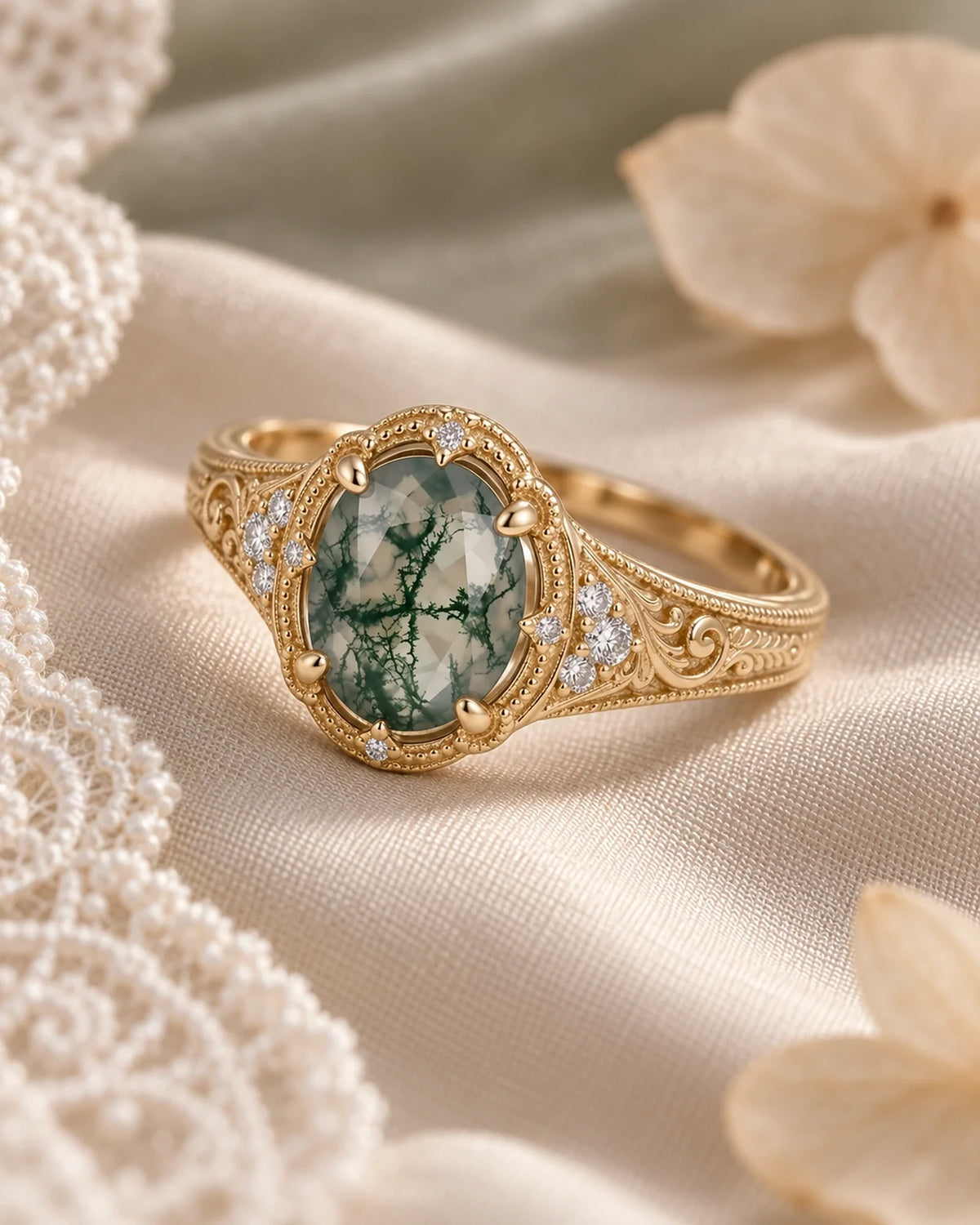

You have found a moss agate pattern you love. Then, while enlarging the photograph, you notice a fine pale line beside a green branch. Is it part of the landscape, a reflection, or something you should ask about before the stone goes into your ring?
You cannot reliably settle moss agate inclusions vs cracks from a beauty photograph. Green branching is characteristic of the material, but a stone can contain both attractive mineral inclusions and fractures. Ask what the specific feature is, whether it reaches the surface, where it sits relative to the setting, and who has examined it.
The goal is not a perfectly empty stone. Much of the appeal of moss agate engagement rings comes from their internal patterns. The goal is to understand the particular stone well enough to approve it without turning uncertainty into an expensive surprise.
Natural does not mean every feature is harmless
Natural moss agate inclusions are mineral features within a fine-grained quartz material. They can form branching, cloudy or concentrated green areas. Those patterns are not living moss, and their presence alone is not evidence of damage.
A fracture is a break in the gemstone material. It may be internal or extend to a surface; it may have formed naturally rather than through recent mishandling. A scratch is a surface abrasion, while a chip is missing material. These are different observations, even when a seller calls all of them character.
There is an important vocabulary trap: inclusion and fracture are not always mutually exclusive terms. In gemological descriptions, fractures can be discussed among clarity characteristics. Being told a line is a natural inclusion does not, by itself, answer whether it is a break or whether it matters for the proposed ring.
GIA technical article on inclusions in gemstones explains why specialists examine internal features with magnification and different lighting arrangements. It also discusses healed fractures and fluid inclusions. A healed feature is not automatically the same as an open crack; identifying the actual feature requires examination.

Color and shape are not dependable shortcuts. A white line is not automatically a crack, a green line is not automatically harmless, and a feature that disappears when the stone tilts has not thereby been cleared. Reflections and focus can conceal as well as reveal detail.
Start with the surface, the edge and the intended stone seat
If you are wondering how to inspect a moss agate stone before buying, start by gathering observations rather than making a diagnosis. Keep the stone in the seller's care if it is still loose. Ask them to identify the area in a clear overview, then provide a closer view of that same location.
The surface: ask whether the line lies inside the material, interrupts the polished surface, or could be a reflection or mark on top. Skimming light across a polished facet may reveal an interruption that a straight-on photograph misses. It does not reliably establish the full depth or extent of the feature.
The girdle: this is the perimeter between the upper and lower portions of a faceted stone. Request views around the whole edge, not only the most attractive side. A visible notch, chip or line at this perimeter deserves a specific explanation before setting.
Points and corners: ask about the tip of a pear, the corners of an angular cut and any narrow area that will sit near metal contact. The question is not merely whether a feature is visible; it is whether its location affects handling, the stone seat or protection during wear.
The proposed mounting: ask the setter to consider the feature in relation to the actual design. Turning the stone so a line sits beneath a prong might hide it visually, but hiding is not an assessment of suitability. A bezel or halo cannot repair a fracture.

Verdessa's current specification lists an approximately 6 by 8 mm cushion moss agate with baguette and round moissanite accents. That describes the design, not the condition of your selected center. A finished ring photograph cannot reveal every area concealed by its mounting.
Do not drag a fingernail, needle or sharp tool across a suspected line. Do not squeeze, tap, flex, heat or soak the stone to see what happens. Such experiments can cause damage and still leave the original question unanswered.
Ask for a photo packet, not another glamorous close-up
A useful packet connects each detail to the same identified stone. Ask for the stone reference, dimensions and orientation to remain consistent. If a replacement is shown, it needs its own reference rather than being slipped into the same conversation as though nothing changed.
| Request | What it helps you locate | What it cannot establish alone |
|---|---|---|
| Whole stone, face-up, in diffuse light | The questioned feature within the complete pattern and outline | Whether a faint feature reaches a surface |
| Close-up under reflected side light | Surface reflections, apparent interruptions and the location of a line | Its full depth, identity or effect on durability |
| Edge views around the perimeter | Girdle, corners, tips and areas that may meet the mounting | Features hidden by a holder or an existing setting |
| Underside and slow-tilt video | Additional views of the lower stone and changing reflections | Every internal feature, treatment or hidden break |
| Normal-distance worn view | Scale and appearance in the finished design | A structural examination or the condition of a different loose stone |
Request sharp original files without beauty filters or aggressive smoothing. The whole-stone picture and close-up should both be included; a very enlarged crop with no location reference is surprisingly difficult to discuss. A short video is useful alongside still photographs, not instead of them.
Backlighting can reveal internal detail, but it is not proof that a stone is free of fractures. Nor does a bright ring light settle a line that appears only from another direction. Ask which area was examined and under what viewing conditions.
The actual-stone selection guide covers sample photographs versus the stone reserved for your order. Here, take that distinction one step further: make sure the seller's condition answers refer to the exact stone you will receive.
When a professional examination is the sensible next step
Pause approval when the seller cannot explain a feature near an edge, tip or planned contact point; when a line appears to interrupt the surface; or when photographs disagree and the uncertainty remains material to your decision. You do not need to prove a crack before requesting an examination.
For an existing moss agate ring, a suspected hairline fracture noticed after a knock is a different situation from a stable-looking line in a listing. Stop wearing it, keep it separately in a protective container and arrange assessment before cleaning or further use. A new appearance does not prove when the feature formed.

A qualified gemologist can help characterize a feature and investigate identity or treatment where needed. An experienced setter should assess suitability for the proposed mounting. These tasks can overlap, but a material-identification document is not automatically a guarantee of setting safety or future wear.
Ask for a written description of the feature, whether it appears surface-reaching, the areas that could and could not be examined, and the recommended next action. If testing or a laboratory report is proposed, clarify its scope, cost and whether it answers your actual concern before authorizing it.
Ask about known treatments, too, including dye, coating, impregnation or fracture filling where relevant. Do not assume these are present in every moss agate, or absent because the pattern looks natural. If something is filled, ask what was used and what care or setting limitations follow. Attractive photographs are not treatment disclosure.
What choosing another stone can change
A different stone can mean a different quote. Matching the preferred pattern, outline and millimeter dimensions may require additional selection or sourcing. Recutting, a revised stone seat, altered prongs or work on an already finished ring can add separate costs. Availability and timing also need reconfirmation.
Two stones with the same carat weight need not share the same length, width, depth or profile. Ask whether the replacement fits the agreed design before approving it. A lower price is not a reason to accept an unexplained structural concern, and a higher price is not proof that no concern exists.
For custom ring design options, settle who approves the stone, when making begins, what happens if the setter recommends against it, and whether changing stones affects the order's return or cancellation terms. These are questions to confirm, not promises that every order includes free replacements or unlimited selection.
Do not assign an informal grade or negotiate a damage discount from a photograph alone. Ask for an itemized revised quote and an explanation of the difference. Pattern preference, assessed condition and the cost of the complete ring are related decisions, but they are not interchangeable measurements.
Three shapes, three useful questions
These current designs provide concrete places to begin the conversation. They are not inspected recommendations or evidence that the pictured sample has a fracture. The selected stone, rather than the model name, needs the condition assessment.

Morvella: check angular edges
14K gold option: $1,060 USD
Listed approximately 6 by 8 mm coffin center. Ask for perimeter views and the setter's assessment of features near its corners.

Avelisse: look beyond the halo
14K gold option: $890 USD
Listed 6 by 8 mm oval center. Ask which parts of the girdle and lower stone can be examined before mounting.

Sylmira: discuss the pear tip
14K gold option: $960 USD
Listed 6 by 8 mm pear center. Request a tip close-up and confirm how its condition relates to the proposed retaining metal.
Catalog specifications and listed 14K prices in USD checked October 30, 2026. Morvella was introduced in October; the other examples are included for their relevant shapes, not presented as new arrivals. Confirm current configuration and quote.
The message to send before approving your stone
You should not have to become a gemologist to ask a precise question. The following is a message template, not a customer case or an examination result:
If the reply is only all natural stones have inclusions, ask again. That statement may be true in spirit, but it has not answered your question. You can love an unusual pattern and still require a clear explanation of the material holding it.
Approve a documented choice, not a reassuring adjective. Keep the stone reference, photographs, written condition explanation, agreed mounting and final quote together. Photos help you ask better questions; they do not replace identification or an in-person professional condition assessment.