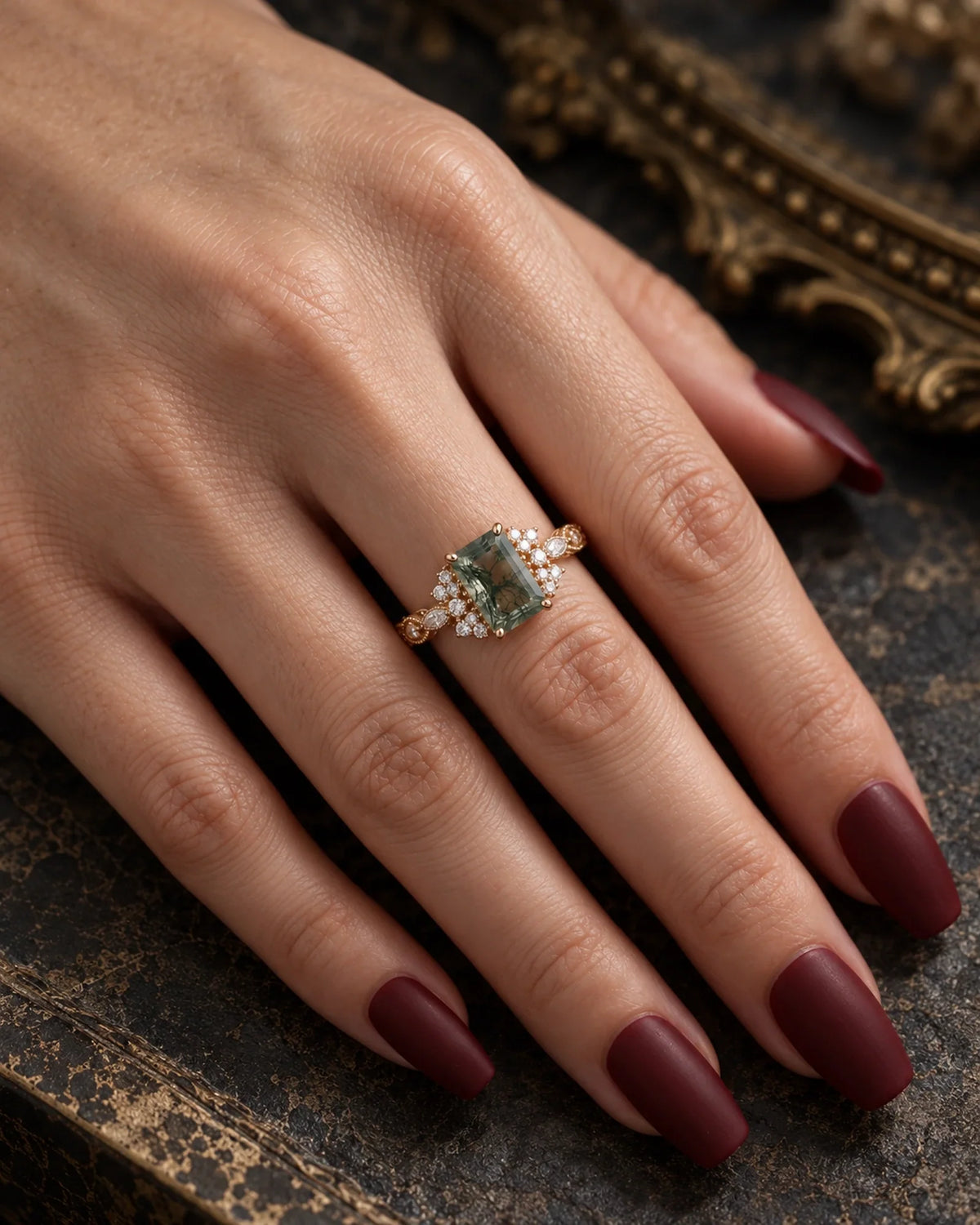

The color catches you first: green in one view, plum in another. Then you find a similar-looking ring at a very different price. One says natural, another says lab-created, and a third simply says alexandrite. Before comparing the sparkle, compare what those descriptions actually promise.
For a natural vs lab-grown alexandrite ring, verify the mineral identity and formation origin separately. Genuine lab-grown alexandrite is synthetic chrysoberyl, the laboratory counterpart of natural alexandrite. A different material made to resemble it is a simulant. Color-change photographs alone cannot establish which you are buying.
The useful question is not simply is it real? Ask for a precise material description, the documents supporting it, and a way to connect those documents to your selected stone. Natural and laboratory-grown can both be valid choices; an ambiguous description is not a third category you should have to accept.
Three names that should not blur together
Natural alexandrite is a color-change variety of chrysoberyl formed in nature. Natural describes formation, not whether the stone has been treated, whether it is attractive, or whether a claimed geographic origin has been established.
Lab-grown, laboratory-created or synthetic alexandrite describes the chrysoberyl counterpart grown through a manufacturing process. Synthetic does not mean glass. It also does not mean mined: the laboratory-grown qualification should remain clear in the product specification and order confirmation.
Simulated alexandrite describes an imitation of another material. Color-change synthetic sapphire, for example, is corundum rather than chrysoberyl. It may be attractive jewelry, but being laboratory-grown does not turn sapphire into lab-grown alexandrite.
So, is lab alexandrite real alexandrite? Yes, when it is genuinely laboratory-grown alexandrite rather than an imitation. That answer is conditional on correct identification, not on a title, a purple photograph or a salesperson's use of the word genuine.
If a listing uses alexandrite sapphire, created stone or alexandrite-like, ask for clarification before paying. Our lab alexandrite and color-change sapphire comparison explains the mineral distinction in more detail. Here, the focus is what evidence belongs with the purchase.
Enjoy the color change without asking it to prove identity
Alexandrite's color-change effect responds to the light source. Daylight-like and incandescent illumination can reveal different colors; the strength and attractiveness of the change vary between stones. Turning a stone under one light can also alter its appearance, so a tilt video and a change-of-light demonstration answer different questions.

Ask for the actual selected stone in ordinary diffuse daylight and an identified warm-light condition, with a neutral background and no color filters. A continuous video moving between those environments is useful, but camera exposure, white balance and your screen still affect the result.
Do not use a dramatic green-to-red image as a natural-origin test. Do not assume a very clean stone must be synthetic or an included stone must be natural. Inclusions can inform a trained examination, but a phone macro is not a substitute for that work.
Natural supply is constrained, particularly when a buyer wants strong color change, attractive colors, good clarity and a larger size together. Laboratory production can make a design brief easier to source, but it does not make every shape, size and color combination interchangeable or immediately available.
If your priority is an individual natural gem, allow the design to respond to its measurements. If your priority is a particular ring silhouette and budget, a correctly identified laboratory-grown center may offer more flexibility. In either case, choose the actual appearance rather than buying an idealized color-change promise.
Read the report as a description of one submitted item
An alexandrite certificate: what to check? Start with who issued it and what it says, not how official the border looks. A seller's specification, an appraisal and an independent gemological identification report serve different purposes. The word certificate does not make them equivalent.
GIA's public colored-stone report samples show how identification information and item details are organized. The page describes reporting natural or laboratory-grown status and detectable treatments. Its public example is a formatting reference, not an alexandrite report for the rings shown here.
Use the following field checklist with the actual issuer's format. Not every laboratory uses the same headings, includes the same services or makes the same observations on a mounted stone.
| Field or document detail | What you need to establish | What not to assume |
|---|---|---|
| Issuer, report number and date | The laboratory exists, the report can be verified through its official service, and all pages belong together | A logo or working QR code proves the document belongs to your stone |
| Identification or species and variety | The result identifies alexandrite/chrysoberyl rather than a different color-change material | A color description or trade name establishes mineral identity |
| Natural or laboratory-grown status | The formation origin is explicit and agrees with the sale description | The absence of the word synthetic automatically proves natural origin |
| Treatments and comments | Read the complete wording, qualifications and any relevant care implications | Natural means untreated, or a short treatment statement is an unlimited guarantee |
| Shape, dimensions and weight | The described item corresponds to the selected center, with loose or mounted reporting limitations understood | One approximate carat number uniquely identifies a gem |
| Color and any color-change description | Understand what the laboratory observed and under which stated conditions, if specified | A printed image reproduces exact appearance on your hand |
| Geographic origin, if requested and reported | An origin opinion is actually present and its scope is clear | Seller location, shipping country or a romantic regional name proves mining origin |
Read the comments and limitations even when the main identification looks straightforward. A geographic-origin opinion concerns a natural stone's source; it is a separate question from whether the material is natural or laboratory-grown. An identification report is not automatically a monetary appraisal, a quality score or a promise of future durability.
GIA evaluates alexandrite but does not issue it a quality grade. Do not treat a seller's AAA or similar designation as a GIA alexandrite grade. Ask the seller to explain its own terminology and the evidence behind it.
A valid report still needs to match your stone
Navigate to the issuing laboratory's official verification service independently rather than relying only on a link embedded in a screenshot. Compare the report number, identification, date and item details with the full document. A successful lookup authenticates a record; it does not, on its own, prove that the gem in your parcel is the one examined.

Ask how the seller connects the selected stone reference, report and finished ring. Shape, measurements, weight when available, distinguishing features and dated photographs are useful together. If the gem has been recut or replaced since examination, ask whether updated documentation is needed.
Mounted jewelry can restrict access and what a laboratory can measure or observe. Check whether a stated weight refers to the center, is an estimate, or describes the whole item. Do not compare a loose center's carat weight with a finished ring's weight in grams as if they were the same field.
If substantial money or a natural-origin claim depends on the answer, arrange an appropriate independent examination before your approval deadline. Ask the laboratory about service eligibility, scope, fees and handling rather than assuming every report type covers every material.
What the current ring description can, and cannot, tell you
Selviora, the pear design shown on the cover, is currently listed with an approximately 6 by 8 mm Lab-Grown Alexandrite center. The Edwardian Virelia below is listed with an approximately 6.5 by 6.5 mm Lab Alexandrite cushion center and round moissanite accents. These are the published material descriptions, not natural-stone offers.

A catalog label is a starting point, not independent proof. Before ordering from alexandrite engagement rings, ask for the precise material identity in writing, including whether the center is synthetic chrysoberyl. Confirm whether any independent report is included, optional or not offered for that order.
Do not infer an included report from the fact that an educational guide discusses laboratories. If no independent report is supplied, understand what documentation is available and whether arranging one is practical for your budget and timeline. A generic supplier card should not be presented as an examination of your individual stone.
Price logic: rarity is not the same thing as a better ring for you
When comparing lab alexandrite vs natural alexandrite value, separate the center from the complete piece. Natural pricing reflects a limited supply and the combination of color, strength of change, clarity, cutting and size, with documented origin sometimes relevant. There is no reliable fixed multiple that converts a laboratory-grown price into a natural one.
A laboratory-grown center still has production, cutting, selection and distribution costs. The ring adds metal, accents, setting work, finishing and any agreed testing. A lower center-stone cost may leave more budget for the design you love; it does not prove that two differently priced stones have the same identity or appearance.
Ask for like-for-like quotations with material, millimeter size, metal, accents and included documents specified. If replacing a proposed laboratory center with a natural stone, have the setter recheck its depth, outline and seat. Do not assume that the same carat weight means a direct swap.
Neither category carries a guaranteed resale price or appreciation promise. Buy natural for the natural origin you have verified and value personally; buy laboratory-grown for the correctly disclosed gem and finished ring you want to wear. A beautiful design does not need an investment story to be meaningful.
Three design references, with the material wording kept visible
These listings use laboratory-grown or lab-created alexandrite descriptions. The Art Deco Virelia and Vesperelle were introduced in October 2026; Lyra is included for its quieter five-stone layout. The examples are not independently identified specimens and do not establish natural alexandrite availability.

Virelia: Art Deco cushion
14K gold option from $1,080 USD
Listed Lab-Created Alexandrite, approximately 6.5 by 6.5 mm. Confirm the selected center and any report arrangements separately from the geometric moissanite frame.

Vesperelle: round geometric frame
14K gold option from $960 USD
Listed Lab-Created Alexandrite with customizable center dimensions. Agree the actual size and resulting quote before approving the stone.

Lyra: oval five-stone balance
14K gold option from $890 USD
Listed Lab-Grown Alexandrite, 6 by 8 mm. The description offers accent-material options; confirm the complete materials list for your quotation.
Published specifications and available 14K starting prices in USD checked November 4, 2026. Configuration, selected stone and any agreed testing can change the quote. No independent report is represented as included by these examples.
Before you approve: keep six answers together
- Identity: what mineral and variety are being sold, and is the center natural, laboratory-grown or a different-material simulant?
- The individual stone: which reference identifies it, what are its dimensions, and do the photographs and video show that selection rather than a sample?
- Documents: who issued them, what do they cover, and how will any report be linked to the stone and independently verified?
- Disclosure: what treatment information and care instructions apply, and does the invoice use the same material wording as the agreed specification?
- Finished design: are center size, accents, metal, finger size and mounting proportions confirmed together?
- Order terms: what is included in the quote, who pays for optional examination, and what happens if a result differs from the description before making or acceptance?
For custom gemstone ring options, settle these points before production authorization and confirm any applicable return or cancellation limits. Do not assume a made-to-order piece automatically has the same approval terms as a ready-to-ship ring.
The reassuring purchase is not the one with the most dramatic photograph or the most elaborate certificate graphic. It is the one where the description, the evidence, the selected stone and the written order all tell the same story.