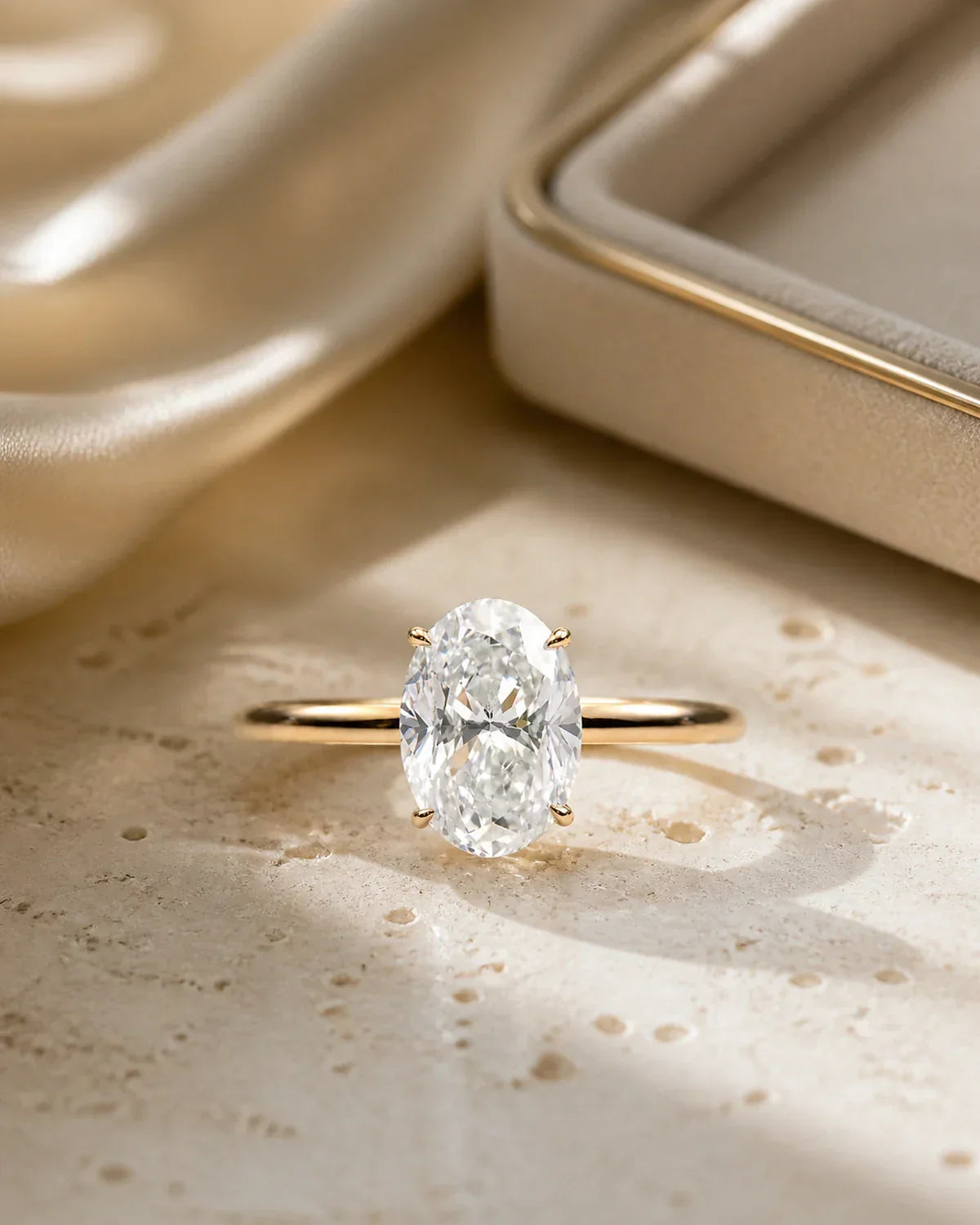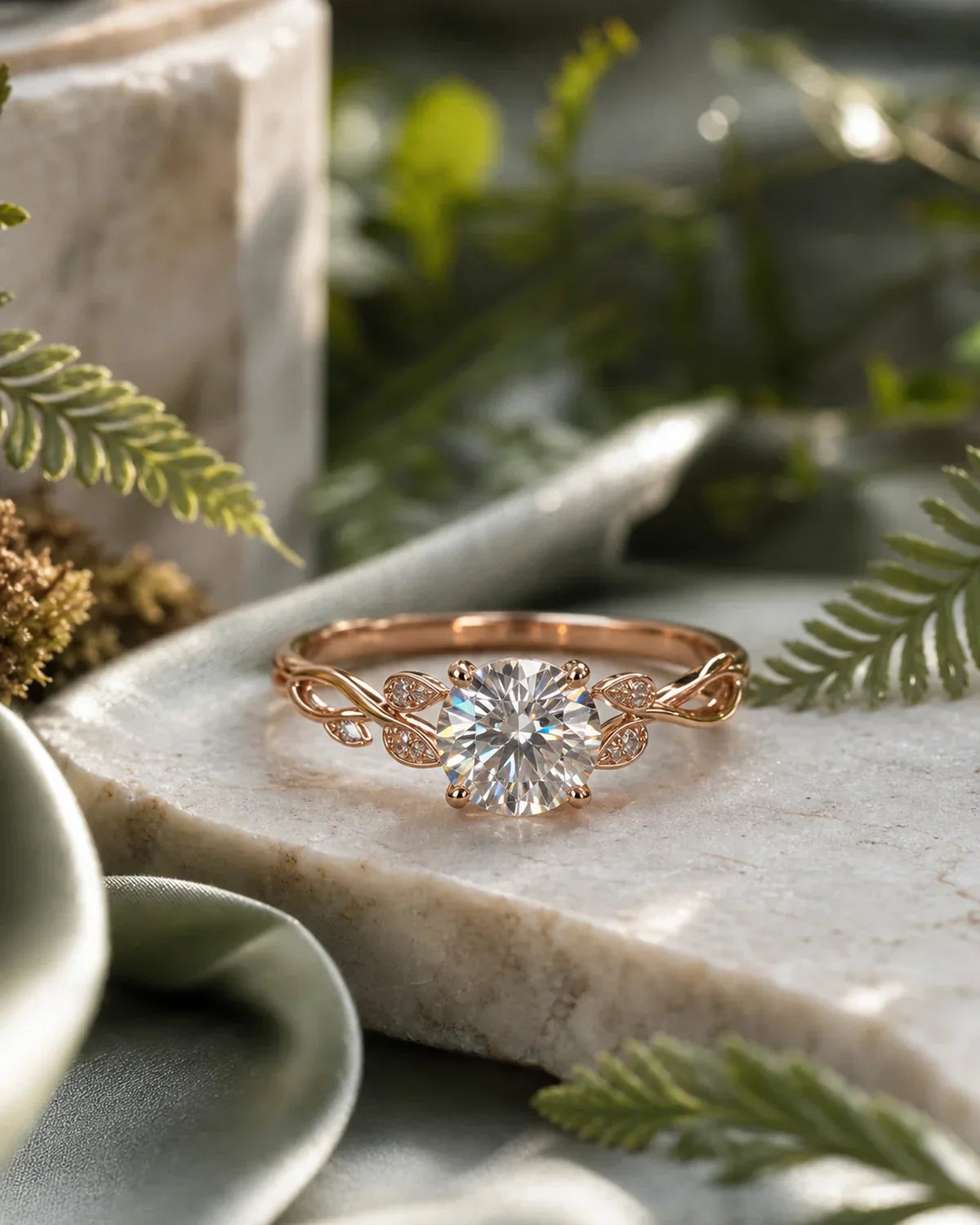

Une bague de fiançailles feuille dégage une émotion différente d’un solitaire classique. Elle reste nuptiale, mais le détail est plus doux, plus personnel, moins figé. Le motif feuille évoque la croissance, le renouveau, un nouveau départ, sans avoir besoin de le dire. Pour une mariée romantique et amoureuse de la nature, ce symbolisme peut sembler parfait : ni trop fort, ni trop mièvre, mais subtilement vivant.
C’est pourquoi les designs feuille se retrouvent dans les bagues de fiançailles inspirées par la nature, les parures de mariage à motif de vigne, les bagues en agate mousse, en moissanite et les créations avec pierres de couleur. Le style est flexible. Il peut être délicat et champêtre, terreux et forestier, ancien et poétique, ou sombrement romantique en or noir.
Que symbolise une bague feuille ?
Les motifs de feuille sont naturellement liés à la croissance. Une feuille naît petite, s’ouvre vers la lumière et change avec les saisons. Pour une bague de fiançailles, ce symbole est particulièrement approprié : deux personnes qui choisissent non seulement une promesse, mais un avenir qui continuera de se déployer.
Le renouveau fait aussi partie de l’attrait. Les feuilles reviennent après l’hiver ; elles marquent le passage d’une saison à l’autre. C’est pourquoi une bague de fiançailles feuille peut être significative pour les couples qui voient le mariage comme un nouveau chapitre plutôt qu’une destination figée. C’est aussi un symbole plus discret qu’un cœur ou une couronne. Il permet à la bague d’être romantique sans être littérale.
Les quatre détails feuille les plus importants
Toutes les bagues de fiançailles botaniques n’utilisent pas les feuilles de la même manière. Certains modèles placent de petites feuilles sur les épaules de l’anneau. D’autres adoptent une structure de bague vigne, où l’anneau se tord comme une tige. Les bagues plus sculpturales peuvent utiliser des montures branche, tandis que de nombreux modèles avec pierres de couleur utilisent des pierres d’accent taille marquise comme feuilles scintillantes.
 Les motifs feuille deviennent plus clairs lorsque la structure est séparée : les épaules feuille se trouvent sur les côtés, les anneaux vigne créent du mouvement, les montures branche changent le langage des griffes et les accents marquise évoquent des feuilles.
Épaule feuille : le détail botanique le plus facile à porter
Une épaule feuille est généralement la version la plus facile à porter au quotidien. Les feuilles sont proches de l’anneau, souvent de chaque côté de la pierre centrale, et créent un cadre doux sans surélever excessivement la bague. Cela fonctionne magnifiquement avec les centres ovale, poire, kite et rond car les feuilles aident à faire la transition entre la pierre et l’anneau.
Si vous voulez une bague de fiançailles feuille discrète, recherchez des bords lisses, des feuilles peu proéminentes et une disposition équilibrée. Les feuilles ne doivent pas sembler pointues, trop fines ou susceptibles de s’accrocher aux vêtements. Une bonne épaule feuille a suffisamment de détails pour être visible de près, mais pas trop de texture pour que la bague devienne chargée.
Anneaux vigne et parures de mariage vigne torsadée
Un anneau vigne est plus fluide qu’une simple épaule feuille. L’anneau peut s’enrouler autour de la pierre centrale, s’incurver en forme de bypass ou créer un effet tissé. C’est utile pour les mariées qui veulent quelque chose de gracieux mais pas trop décoratif. La bague peut sembler dessinée à la main, presque comme si le métal avait poussé autour de la pierre.
Les détails vigne deviennent particulièrement importants dans une parure de mariage. Une alliance droite peut ne pas s’ajuster parfaitement à côté d’une bague de fiançailles torsadée, c’est pourquoi la parure nécessite souvent une alliance courbée ou galbée. C’est pourquoi les recherches longue traîne telles que parure de mariage vigne, parure de mariage vigne torsadée et parures de mariage inspirées par la nature sont importantes : les acheteuses ne choisissent pas seulement une bague ; elles choisissent comment l’ensemble complet se portera au doigt.

Montures branche pour une ambiance forestière
Les montures branche sont moins polies et plus atmosphériques. Au lieu de feuilles symétriques, elles peuvent utiliser une texture de brindille, des courbes irrégulières, un travail du métal imitant l’écorce ou des pierres positionnées comme de la rosée sur une branche. Cette direction convient bien aux mariées qui aiment les mariages en forêt, les élopements sylvestres, l’agate mousse, l’onyx noir, la moissanite grise ou les pierres précieuses vert foncé.
Le risque avec les montures branche est le volume. Une bague peut rapidement devenir trop épaisse, trop sujette aux accrocs ou trop proche du déguisement si chaque élément est littéral. Les designs les plus réussis gardent l’idée de branche sobre : une épaule texturée, une griffe incurvée, une couronne de feuilles ou une alliance assortie qui évoque la forêt sans transformer la bague en sculpture miniature.
Pourquoi les pierres marquise font des feuilles parfaites
Les accents marquise sont l’une des façons les plus astucieuses de créer une bague de fiançailles botanique. Leur forme ovale pointue ressemble déjà à une feuille, donc un designer peut les utiliser comme pierres latérales, points de halo, détails de vigne ou pétales floraux. Elles ajoutent de l’éclat tout en gardant le langage feuille élégant.
Une disposition de feuilles marquise est également utile lorsque la pierre centrale n’est pas verte. Une moissanite incolore, une alexandrite, un saphir, un onyx noir ou une bague avec accent de perle peut tout de même sembler botanique car les accents marquise portent la forme de feuille. C’est une bonne option pour les mariées qui veulent une bague inspirée par la nature mais pas une pierre centrale vert forêt.
| Choix de design | Idéal pour | Attention à |
|---|---|---|
| Épaule feuille | Détail botanique discret au quotidien | Bords trop saillants ou coupants |
| Anneau vigne | Mouvement, asymétrie, fluidité romantique | Alliances qui ne s’ajustent pas bien à côté |
| Monture branche | Style mariage forêt et romantisme terreux | Texture trop volumineuse ou griffes qui accrochent |
| Feuilles marquise | Formes de feuilles scintillantes autour de toute pierre centrale | Trop d’accents qui rivalisent avec le centre |
Pierres précieuses qui conviennent aux bagues de fiançailles feuille
L’agate mousse est le choix évident car ses inclusions ressemblent déjà à un paysage, des branches ou une douce croissance verte. Une bague feuille en agate mousse peut sembler profondément forestière sans avoir besoin de décoration lourde. La moissanite est plus brillante et plus nuptiale ; elle fonctionne quand vous voulez des détails feuille mais aussi un éclat net. L’alexandrite ajoute du mystère grâce à son changement de couleur, tandis que l’onyx noir crée une ambiance botanique gothique plus sombre.
Les pierres centrales poire, ovale, kite et marquise sont particulièrement fortes avec les designs feuille. Une pierre poire peut faire écho à un pétale ou une larme. Un ovale semble doux et classique. Une forme kite rend le détail botanique plus artistique. Un centre marquise peut devenir très dramatique, bien qu’il nécessite un équilibre soigné pour que la bague ne semble pas trop pointue.
Pour les acheteuses qui comparent les bagues de fiançailles taille marquise avec les styles feuille, la clé est la proportion. Les pierres marquise allongent la main, tandis que les accents feuille élargissent le cadre visuel. La combinaison peut être belle, mais elle ne doit pas surcharger le doigt.
La couleur du métal change le symbolisme
L’or jaune donne à une bague feuille une sensation chaleureuse, d’héritage et forestière. L’or rose adoucit le look et peut rendre les détails floraux ou de vigne plus romantiques. L’or blanc et le platine rendent le design plus propre et plus moderne, surtout lorsqu’ils sont associés à la moissanite ou aux diamants. L’or noir ou le rhodium donne aux détails feuille une sensation dramatique, de clair de lune, mais cela fonctionne mieux lorsque le design est intentionnel plutôt que simplement sombre.
Si le style de la mariée est doux et romantique, les détails feuille en or rose sont souvent flatteurs. Si la cérémonie est en plein air, rustique ou d’inspiration forestière, l’or jaune peut sembler plus naturel. Si la bague doit rester raffinée pour un port quotidien, une fine épaule feuille en or blanc peut garder le motif discret.
Six bagues feuille et vigne à comparer
Ces véritables directions de produits montrent comment les motifs feuille peuvent passer de doux et romantiques à forestiers, vintage, sombres ou axés sur les pierres précieuses. L’objectif n’est pas de choisir la bague la plus détaillée, mais celle où le langage feuille semble le plus naturel.


Comment choisir une bague de fiançailles feuille qui vieillira bien
Commencez par la silhouette. Si vous aimez le symbolisme mais voulez que la bague reste facile à porter, choisissez une épaule feuille ou des accents feuille marquise qui restent proches de l’anneau. Si vous voulez une bague plus artistique, envisagez les montures branche, l’asymétrie ou une parure de mariage vigne incurvée.
Vérifiez ensuite les détails pratiques. Les feuilles sont-elles assez lisses pour un port quotidien ? La pierre centrale est-elle bien fixée ? La bague peut-elle s’associer à une alliance ? Le design est-il toujours beau de profil ? Les bagues feuille ont souvent plus de petites surfaces que les solitaires, donc la qualité de fabrication est importante.
Enfin, choisissez le registre émotionnel. Une bague de fiançailles feuille peut être romantique, forestière, vintage, gothique ou moderne. Le motif lui-même n’est que le point de départ. La pierre précieuse, la couleur du métal, la courbe de l’anneau et les pierres d’accent déterminent si la bague évoque un jardin, une forêt ou un nouveau départ discret.
FAQ
Les bagues de fiançailles feuille sont-elles une tendance ou intemporelles ?
Elles sont pertinentes car les bagues de fiançailles botaniques sont populaires, mais le motif feuille lui-même est assez ancien et symbolique pour sembler durable. Les versions les plus intemporelles utilisent des feuilles sobres et des proportions épurées.
Une bague de fiançailles vigne est-elle pratique pour un port quotidien ?
Cela peut l’être, tant que les courbes de la vigne sont lisses et que la monture n’est pas trop haute. Si la forme de la vigne est très sculpturale, vérifiez comment elle s’ajuste avec une alliance avant de la choisir.
Quelle pierre précieuse est la meilleure pour une bague de fiançailles feuille ?
L’agate mousse est idéale pour un style forestier, la moissanite est parfaite pour un éclat brillant, l’alexandrite semble inhabituelle et romantique, et l’onyx noir convient à un look botanique plus sombre. La meilleure pierre dépend de l’ambiance que vous souhaitez.
Que symbolise une bague feuille ?
Une bague feuille suggère généralement la croissance, le renouveau, la nature et un nouveau départ. Pour les bijoux de fiançailles, cela rend le design personnel sans utiliser de symboles romantiques évidents.
Un motif feuille fonctionne parce qu’il n’a pas besoin de crier. Il s’incurve autour de la pierre centrale, adoucit l’anneau et donne à la bague une sensation de vie. Pour les mariées qui veulent du romantisme avec la nature au centre, une bague de fiançailles feuille peut sembler moins une tendance qu’une petite promesse portable de croissance.