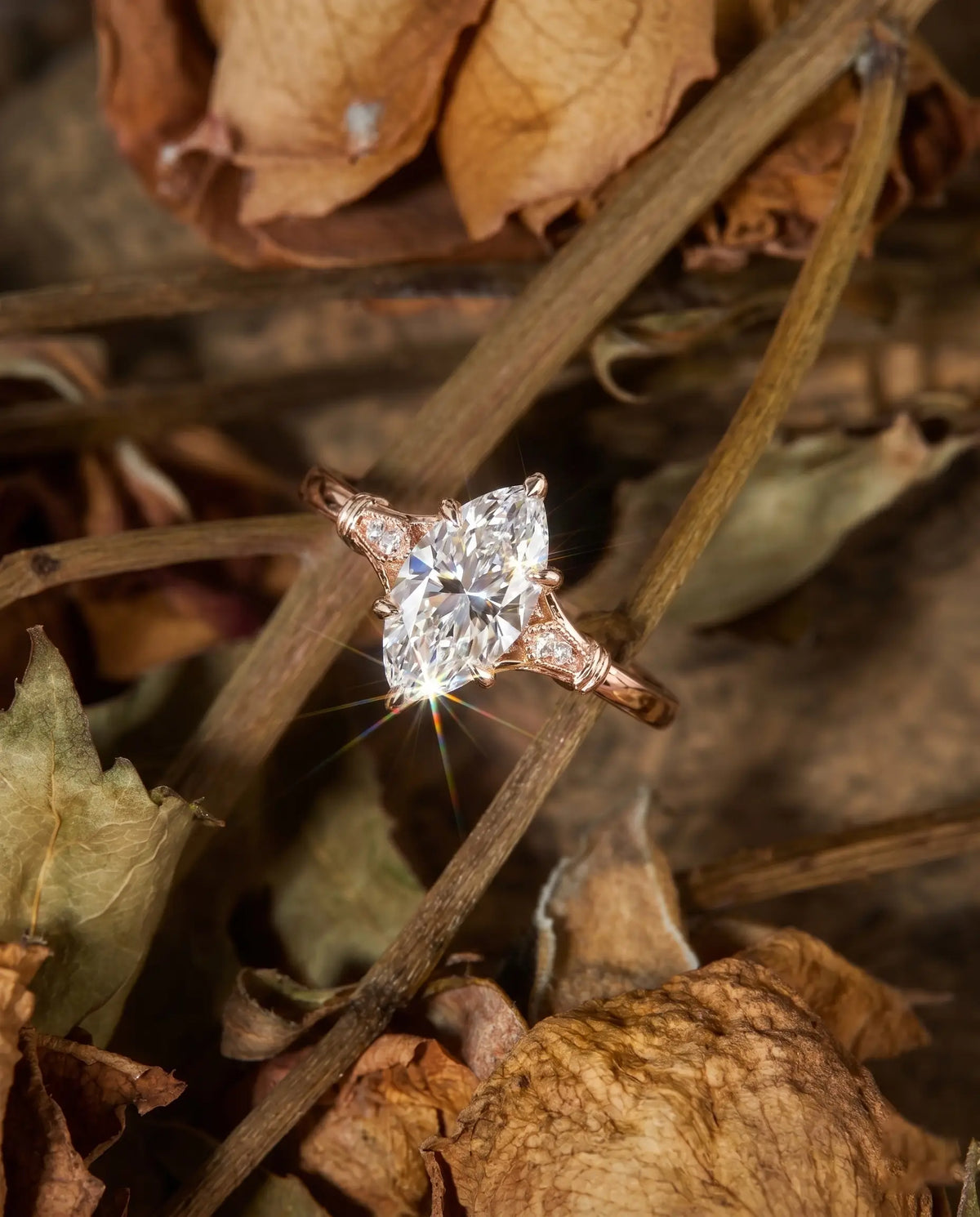

Choose moissanite if the flower-and-leaf setting, a larger-looking center or a matching wedding band matters more to you than having a diamond. Choose a lab-grown diamond if you want diamond itself, and consider a slightly smaller center before giving up the details that drew you to the ring.
Either can work in a botanical ring. The mistake is spending the whole budget on the center, then discovering that the petals you liked were in a different setting or that your wedding band won't sit beside it. Price the ring you plan to wear, including the band if you want one, before you decide how many millimeters the center needs.
How the stones look when there is already a lot going on
At normal distance, you'll probably see the oval first, then the outline of the gold around it. When you turn your hand, the order can reverse: little stones in the leaves flash, a petal catches the light, and the center is one part of a busier picture. That is the useful distinction in a moissanite vs lab diamond comparison for a nature-inspired ring. Which part do you want your eye to come back to?
A lab-grown diamond is diamond grown in a laboratory. Moissanite is a different gem, silicon carbide. It has higher dispersion, the property that separates white light into colors, so colored flashes can be more noticeable in comparable lighting. The GIA study of synthetic moissanite explains why the two materials do not behave identically. Diamond can show rainbow flashes too; neither its origin nor the stone name tells you how bright a particular oval will look.
Don't compare a moissanite video under tiny spotlights with a diamond still taken beside a window. Start with similar face-up dimensions in diffuse light, then view each under the same ordinary indoor light. Look at the center and shoulders together. Do the petals have clear edges, or do the small flashes make their shape harder to read? Is the oval bright across the middle when you move, or are the ends doing most of the flashing? These are design and cut questions, not judgments about which material is more elegant.
For a floral lab diamond vs moissanite ring, also ask whether you are comparing bare gold flowers to flowers with stones in their centers. Gold petals give shape and texture without adding separate points of sparkle. A ring with small stones in the flowers can look more animated, even with a center of nearly the same dimensions. Changing the accent layout can change that impression as much as changing the center material.
Make two changes on paper before changing the ring
Get two quotes for the same design, where the jeweler can build it for either material. Keep the alloy and color, ring size, finish, accent layout and wedding-band scope the same. Compare the center by length and width in millimeters and ask about depth and head height. Carat is a weight, and a moissanite listing's diamond-equivalent figure is not the stone's measured carat weight. Similar face-up dimensions also don't mean a stone can drop into the same seat.
| What you would miss most | Protect in the quote | Adjust first |
|---|---|---|
| Having a diamond | Lab-grown diamond center and the selected stone's report details | Compare a slightly smaller oval or reduce the number of accent stones. |
| The flowers and leaves you fell for | Visible goldwork, well-finished edges and comfortable shoulders | Try a comparable-size moissanite rather than stripping the design down. |
| A wedding band that sits the way you want | Both rings, with the gap and contact points shown | Set aside the band budget before choosing center dimensions. |
| A bright center that isn't overwhelmed | Face-up appearance in ordinary light and enough space around the oval | Test quieter shoulders or fewer accents before increasing center size. |
Then reverse the comparison. Keep the same proposed center and ask for the simpler shoulder and the detailed shoulder. This helps you tell what a ring-design change does to the quote, separately from a material change. Do not assume the seller can itemize its labor or will offer every combination; request the closest buildable alternatives and note which elements changed.
The setting side of the budget is not just a surcharge for decoration. More accent seats mean more stones to set. Sculpted flowers, open spaces between vines, and finishing around tiny edges can add work even on a ring with no accents. A larger or deeper center may also need a different basket, longer prongs or altered shoulders. Ask whether a revised center changes the ring height or wedding-band clearance before you compare totals.
Please quote the same botanical design in my ring size and metal, with one oval moissanite and one oval lab-grown diamond of comparable face-up size. Tell me what changes in the head, which accent stones are included, whether there is a report for the selected diamond, and the separate total for the matching band.
For daily wear, look where the ring meets your hand
Both center materials are hard enough to be practical for many everyday rings. Diamond is harder, but scratch resistance isn't the same as protection against chipping, and it says nothing about whether a prong will catch a sleeve. When choosing moissanite or lab diamond for an intricate setting, inspect the parts you will actually brush against: a raised leaf tip, the highest prong, and the outer edge of a petal. A beautiful top view does not tell you whether those surfaces stand proud of the band.


Existing product images show the construction and motif. The views are not a matched-light, matched-scale comparison or a test of comfort, snagging or durability.
Ask for a side view with the wedding band you actually intend to wear. A low head may leave too little space for a straight band to pass under it; a curved band can follow the shape, but its stones or edges still need clearance. A small intentional gap may be a better choice than forcing a flush fit where one ring rubs an exposed prong or a neighboring stone.
Think about upkeep before choosing how much detail to add. A metal-only flower still has recesses that collect residue. A ring with many accents adds more places where the jeweler may need to check stone security. A clean, smooth shoulder is a better use of the budget than extra decoration you find yourself taking off to wear a sweater. For any ring, remove it before activities likely to knock the setting, and have a new snag, moving stone or changed prong checked rather than testing it by pulling on the ring.
What three real designs buy you
These listings make a useful leaf engagement ring gemstone comparison because all three use oval centers of close listed dimensions, but allocate the surrounding design differently. On November 13, 2026, the displayed 14K prices before promotional codes put both moissanite examples below the diamond solitaire, including the two-piece Elaris set. That is a comparison of three finished designs on one date, not a market rule, a stone-only premium or an estimate of workshop cost. Open the product pages for current pricing and confirm the options included in your total.

Avelune Floral Solitaire
Lab-grown diamond; about 6.2 × 8.3 mm target, with sculpted gold flowers and no accents. Confirm final stone details against the selected diamond's report.
14K option; engagement ring only.

Floravelle Floral Ring
6 × 8 mm oval moissanite, six round moissanite accents, and openwork vines. The center need not get bigger to give the ring more sparkle across the shoulders.
14K option; engagement ring only.

Elaris Leaf Bridal Set
6 × 8 mm oval moissanite with six marquise and two round accents on the engagement ring. The shaped wedding band is part of the set.
14K option; two rings.

When you browse moissanite engagement rings and lab-grown diamond rings, save one design you like from each. Then look at the shoulders without zooming. Does the ring still feel like a plant-inspired design if you imagine a smaller oval? If you're drawn to the veins and branch lines, start with leaf engagement rings. If the petals are what you keep coming back to, compare floral engagement rings with and without stones in the flowers.
Two questions to settle before you order
Can I upgrade to a lab-grown diamond later?
Possibly, but don't buy on the assumption that the old head will accept it. Even with similar length and width, depth, outline and girdle fit may differ. An integrated flower or vine beside the head can make alterations more involved. Ask the setter whether a future center would require a new seat, head or band fit check, and what work would be covered in a new quote.
Will I regret a smaller center in a detailed ring?
Not necessarily. A smaller oval can leave room for the petals to read as petals. Ask to see it in the intended setting from above, from the side and at normal distance, with the band if you plan to stack one. If the shape of the ring is the part you love, pay for enough space to see it. If the center is what makes the ring yours, keep the stone you want and give it a setting that lets it stand out.