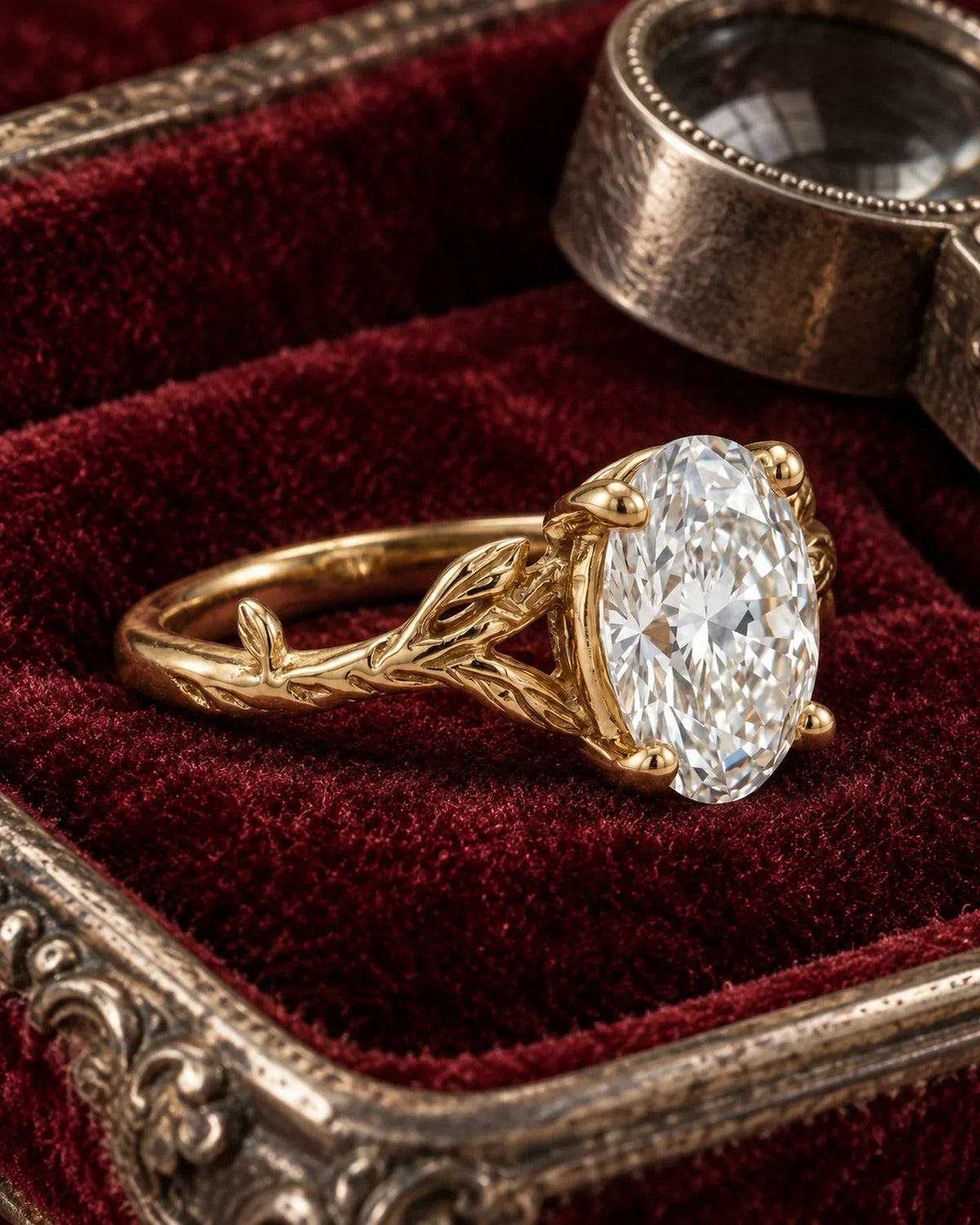

“Will my moss agate ring look like the photo?” is a fair question, not an unreasonable demand for nature to repeat itself. The photographed design may be the exact ring being sold, a sample of a made-to-order setting, or an example stone chosen for a product shoot. Those are three very different promises. Before you buy, find out which one applies.
A sample ring photo and your individual stone are not the same thing
The metalwork, center shape and overall scale can be repeatable even when the moss agate is not. Natural-looking branch, plume and cloud patterns lie within the stone rather than being printed on its surface. Cutting another piece from the same rough does not reproduce the exact scene. GIA's guide to gemstone inclusions explains why internal features are useful identifiers; in a patterned ring stone, their visible location is also a major aesthetic choice.
First identify the selling arrangement. An individually photographed ready-to-ship ring may include the very center shown, but only if the seller states that clearly. A made-to-order listing usually demonstrates the design and possible appearance rather than allocating a specific photographed gem. A custom commission can include stone selection, but the number of available choices, sourcing time and approval point need to be agreed rather than assumed. None of these models is inherently wrong. Confusing them is what creates regret.
Product pages may use several photos of one sample ring to explain proportions and details. Even then, the gallery is not automatically a record of what is reserved for your order. Ask the direct question: “Is the pictured center stone the exact stone I will receive, or a design example?” If the answer is “example,” ask when and how you can evaluate actual candidates. If an exact-photo match is essential and specific-stone approval is unavailable, pause before placing a made-to-order request.
Read moss agate ring patterns in four separate ways
The useful comparison is not simply “more green” versus “less green.” Pattern density, transparency, contrast and position can move independently. Two stones with similar green coverage may feel entirely different because one has a clear center and the other places a dark branch across the focal area.
| What to compare | What to look for | Common photo trap | What to ask for |
|---|---|---|---|
| Pattern density | How much of the face is occupied by green or dark inclusions | A strongly backlit clear stone looks almost empty | Face-up photo on a pale neutral surface |
| Transparency | Whether light passes through open areas or is diffused by cloudy material | A dark background makes transparent edges look deeper | Same stone on pale and skin-toned backing |
| Pattern placement | Branches near the center, edge, tip or under future prongs | A tilted photo hides a dense zone at one edge | Straight face-up view with intended top marked |
| Contrast | Difference between the body and green, gray or near-black features | Sharpening, saturation and exposure exaggerate separation | Unfiltered short video in neutral light |

Clear versus opaque is a continuum
“Clear vs opaque moss agate” is useful shorthand, but many candidates contain both clear windows and milky or heavily included zones. A transparent opening may let the metal below or the wearer's skin contribute to the apparent color. A dense stone can read as rich forest green under bright light yet become nearly black in dim indoor conditions. Neither result is a defect by itself; the question is whether it matches the look you want in ordinary wear.
Do not ask a seller to make a heavily included stone “more transparent” through photography. Instead, describe your preference in observable terms: “I want at least one clear area near the center, dark branches mainly along the lower edge, and no large opaque patch under the upper prong.” That instruction can guide selection; “just like the product photo” cannot define a unique natural stone. If you want the green inclusions to dominate, state that too. There is no universal best density.
Compare the same candidate in the same light
A convincing selection set compares individual candidate stones, not one dramatic campaign image against a dim phone snapshot. Ask for a stone identifier on each file. Have the supplier photograph candidates A, B and C with the same camera, distance, background, exposure and neutral diffuse light, ideally in one session. Then ask for a short tilt video of each. The goal is not laboratory color measurement; it is a fair comparison in which lighting does not quietly pick the winner.
- Start face-up on a matte pale background. This shows outline, branch placement and cloudy areas without a black surface intensifying green.
- Repeat on a neutral skin-toned backing. It approximates how clear windows may read on a hand. A flat card is useful, though it is not a substitute for an actual try-on.
- Add a side or three-quarter view. This shows depth, uneven saturation and how the intended setting may cover an edge.
- Record one normal-distance view. A macro image magnifies tiny features. See whether the pattern remains legible from the distance at which you usually look at a ring.
- Keep files unfiltered. Avoid colored LEDs, strong backlighting, beauty filters, aggressive contrast adjustments and moving exposure between candidates.
If video is possible, ask the seller to rotate the stone slowly through a small arc under the same fixed light. Facet reflections will move; the internal pattern will not rearrange itself. Note when a pale zone disappears behind a glare and when a dense area becomes visually dominant. A ring with a heavily enclosed basket can also change the way light passes through a clear area, so loose-stone approval and mounted-ring review serve different purposes.


These existing gallery views of the Virelia botanical vine design are useful for understanding viewing distance and background. They are not a controlled same-light comparison and do not certify that the pictured sample stone is reserved for another order. A genuine stone-selection comparison must be supplied for the specific candidates under consideration.
What changes once the stone is on your hand?
Against white paper, transparent portions often look light gray or almost colorless. Against skin, they can pick up warmth and appear creamier or more muted. Against a black display card, dark green inclusions can become more dramatic while the clear body seems deeper. Move the same stone among backgrounds before concluding that one photograph is inaccurate. The difference may come from light passing through the material and reflecting from what sits behind it.
Scale also matters. A loose stone fills a phone screen; an engagement ring occupies a few millimeters on a moving hand. A fine fern-like inclusion that looks spectacular in macro may blend into a gentle haze at conversational distance. A broad branch crossing the center may keep its identity from farther away. Choose for the distance at which you will enjoy the ring, not only for the most enlarged image.
The setting changes the picture a little more. Rounded prongs can cover small sections near the girdle. A broad bezel frames or hides part of the perimeter. Yellow gold may lend warmth to clear zones; white metal usually gives a cooler edge. Leaf shoulders and floral details may visually extend the “garden” beyond the gem, while a plain shank lets the internal scene carry the design. These are styling effects, not a way to guarantee a different stone will match a reference image.
For a moss agate leaf ring, ask whether an important branch will sit beneath a prong or leaf-shaped surround. For broader botanical moss agate rings, decide whether you want the metalwork to echo a dense pattern or balance it with more open space. The parent moss agate engagement ring collection is useful for browsing shapes and frames; it cannot tell you which individual stone has been allocated to a future order.
Three design contexts worth checking with an actual stone
These recent ring designs illustrate why the same inclusion preference can work differently in different mountings. Their listing photos show design examples; request confirmation of the individual stone if its exact pattern is central to your decision.

Open, detailed center
The Sylvaren leaf solitaire gives the oval center most of the visual attention. A clear central window or distinct branch position will be immediately noticeable, so approve those details face-up and at hand-viewing distance.

Contrast beside bright accents
The Elaris three-stone ring places bright accents beside a quieter moss agate center. A very pale stone may become visually secondary; a heavily dark one may dominate. Review the exact candidate in a mounted mockup or beside similar-size accents if available.
Virelia's botanical frame is the third context: vines and small flowers already create texture, so stone density affects whether the finished ring feels airy or richly layered. This is an aesthetic judgment, not a claim that one density makes the ring better made.
The actual-stone approval checklist
If you are wondering how to choose a moss agate stone without holding it, use a written record. It does not need to be formal, but it should identify what was shown and what was approved. Save the files and the seller's confirmation with the order rather than relying on memory or a disappearing message thread.
- Clarify the listing: exact photographed stone or representative sample? Is individual stone selection available for this order?
- Request candidate IDs: label every available stone or image set so two similar ovals cannot be confused.
- Compare fairly: ask for face-up, side and short video views of each candidate in the same neutral light, including pale and skin-toned backing.
- Describe the pattern: record acceptable density, clear-versus-cloudy balance, contrast and the location of any must-have branch or open window.
- Check size and direction: confirm dimensions, cut outline and which end faces the fingertip. Mark whether a significant feature will sit beneath a prong or frame.
- Ask about treatment and condition: request disclosure of any known dye, filling, surface-reaching fracture or other issue relevant to the candidate. Photographs alone cannot establish gem identity or treatment.
- Confirm timing and terms: identify the stone-approval point, any deposit or special-sourcing cost, the deadline for changes, and the applicable return or stone-change policy.
- Approve one identifier in writing: attach the chosen images and ID to the order conversation, then request a final mounted-ring photo before shipment if this service is available.
The store's FAQ on stone selection and changes says customers can contact the team to see available stones and that sourcing an unavailable option may require a deposit. It also distinguishes disliking the color of a received moss agate from a refundable mistake and describes a possible main-stone change. Read the current terms and agree on your particular approval process before payment; this guide does not replace the order-specific policy. For a more tailored design and sourcing conversation, use the custom ring design service.
One final distinction protects both buyer and maker: approving a design is not the same as approving an individual stone. A rendering can settle band width and prong layout without recording which green branches you chose. When the natural scene is the reason you are buying the ring, make the stone's identity part of the documented design decision.
Will my moss agate ring be different from the picture?
It may be if the listing uses a representative sample or the ring is made to order. Ask whether the pictured center is the exact reserved stone. If not, request images of the candidate that will be set and confirm its identifier before production.
Is a clearer moss agate always better?
No. Greater transparency can show delicate inclusions and allow background color to influence the look; denser material can produce a richer forest effect. Judge branch placement, contrast and appearance in ordinary light rather than treating clarity as a universal grade.
Can a seller guarantee the exact branches in a sample photo?
Only if that specific photographed stone is the one reserved for you and the arrangement is confirmed. Another natural stone may share a style but will not duplicate its internal pattern.
What photo should I request before approving a stone?
Ask for a labeled face-up image in neutral diffuse light, a side view, a normal-distance view and a brief tilt video. Compare every candidate under the same conditions and include a pale and skin-toned background.