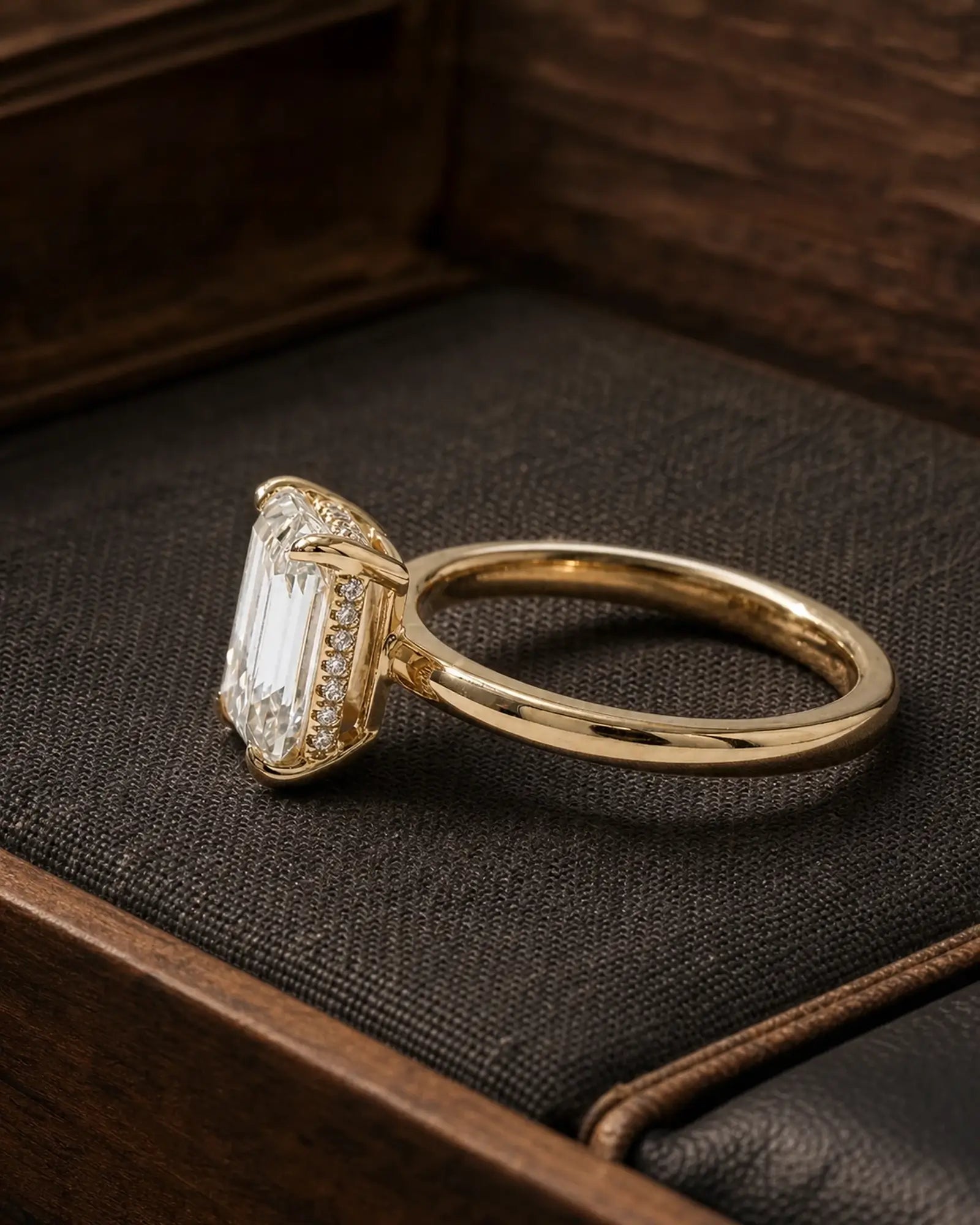

A bezel setting wraps a metal rim around all or part of a gemstone's perimeter. A prong setting holds the stone at selected points, usually with four or six metal tips. For a buyer choosing between them, the most useful distinction is not simply “secure versus sparkly.” A bezel usually gives the girdle and vulnerable edges more continuous protection and a smoother outline. Prongs reveal more of the stone, make its outline easier to see and often create a lighter, more traditional engagement-ring silhouette.
Neither setting is automatically better. A finely made six-prong ring may be a wiser daily-wear choice than a thin, poorly supported bezel. A low bezel can be wonderfully practical, while a raised bezel can still catch a pocket. An emerald can benefit from protected corners in either design, yet the pressure required to set it means workmanship matters enormously. The right answer depends on the gemstone, shape, setting height, metal, lifestyle and how the wedding band is expected to sit.
Bezel vs prong settings at a glance
| Decision | Bezel setting | Prong setting | The detail that decides it |
|---|---|---|---|
| Edge protection | Continuous or partial rim shields more of the girdle | Exposed areas remain visible and accessible | Rim thickness, prong placement, stone shape and craftsmanship |
| Snagging | Usually smoother, especially when low and well finished | Tips can catch if tall, worn or lifted | Overall height and finish matter more than the name alone |
| Sparkle | Can remain highly brilliant face-up | More side visibility and an airy presentation | Cut quality, cleanliness and lighting dominate light performance |
| Apparent size | A contrasting rim can enlarge the overall silhouette | Minimal metal keeps the true stone outline obvious | Metal color, rim width, stone color and halo design |
| Cleaning | Enclosed areas can retain lotion and soap | Open galleries are usually easier to reach | Cleaning ports and under-gallery access |
| Repair | Reshaping or replacing a rim can be specialized | Individual prongs can often be retipped | Metal loss, stone condition and access for tools |
| Wedding-band fit | Often low and broad, so a contour may be needed | Can be raised for a straight band, but not always | Bridge clearance and basket footprint |
| Style | Modern, sculptural, graphic or antique when milgrained | Classic, delicate, botanical or architectural | Proportions and surrounding details |
Why bezel engagement rings are receiving more attention
Bezel-set centers are not a new invention, but they fit several current preferences at once: smoother surfaces, lower visual profiles, stronger geometric outlines and settings that feel designed around daily life. A 2026 trend report from National Jeweler notes growing interest in bezel- and burnish-set center stones alongside heavier bands. That helps explain the visibility of the look, but a trend report cannot decide whether a bezel suits a particular gemstone or wearer.
The strongest bezel designs are not merely prong settings with extra metal. The rim is treated as part of the composition. It can sharpen a hexagon, echo the frame of an Art Deco cluster, trace the asymmetry of a salt-and-pepper diamond or create a clean border around moss agate. Warm gold can turn the perimeter into a deliberate color contrast. Fine milgrain can move the same construction toward a vintage mood. A partial bezel can leave the ends of an oval open while holding its sides, balancing structure with a less enclosed look.
Prongs remain enduring for equally good reasons. They can almost disappear from the face-up view, preserve scalloped or pointed outlines and allow a stone to feel suspended rather than framed. Double claws can add antique precision; rounded tips can feel soft and quiet; V-prongs can protect the point of a pear or marquise. The current popularity of bezel settings adds a valuable option. It does not make prongs outdated.
Four constructions buyers should not confuse

Full bezel
A full bezel forms a continuous collar around the stone. It provides the most uninterrupted perimeter coverage and the smoothest transition from metal to gem. The rim should be even, closely fitted and substantial enough to hold the stone without looking heavy. On a transparent faceted stone, the design must still allow cleaning and drainage beneath the pavilion. Full bezels are especially convincing on round, oval, cushion, emerald, hexagonal and kite shapes when the metal faithfully follows the outline.
Half bezel or semi-bezel
A half bezel secures selected sides with broad metal walls while leaving other sections open. An oval may be held at the north and south ends or along the east and west sides, depending on the desired view and stress path. This construction can expose more outline than a full bezel, but the open portions of the girdle receive less protection. The term describes coverage, not a single engineering recipe, so side photographs and CAD matter.
Four- and six-prong settings
Four prongs cover less of a round or oval stone and make the outline easy to read. Six prongs distribute retention around more points and provide redundancy if one tip is damaged. The GIA engagement-ring setting overview describes six prongs as more secure than four for a round center, while noting that fewer prongs expose more of the diamond. That principle is helpful, but placement and condition still matter. Six thin or poorly seated prongs are not automatically safer than four strong, accurately fitted ones.
Burnish or flush setting
A burnish-set stone sits in a seat cut into the metal, with the surrounding edge pushed over it. It is usually used for smaller accent stones or substantial bands rather than for every center gem. Its surface can be extremely smooth, but it is not interchangeable with a raised bezel. There must be enough metal depth beneath and around the stone, and future resizing can be limited when stones extend far around the band.
Protection: what a bezel can and cannot do
A bezel's clearest functional advantage is edge coverage. The girdle is where a faceted stone meets its top and pavilion, and corners or points concentrate stress. A surrounding rim can intercept side contact before it reaches that vulnerable edge. It also removes individual prong tips from the exterior, which can reduce catching and the chance of a tip being pulled away.
Protection is not the same as invulnerability. A hard blow can dent a bezel, transmit force into the gemstone or distort the entire head. A poorly fitted rim may press unevenly. Dirt beneath a transparent stone can dull it even though the edge remains protected. A wearer should still remove any ring for weight training, heavy tools, gardening, climbing, household chemicals and activities where the ring could be crushed or trapped.
Which setting suits each gemstone?

Diamond and moissanite: both settings can work
Diamond and moissanite are strong candidates for frequent wear, but exposed girdles and sharp points can still chip under impact. A bezel is useful for a wearer who prioritizes a smooth silhouette or works around clothing and equipment. Prongs are excellent when a crisp outline and open side view matter. Round stones adapt easily to four or six prongs; pears and marquises need purposeful point protection, commonly a V-prong or a shaped bezel end. The decision is primarily about lifestyle and visual language rather than whether the material is “strong enough.”
Sapphire and ruby: durable, with attention to treatment and shape
Corundum is well suited to daily jewelry, which makes both bezels and prongs reasonable. A bezel can intensify the outline of a blue, teal or parti-color sapphire and protect a pear point or emerald-cut corner. Prongs reveal more of the color boundary and may make a dark stone feel less visually enclosed. Ask whether the stone has undergone treatment and whether any surface-reaching features are present, because these facts affect care and repair. Explore sapphire engagement rings to compare how metal color and edge exposure change the face-up color.
Emerald: protect corners, but avoid careless pressure
Emeralds are commonly included and can be fracture-filled or oiled. Their beauty and everyday suitability depend on the individual stone and the wearer's habits. A well-engineered bezel can protect corners and girdle edges after setting, but forming the rim requires controlled pressure around a stone that may contain fissures. Four substantial corner prongs or protective double claws can provide a more open alternative. Routine ultrasonic or steam cleaning may be inappropriate. This is a case where “more metal” is not a substitute for an experienced setter and disclosed treatment history.
Moss agate: frame the outline and respect natural inclusions
Moss agate is chosen for landscape-like inclusions rather than maximum brilliance. A bezel can frame those patterns beautifully, smooth a geometric outline and reduce direct contact at the edge. Kite, hexagon and pear forms benefit when the rim is tailored to their points rather than made visually bulky. Prongs allow more of the perimeter to remain visible, but their seats must follow the stone accurately. Because natural patterns and internal features vary, approve the exact stone rather than expecting every sample to behave or look alike. Browse moss agate engagement rings for examples of framed and botanical treatments.
Opal and moonstone: protective design helps, but wear remains selective
Opal and moonstone are more susceptible to scratches and impact than sapphire, diamond or moissanite. A low bezel around a cabochon removes exposed prongs and shields much of the edge, making it a sensible construction for occasional or careful wear. It does not make the surface scratch-proof, and an exposed dome can still meet a hard object. Choose a modest cabochon height, a substantial protective rim and a lifestyle that permits removing the ring. For an engagement ring intended to stay on through nearly every task, the material itself may be the larger compromise.
Does a bezel reduce sparkle?
A bezel changes the view of a stone, but the claim that it automatically “kills sparkle” is too simple. In many brilliant cuts, most useful light enters and exits through the crown. Cut proportions, facet alignment, polish, cleanliness and the observer's lighting determine far more than whether the girdle is covered. A well-cut round, oval or radiant can remain vivid in a bezel.
What does change is side visibility. A full rim hides the girdle and may cover a small portion of the crown near the edge. The stone can feel more contained, and a dark or thick bezel may emphasize color and outline over airiness. Prongs expose more side surface and create larger open areas between metal contact points. That openness is visually lighter and makes it easier to inspect and clean beneath the stone.
For a pale or colorless center, a fine white-metal bezel can visually merge with the edge, while yellow or rose gold creates a deliberate border. For a dark sapphire or black onyx, a heavy darkened rim can make the center feel smaller; a fine warm rim may produce useful contrast. Rather than asking which setting sparkles more in theory, compare the exact stone face-up under diffuse daylight, spot lighting and ordinary indoor light, then view it after normal handling. A dirty open setting and a clean bezel do not provide a fair comparison.
Which setting makes the gemstone look larger?
Prongs reveal the actual outline with minimal interruption, so the gemstone itself can appear clean and expansive. A bezel adds a border. When that border is fine and close in color or brightness to the gem, the eye may read metal and stone as one larger silhouette. This is why an oval bezel engagement ring can have strong finger coverage without a halo. A thick, contrasting rim can instead make the gemstone's boundary more obvious and visually reduce the exposed stone area.
Face-up dimensions matter more than carat weight alone. An elongated oval, pear or marquise often covers more finger length than a deeper stone of the same weight. A halo increases the total outline differently from a bezel because it adds separate points of light. If apparent size is the goal, compare millimeter dimensions, rim width and total design span. Do not rely on a close-up product photograph whose scale is unknown.
Shape-by-shape setting guidance
Round
A full bezel creates a precise circle and smooth daily profile. Four prongs make the stone look slightly squarer; six reinforce the round outline and add retention points. Round is the easiest shape for a clean comparison because its symmetry distributes the setting evenly.
Oval
A fine bezel emphasizes length and can disguise subtle outline irregularity. Four prongs preserve open sides; six may offer extra security but add visible metal. Check for bow-tie contrast in the loose stone, because neither setting corrects weak faceting.
Pear and marquise
Protect every point. A shaped bezel can create a smooth continuous edge, while prongs should include a fitted V-tip or equivalent guard at each acute end. Also check alignment: even a small rotational error is obvious on elongated pointed shapes.
Emerald and radiant
A bezel highlights the architectural rectangle and protects clipped corners. Corner prongs create an airy classic alternative. Ensure metal does not cover so much of the corner that the shape reads as a plain rectangle or makes the center look undersized.
Cushion
Rounded corners make cushions adaptable. A bezel can sharpen or soften the outline depending on its geometry. Four prongs show more of a scalloped cushion; double claws can add vintage detail without hiding broad sections of the edge.
Kite and hexagon
Custom bezels excel at tracing unusual geometry and shielding multiple points. Prongs can celebrate the angular outline, but every seat and tip must correspond to the exact stone. Generic stock heads are rarely the best solution for nonstandard dimensions.
Snagging, gloves and a truly low-profile ring
A bezel generally presents fewer small hooks to hair, yarn and pockets. That is a meaningful advantage, especially for a full rim with a polished upper edge. Yet bezel and low profile are separate choices. A center can sit in a raised bezel above cathedral shoulders or an open gallery. It may still project far enough to strike a desk or compress under a glove.
Prongs are not destined to snag. Properly seated tips should lie against the stone without lifted edges. Rounded, tab or carefully finished claw tips can feel smooth. Repeated catching in one location deserves inspection because it may indicate wear or movement. The relevant comparison is the highest point, outer edge, head width and finish of two actual rings.
The same distinction affects wedding-band fit. A low, broad bezel often blocks a straight band even though it feels practical on its own. A raised prong basket may allow a straight band beneath it, yet a wide gallery rail can still obstruct the stack. The full geometry is explained in this guide to engagement-ring height and wedding-band clearance. If a flush stack matters, model the intended band beside the engagement ring before manufacture.
Maintenance and repair are different

Prong maintenance is familiar and visible. Tips thin through contact and can be retipped or rebuilt before they fail. The wearer should look for a gap between tip and stone, catching that begins suddenly, asymmetry, or a stone that clicks when the ring is gently moved near the ear. Do not test a loose stone by pushing it repeatedly.
A bezel has no isolated tip to lift, but its rim can wear, dent or separate locally from the gemstone. Damage may be less obvious because the stone still appears surrounded. Repair can involve tightening, rebuilding a section or replacing the setting, and access is more restricted than with an open basket. The stone's treatment and fragility influence whether heat, pressure or removal is safe.
Cleaning also differs. Open prong galleries let a soft brush reach the pavilion. Bezels can trap lotion near the underside if cleaning openings are small. Use lukewarm water, mild dish soap and a very soft brush only when appropriate for the gemstone and its treatments. Avoid assuming that an ultrasonic or steam cleaner is safe. The GIA ring-protection guidance recommends professional inspection and explains why prong count, point protection and setting condition matter.
Six bezel designs that solve different problems
These examples are not a ranking. Each demonstrates a different use of a metal perimeter: geometric edge protection, a framed natural inclusion, a pointed sapphire with a coordinated band, a decorative halo, a compact five-stone layout and a graphic opaque center. Compare the close-up and side views before deciding whether the structure suits your routine.

Hexagon Diamond Bezel Cluster
A tailored frame protects the angular center while side stones keep the composition light.
14K gold option: $1,980

Kite Moss Agate Botanical Bezel
The geometric rim protects pointed edges and gives the natural inclusions a clear frame.
14K gold option: $790

Pear Sapphire Milgrain Ring Set
A vintage-textured frame defines the pear and solves the stack with a shaped companion band.
14K gold option: $1,290

Alexandrite Sunburst Bezel Halo
The framed center stays legible inside a directional halo rather than disappearing into it.
14K gold option: $1,260

Vintage Five-Stone Moissanite Ring
Compact framed stones create broad sparkle without relying on a tall oversized center.
14K gold option: $890

Hexagonal Black Onyx Bridal Set
A warm metal rim makes the opaque center graphic, with a coordinated band planned around the head.
14K gold option: $1,320
For a broader comparison, begin with bezel set rings and inspect rim thickness, underside access and side height. Then compare gemstone engagement rings with open prongs in the same shapes and approximate millimeter sizes. Buyers seeking nonstandard geometry can review unique engagement ring designs, while a planned stack is easiest to judge among coordinated bridal sets.
A practical CAD and buying checklist
- Identify the exact gemstone. Record dimensions, depth, treatments, inclusions near the girdle and any cleavage or fracture concerns.
- Choose what needs protection. Mark every point, clipped corner and exposed edge rather than asking vaguely for a “secure” setting.
- Measure visible metal. Approve bezel width or prong size in the face-up view. A protective setting should not erase the desired outline.
- Inspect the side profile. Confirm total height, basket width, gallery openings and the distance from the gemstone to the finger.
- Model the wedding band. Include its width, thickness, stones and curvature. Decide deliberately between flush, gap, contour, chevron or open.
- Check cleaning access. Transparent stones need practical access beneath the pavilion; enclosed areas should not become permanent dirt traps.
- Match the metal to the structure. Extremely fine rims or prongs may not provide the longevity implied by their style. Ask about minimum dimensions for the chosen alloy.
- Request three views. Face-up, true side and three-quarter CAD images reveal different risks. A beauty render alone is insufficient.
- Plan maintenance. Ask how often the setting should be inspected and whether the gemstone limits heat, ultrasonic cleaning or future repair methods.
Frequently asked questions
Is a bezel setting more secure than prongs?
A well-made full bezel generally gives more continuous edge coverage and removes exposed prong tips, so it is often the more protective choice. Security still depends on rim thickness, fit, support beneath the stone and workmanship. A damaged or poorly fitted bezel is not automatically safer than a substantial six-prong head.
Does a bezel setting make a diamond look smaller?
It can cover a narrow portion of the edge, but a fine bright rim may make the total silhouette look larger. A thick contrasting rim makes the exposed gemstone area more obvious and can feel visually smaller. Compare face-up millimeter dimensions and rim width, not only carat weight.
Do bezel-set engagement rings sparkle less?
Not necessarily. Most face-up light performance comes from the cut, crown, cleanliness and lighting. A bezel hides more side surface and may create a more contained appearance, while prongs create an airier side view. A well-cut stone can remain very bright in either.
Is a bezel engagement ring always low profile?
No. Bezel describes how the edge is held, not how high the head sits. A bezel may be low and integrated or raised above a gallery. Check the true side view and total height before assuming it will suit gloves or pockets.
Are four prongs or six prongs better?
Four expose more of a round or oval outline. Six add retention points and redundancy if one tip is damaged. Shape, stone size, prong thickness and placement matter, and pointed shapes require protection designed for their ends rather than a simple count.
What is a half bezel engagement ring?
A half or semi-bezel uses broad metal walls on selected sections of the stone while leaving other edges open. It offers a visual and structural middle ground, but protection depends on where the metal sits and which parts remain exposed.
Which setting is best for an emerald engagement ring?
Both can work when designed for the exact emerald. A bezel protects edges after setting but requires careful pressure during manufacture. Strong corner prongs can leave the stone more open. Inclusions, treatments and the setter's experience are more important than a universal rule.
Can a bezel ring sit flush with a straight wedding band?
Only if its bridge and lower head provide enough clearance for that band's exact width and thickness. Many low bezels have broad bases that require a contour or intentional gap. Test the two rings in the same CAD before production.
Are bezel settings harder to clean?
They can be when the underside is enclosed or cleaning ports are small. Prong baskets usually offer more brush access. Good bezel design leaves practical openings where the gemstone permits, and cleaning instructions should reflect the stone and any treatments.
Can a gemstone be reset from prongs into a bezel?
Sometimes, but the stone must be measured and inspected first. Existing chips, girdle condition, depth, treatments and shape affect whether forming a bezel is safe. The new head may also change ring height and wedding-band fit.
The final choice
Choose a bezel because you value its framed outline, smoother perimeter and added edge coverage, not because a trend has declared it the only modern answer. Choose prongs because you value an open silhouette, visible shape and adaptable repair, not because more exposed stone guarantees better sparkle.
The strongest decision starts with the exact gemstone and the wearer's ordinary day. Protect vulnerable points, keep enough structure in the metal, inspect the side profile, model the wedding band and make cleaning possible. When those questions are answered in the design, bezel versus prong stops being a contest between two labels and becomes what it should be: a deliberate choice about how beauty will be worn.