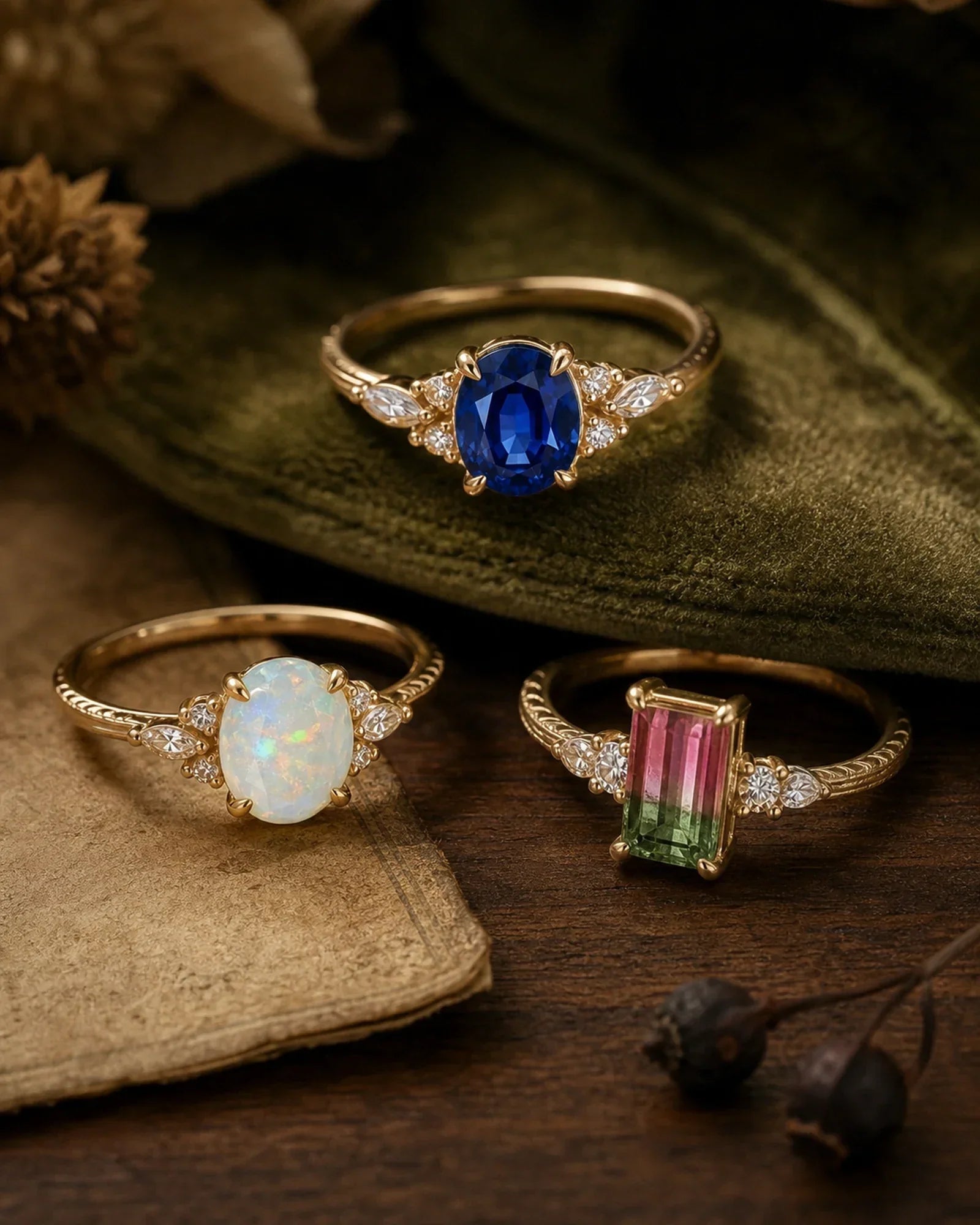

A high-set engagement ring lifts the center stone above the finger, creating a more open side view and often more room for decorative galleries. A low-profile engagement ring keeps the stone and basket closer to the hand, which usually feels quieter and is less exposed to everyday contact. That is the useful starting point. It is not the whole answer.
The detail many buyers discover too late is that setting height and wedding-band clearance are not the same measurement. A ring can look tall from the side yet have a wide basket or low bridge that stops a straight wedding band. Another ring can look relatively low but still accept a straight band because its head narrows above a deliberately raised bridge. Snagging, spinning and comfort are equally structural: prong finish, head width, ring size, shank shape and center-stone depth can matter as much as the headline height.
High-set vs low-profile rings in 60 seconds
| Decision | High-set ring | Low-profile ring | What actually decides it |
|---|---|---|---|
| Snag risk | Usually more exposed | Usually less exposed | Prong finish, projection, halo edge and ornament |
| Ring spinning | Can feel top-heavy | Often more stable | Fit, finger shape, head mass, shank width and inside profile |
| Gloves and sleeves | More likely to press or catch | Typically smoother | Highest point, sharp edges and workplace requirements |
| Straight wedding band | Often easier, never automatic | Often leaves a gap | Bridge height, basket width and band dimensions |
| Visual presence | Airy, lifted, architectural | Integrated, grounded, often wider | Stone size, face-up spread, shoulders and halo design |
| Protection | More leverage during a knock | Less projection | Setting type, prong condition, bezel coverage and craftsmanship |
| Sparkle | Open sides can look lively and clean easily | Can still be extremely bright | Cut quality, facet proportions, polish, symmetry, cleanliness and light |
First, separate six measurements that sellers often call “height”
“Low,” “medium” and “high” are useful comparative descriptions, but they are not universal engineering standards. Stone depth changes by shape and cutting style. A deep cushion may require more vertical space than a shallow portrait cut. A one-carat oval and a two-carat oval cannot occupy the same basket. Even two stones with the same carat weight may have different millimeter dimensions and pavilion depths.

Ask for an annotated side-view CAD when profile is important. The drawing should include the center-stone dimensions, overall ring height, shank width and thickness, and the clearance available to the wedding band you plan to wear. “It should sit flush” is not a specification. “The ring must clear a straight band that is 1.8 mm thick and 2.0 mm wide” gives the designer something testable.
When a high-set engagement ring is the better choice
High settings are not only about drama. Their main design advantage is space. Raising the head can expose an elegant basket, allow cathedral shoulders to rise toward the center, make room for a hidden halo, or leave a passage for a straight wedding band. A lifted center also separates the stone visually from an ornate shank, which can help a detailed ring feel less crowded.
This architecture is especially useful for a classic solitaire engagement ring setting. A tapered head can keep the top view clean while the side view carries the detail. Emerald, oval, round and radiant centers often suit this treatment because the head can be narrow at band level and expand only near the girdle. A hidden halo also needs enough vertical space to be visible from an angle rather than compressed against the shank.
What high profile does well
- Creates a clear, elevated center-stone silhouette.
- Makes cathedral shoulders, tulip baskets and hidden details easier to see.
- Can provide space for a straight wedding band when the bridge and basket are designed correctly.
- Offers cleaning access beneath an open gallery.
- Lets a modest center stone read as the focus without requiring an oversized gem.
Where buyers regret it
The same elevation increases leverage. When a tall head hits a hard edge, the force acts farther from the finger and can twist the ring or stress a prong. A narrow shank under a heavy oval, halo or three-stone head may rotate on tapered fingers. Tall claw prongs can meet hair, knit loops and pocket seams repeatedly. None of these outcomes is guaranteed, but the margin for careless contact is smaller.
A raised ring also changes proprioception: the wearer notices the head before the finger meets a surface. Some people adapt within days. Others continue striking the ring on desk edges or door frames because their work keeps their hands in tight spaces. A high setting is most successful when the wearer already removes rings for lifting, gardening, gym sessions, cleaning and other impact-heavy tasks.
When a low-profile engagement ring is the better choice
A low setting integrates the stone with the shank instead of suspending it above the hand. This can make an engagement ring feel calmer, more secure and more natural during typing, dressing and travel. It is often the sensible direction for people who work with children, equipment, textiles, fitted sleeves or frequent pockets. It can also be the stronger aesthetic choice: Art Deco clusters, botanical rings, bezel frames and east-west settings often look more intentional when their components form one close silhouette.
Low profile does not have to mean visually small. A hexagonal bezel, oval cluster, pear halo or broad three-stone layout can cover significant face-up area while keeping the center close to the finger. The visual weight moves outward rather than upward. That is why many unique low profile engagement rings feel substantial without relying on a large center stone.
What low profile does well
- Reduces how far the ring projects into sleeves, pockets and nearby objects.
- Lowers the center of mass and often improves stability on the finger.
- Supports protective bezels, partial bezels and integrated galleries.
- Works naturally with cluster, floral, leaf, vintage and geometric designs.
- Can feel more comfortable between adjacent fingers when the head is also well proportioned.
The compromise is usually the stack
A deep center stone needs physical space below its girdle. If the jeweler lowers the head, the pavilion and basket move closer to the shank. A straight wedding band then reaches the basket before it reaches the engagement-ring shank. The result is a gap. That gap is not a defect when it is expected and even; it becomes a regret when a buyer was promised a flush stack without seeing the two rings together.
Low settings can also be harder to clean beneath the stone if the gallery is enclosed. Lotion and soap can collect between a broad basket and the finger. A bezel removes exposed prong tips but adds a metal rim that must be finished smoothly and kept clean. The GIA engagement ring buying advice notes that settings vary in protection: a bezel protects the perimeter, while prongs expose more of the stone. “Low” describes position; it does not certify construction quality.
What actually makes a ring snag?
Height increases exposure, but snagging usually happens at a small contact point. A slightly raised prong tip can catch more often than a taller but smoothly finished bezel. A leaf shoulder with a sharp outward tip may meet knitwear before the center stone does. A halo whose outer stones project beyond the gallery can catch from the side even when the center sits relatively low.
Use a fingertip and a piece of tightly woven fabric to inspect the ring gently. Move around every prong, gallery rail, shoulder and accent stone. The surface should feel continuous. Do not pull a ring through delicate knitwear as a test; that risks both the garment and the setting. If one location repeatedly catches hair or lint, have the prongs checked. Snagging can be an early sign of a lifted, worn or poorly finished prong rather than a reason to replace the entire design.

Sweaters, hair and pockets
Fine claw prongs give a beautiful minimal top view, but their tips need precise finishing. Rounded prongs and bezels generally move through fabric more easily. Long hair can loop beneath a raised basket or around cathedral shoulders, especially when the gallery has open decorative details. Coat and trouser pockets test a different direction: the outer halo edge, pear point and shoulder ornament can meet the seam as the hand enters.
Can you wear an engagement ring under gloves?
A low, smooth ring is easier under an ordinary fitted glove, but “easier” does not mean appropriate for every glove or every workplace. Tight gloves can press prongs sideways, trap moisture and make removal awkward. Clinical, laboratory, food-handling, industrial and safety rules may require jewelry to be removed regardless of profile. For cold-weather or fashion gloves, test the actual glove slowly. If the glove distorts, catches or compresses the head, remove the ring rather than forcing it.
Why rings spin, and why lowering the setting may not fix it
A tall heavy head creates more rotational leverage, so high settings receive much of the blame for ring spinning. Yet rotation is a balance problem, not a single-height problem. The ring may be loose enough to pass a prominent knuckle, then become roomy at the base of the finger. The shank may be too narrow for the head. The inner profile may offer little resistance. Cold weather may reduce finger size. Tapered fingers may naturally push rings toward the fingertip.
Before redesigning the head, check the fit throughout the day and across seasons. A modest sizing adjustment, a wider lower shank, a euro-style shank, sizing beads or a different inside profile may stabilize the ring while preserving the design. For a very wide halo or three-stone head, balance the head width against the shank during CAD review. A low ring can still spin when it is loose; a well-balanced high ring can remain centered.
Wedding band fit: the part to design before the proposal ring is finished
A flush stack means the engagement-ring shank and wedding band can sit in continuous contact without the band striking the basket, prongs, halo or side stones. It is a visual preference, not a durability requirement. A small intentional gap can look elegant and may make each ring easier to distinguish. The important point is that the result should be chosen, not discovered.

Why a high ring can still fail the flush-fit test
Imagine a hidden-halo ring with the center stone visibly elevated. The halo rail may sit high, but a support strut or basket base may extend outward near the shank. A wedding band that is 2.2 mm thick meets that strut before the band reaches the engagement ring. From the top, the ring looked like an obvious flush-fit design. From the side, the usable passage was too short.
This is especially common when buyers change the wedding-band specification after the engagement ring is approved. A delicate 1.5 mm plain band might clear the head; a substantial 2.3 mm pavé band may not. “Straight band compatible” is incomplete without the intended band's dimensions.
Four valid stack solutions
- Straight flush band: best when the bridge is high enough and the basket tapers inward above band level.
- Intentional gap: a clean space that preserves a low head and allows both rings to remain straight. Consistency matters more than zero distance.
- Contour or chevron band: follows an oval, pear, cluster or broad basket. It should clear the engagement ring without pressing its prongs.
- Open band or spacer: leaves a controlled opening around the head or separates two rings that would otherwise rub.
Adjacent rings move. A wedding band that touches a prong, gallery rail or pavé edge can wear metal over time. Check the stack not only at rest but also while gently rotating each ring. If the surfaces scrape or lock, add clearance. A perfectly flush photograph is not worth continuous metal-on-metal damage.
Three recurring design-review situations
The following are composite scenarios based on common CAD and after-purchase problems. They are not presented as individual customer testimonials.
The tall oval that catches every cuff
The center is not unusually large, but the peg-style head is narrow and tall, the claw tips project, and the shank is very fine. Lowering the basket slightly helps, but refining the prongs and widening the lower shank solves more of the daily problem than height reduction alone.
The low three-stone ring with a surprise gap
The side stones and baskets spread across the finger. A straight band cannot pass beneath them. The right answer is not to force the ring upward after manufacture; it is to approve a contour band or intentional gap when the three-stone layout is designed.
The “high” hidden halo that blocks a thick band
The center stone looks elevated, but the lower gallery is wide. A thin sample band clears it; the chosen pavé wedding band does not. Modeling the exact wedding band beside the engagement-ring CAD reveals the collision before production.
Six real side profiles worth comparing
Do not use product names as substitutes for structural inspection. A hidden halo can be high or medium. A bezel can be low or raised. A bridal set may use a straight, curved or open band. The following current designs are useful because their side photographs show different answers to the same profile problem.

Emerald-Cut Hidden Halo Solitaire
A raised side gallery makes the hidden detail visible and keeps the top view clean.
14K gold option: $890

Oval Hidden Halo Solitaire
An elevated oval head illustrates why fit and lower-shank stability matter with a larger center.
14K gold option: $2,100

Oval Art Deco Cluster Ring
A lower integrated cluster spreads visual presence across the finger instead of lifting it upward.
14K gold option: $890

Hexagon Bezel Cluster Ring
A framed center reduces exposed edge and prong contact while preserving a geometric outline.
14K gold option: $1,980

Pear Sapphire Milgrain Ring Set
The coordinated band solves the low framed pear center instead of forcing a straight flush stack.
14K gold option: $1,290

Pear Grey Moissanite Leaf Ring Set
A nesting leaf band follows an ornate low head while keeping decorative elements from colliding.
14K gold option: $1,560
To compare the category broadly, start with engagement rings, then inspect side views rather than filtering by top-view style alone. Raised classics are easiest to study among solitaire engagement rings. For smoother perimeter protection, compare bezel set rings. When the stack should be solved as one design, coordinated bridal ring sets are more informative than imagining a future band. For side sparkle, review hidden and visible halo rings with the gallery in view.
A ten-minute try-on that reveals more than a top-view photograph
Use a sample ring with similar head width and height if the exact ring is not available. The goal is not to abuse the sample. It is to observe ordinary movement.
- Make a relaxed fist. Notice pressure between fingers and whether the basket touches the adjacent finger.
- Type for two minutes. Check whether the ring rotates or the head repeatedly meets the desk.
- Put a hand into a real coat pocket. Move slowly and note which edge contacts the seam.
- Brush a tightly woven cuff past the ring. Do not use delicate knitwear. Listen and feel for a raised prong.
- Try the glove you actually wear. Stop if it compresses the head or catches.
- Lift a light bag by its handle. Check side pressure and rotation, without allowing the handle to strike the stone.
- Stack the intended wedding band. View the rings from the side, rotate them gently and look for rubbing.
- Photograph the side profile. A close side image often reveals clearance more clearly than memory.
What to approve in CAD before production
- Exact center-stone length, width and depth in millimeters.
- Overall ring height measured from the finger-side shank plane.
- Bridge height and the narrowest passage available to an adjacent band.
- Basket width at the height of the proposed wedding band.
- Wedding-band width and thickness, modeled beside the engagement ring.
- Minimum gap where two rings could rub prongs, pavé beads or gallery rails.
- Shank width, shank thickness and any taper beneath a heavy head.
- Prong style, tip direction and protection for points or corners.
- Cleaning access beneath low baskets and enclosed galleries.
- Top, side and three-quarter views at a readable scale, not only a beauty render.
For custom work, approve the engagement ring and wedding band in the same CAD file whenever possible. That single step resolves more uncertainty than a label such as “high setting” or “low profile.” It also lets the designer preserve the part you care about most. A low head may remain low while the wedding band becomes curved. A straight band may remain straight while the bridge rises modestly. Good design makes the compromise visible.
Choose by lifestyle, not by a generic winner
Start with a low or medium profile, smooth perimeter, restrained prongs and an integrated head.
Choose a tapered wed-fit head and model the exact band's dimensions before production.
A medium-to-high setting may display them best; balance the head with the shank and inspect snag points.
Prioritize sizing, shank geometry and head mass. Height reduction alone may not solve rotation.
Favor a smooth low profile, but follow workplace rules and remove the ring whenever gloves compress or trap it.
Plan a contour, chevron or open band from the beginning; broad low galleries rarely suit every straight band.
Frequently asked questions
Is a high-set or low-set engagement ring more comfortable?
A low-set ring usually projects less and often feels more natural for pockets, sleeves and desk work. Comfort also depends on head width, basket edges, shank shape, fit and pressure against adjacent fingers. A well-balanced medium or high ring can be comfortable; a broad low cluster can feel intrusive if it presses the neighboring fingers.
Do high-set engagement rings snag more?
They are generally more exposed, but height is not the only cause. Raised prong tips, sharp leaf details, projecting halo edges and loose stones create local snag points. A smooth tall bezel may snag less than a lower ring with unfinished claw tips.
Do low-profile engagement rings sit flush with a wedding band?
Not automatically. Many low settings place the basket close to the shank, blocking a straight band. A flush fit requires enough bridge clearance and a basket that narrows above the wedding band. Otherwise choose an intentional gap, contour band, chevron or open design.
Does a high setting make a diamond sparkle more?
Height alone does not determine sparkle. Cut proportions, facet arrangement, polish, symmetry, cleanliness and lighting have much greater influence. An open prong gallery may expose more of the stone and make cleaning easier, but a well-cut stone can remain bright in a lower setting.
What setting is best for someone who wears gloves?
A low bezel or smoothly finished low-to-medium basket is usually the easiest. Test the actual glove and stop if it presses or catches. Occupational rules may require all rings to be removed, regardless of design.
Why does my engagement ring keep spinning?
Common causes include loose fit, tapered fingers, seasonal size changes, a narrow shank and a wide or heavy head. A high setting can add leverage, but lowering it is not always the right repair. Ask a jeweler to assess fit and balance before resetting the stone.
Can a high-set ring be lowered later?
Sometimes, but it may require a new head or complete reset. Stone depth, hidden halos, prongs, shoulders and the planned wedding band limit how far the center can move. Lowering can also remove straight-band clearance, so the stack must be reviewed at the same time.
Is a gap between engagement ring and wedding band bad?
No. A small even gap can be deliberate and attractive. It may prevent a wedding band from rubbing the engagement-ring basket. Uneven contact, metal scraping or pressure on prongs is a structural concern; visible space by itself is not.
What is the best compromise between high and low?
A medium-height wed-fit design often gives the best balance: the head is tapered, the bridge is high enough for the intended band, the center is not lifted farther than its depth requires, and the shank is substantial enough to stabilize the ring. The exact answer must be drawn around the chosen stone and wedding band.
The final decision
Choose the lowest profile that still supports the center stone, protects its vulnerable areas and accommodates the wedding-band result you actually want. Raise the head only when the extra space serves a purpose: a straight band, an open gallery, a hidden halo, cathedral shoulders or a deliberate elevated silhouette.
The best engagement ring setting is not the one that wins a high-versus-low checklist. It is the one whose side profile agrees with the wearer's ordinary day. When the CAD includes the real center stone and the real wedding band, comfort and beauty stop competing in theory and become dimensions that can be checked before the ring is made.