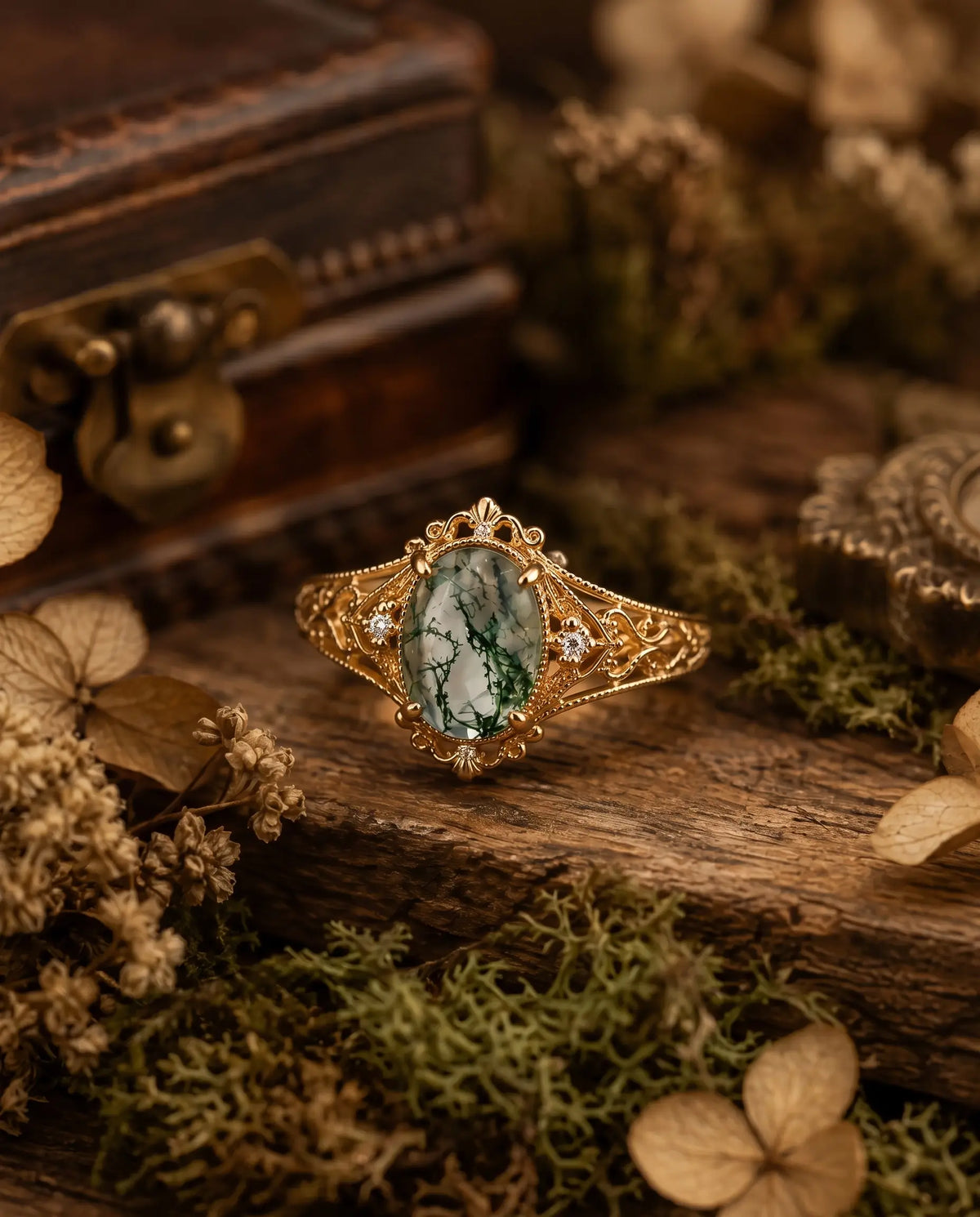

A leaf-shaped shoulder can be the reason you fall for a ring. It can also be the reason you pause before buying: will those little points catch your sweater every morning? The answer depends less on the botanical theme than on where the metal ends, how far it stands away from the band, and how the stones are secured. Two leaf rings that look equally delicate from above can feel quite different when you put on a knitted sleeve.
Where does a botanical ring actually catch?
Think about the path a sleeve takes over the ring, from fingertip toward the wrist. The first contact may be the center head, not the leaves. A taller basket, open gallery or long prong can meet fabric before the decorative shoulder does. The next possible contact is the outside edge of a leaf or branch. A motif that rises above the surrounding metal may behave like a small hook if its tip is acute or its underside leaves a narrow gap.
Then look at accent stones. A marquise-shaped stone makes an elegant leaf, but it introduces two pointed ends and often more prong tips than a plain metal leaf. Whether those ends are protected by suitable prongs or a bezel matters more than the name of the design. Finally, the ring itself may rotate if the size is loose or the head is heavy relative to the shank. A ring that turns sideways brings its raised detail into contact with clothing more often.
There are three useful levels of contact. Brush: a smooth ring touches a close-fitting garment and glides away. Catch: the same spot repeatedly pulls a thread or stops the fabric. Change: a ring that used to glide now catches, especially at a prong or accent stone. The last two call for a closer look. None can be diagnosed confidently from one face-up product photo.
Three botanical structures, seen from the side
The images below are actual catalog side views. They are examples of what to inspect, not certificates that an individual finished ring will or will not snag. Polishing, setting security, ring size and everyday activity still need to be judged on the piece you receive.

1. Leaves that lie along the shoulder
In the Liorenne leaf solitaire, the long sculpted leaf reads as part of the shoulder rather than a separate twig reaching outward. That geometry is a useful starting point for a buyer who wants foliage with fewer exposed ends. It does not make the whole ring flat: the oval center still rises on a pronged head.
Ask for a near-horizontal side view with the ring upright. Can you trace a continuous, polished line from band to leaf to head? Is there an abrupt pointed end facing outward? Is the underside open enough to trap fabric or hair? A smooth integrated leaf is generally more forgiving than an unsupported tip, but the final inspection belongs to the actual ring.
Best design question: “Does any leaf edge stand proud of the shoulder when viewed from the side?”

2. Vine and branch details that project outward
The Fiorenne botanical solitaire uses several individual leaves on an open, branching shoulder. The spaces create movement and shadow; they also make the end of each tiny branch worth checking. If a vine ring catches on clothes, the source may be one lifted leaf tip, a narrow fork between branch and band, or a prong near the center. The photograph alone does not establish which, if any, is a problem.
For a custom vine design, request rounded terminals rather than needle-like ones and ask whether the designer can keep the outermost leaves close to the shank without erasing the open-vine effect. A branch that is attached at both ends or joined cleanly to the shoulder often has a different wear profile from a long, free-standing tip.
Best design question: “Which decorative points can a sleeve approach from underneath?”

3. Marquise stones used as leaves
The Elaria oval cluster ring shows why stone-set foliage deserves its own check. Marquise accents produce a luminous leaf shape, but each pointed stone end needs appropriate protection and each small prong needs close, smooth contact with the gem. More small settings mean more individual points to inspect, even when the overall ring looks compact.
Ask for a close, well-lit video rotating the ring through both sides. Look for symmetry in the prongs and ask whether the marquise tips are covered by protective metal. Do not infer security from sparkle or from a polished face-up render. If your hands regularly pass through gloves, tight sweater cuffs or hair, a carved-metal leaf or a more enclosed accent setting may suit your routine better.
Best design question: “How are the sharp ends of every marquise accent protected?”
Low profile helps, but it is not a promise of zero snagging
A low profile botanical engagement ring typically sits closer to the finger at the center. That can reduce how often the main stone meets a sleeve, glove or pocket. It says almost nothing, by itself, about a leaf at the outer edge. A compact head with one upward-facing branch tip can still catch; a slightly higher head with smooth, close-set shoulders may glide more easily. Compare the highest point of the stone and the outermost decorative points.
There is a trade-off too. A very low basket may leave less room for a straight wedding band to sit flush. If you plan to stack rings, ask for a side view of the engagement ring beside the exact wedding-band profile you want. A contour band or intentional gap can be a sensible solution. Do not choose an uncomfortable head height just to force two bands together. The stack should be evaluated for rubbing as well as silhouette.
For leaf engagement ring everyday wear, your own routine is the decisive test. Smooth office clothing may never reveal the contact that a loosely knit cardigan, salon gloves, gardening gloves or lifting work reveals immediately. No fine-jewelry ring should be worn into every activity. Remove it for tasks that put force on the setting or expose it to chemicals, and treat persistent snagging during ordinary dressing as a reason to seek a bench inspection rather than to simply “get used to it.”
Normal brushing or a loose prong?
A smooth prong can brush a close-fitting sleeve without indicating failure. A prong that catches the same fine thread repeatedly, shows a visible gap above the stone, looks shorter or bent compared with its opposite, or accompanies a stone that seems to tilt or move is different. Stop wearing the ring until a qualified jeweler checks it. Do not push the stone or bend the prong back with household tools. Nor should you drag a cotton pad over the setting as a “test”: fibers can entangle a sound but intricate design and may disturb an already weak one.
GIA's jewelry setting quality guidance says prong tips should contact the gem's crown without gaps; non-flush tips can snag clothing, scratch skin and break. This is why a new catch at the head is not merely a styling annoyance. It can be a maintenance signal. A jeweler can distinguish an unfinished metal edge from a lifted prong, worn tip or loose accent and recommend polishing, tightening, retipping or resetting as appropriate.
At home, use good light and a stable surface. Look from both sides, compare matching prongs and note exactly where the catch occurs. If you hear a rattle, see movement, or notice a sudden change in alignment, set the ring aside in a closed box. Take a short video of the problem if it can be filmed without manipulating the stone. A photograph of last month's sound setting can help document what changed, but it cannot replace an in-person inspection.
| What you notice | Likely question | Next step |
|---|---|---|
| Occasional smooth contact at a raised center | Is the head simply higher than your preferred wearing profile? | Review side height and clothing routine before purchase; monitor if already owned. |
| Repeated catch at one leaf or branch end | Is the end pointed, lifted or poorly finished? | Ask a jeweler to identify the precise contact point and whether refinishing is safe. |
| New catch at a center or accent prong | Has the tip lifted, worn or lost contact? | Stop wearing; arrange a professional prong and stone-security inspection. |
| Ring spins and catches at different points | Is fit or head balance putting details sideways? | Discuss sizing or fit adjustment; inspect the setting as well. |
The buying checklist: request these views before approval
A front-on beauty image tells you why you like the ring. A wearability decision needs the less glamorous angles. For an online order, custom design or final approval, ask for the following views of the intended setting or a representative finished sample. If it is made to order, clarify which details are fixed and which may vary with stone size or ring size.
- True side profile, level with the shank: measure visually how far the center head and motifs rise above the band; check whether a wedding band can approach the basket.
- Three-quarter views from both sides: look under leaf tips, along branch forks and beneath the center gallery. A single angled photo may hide the opposite side.
- Macro of each setting: inspect the center prongs and any marquise accent tips. Ask about close contact, rounded finish and tip protection rather than a generic claim that the ring is “secure.”
- Normal-distance on-hand view: a 20x macro exaggerates every gap; ordinary hand scale tells you how prominent the branches and head will feel in daily life.
- Band-pairing view: if you plan a stack, request the intended straight, curved or open band next to the engagement ring. Look for rubbing at foliage and gallery, not only an attractive top view.
- Written design preference: if snag resistance matters, specify “rounded, closely integrated leaf ends; no free-standing sharp branch tips; protected marquise points.” Ask what compromises this creates for the design.
For browsing, the wider nature inspired engagement rings collection shows the full range of organic profiles. The leaf engagement rings collection is useful when you prefer foliage integrated into the band. Compare more open lines in vine and branch engagement rings, and look at petal placement and side accents in floral engagement rings. These are design starting points; the side views and finish of the selected ring decide wearability.
Which botanical structure fits your routine?
If you pull on fitted gloves several times a day or work with delicate textiles, start with the fewest protruding details: an integrated leaf shoulder, rounded prongs, a compact center and no exposed marquise tips. If you mostly wear smooth fabrics and remove your ring for manual work, a more expressive open vine may be worth the additional attention it asks of you. Neither choice is more romantic or more “authentic” to nature. It is a decision about contact points.
For a highly sculptural ring, ask what can be adjusted without making the design unrecognizable. A jeweler may be able to soften a leaf termination, alter a branch's angle, lower an accent slightly, or use a more protective stone setting. Those changes should be reviewed in a side-view design drawing and, ideally, in a finished sample. A side photograph also helps catch an important misconception: a low center can coexist with tall outer leaves, while a taller center can coexist with smooth shoulders.
Do all leaf engagement rings snag sweaters?
No. The likelihood depends on exposed tips, prong finish, head height and garment weave. Check the actual side profile instead of treating every leaf motif as the same construction.
What if my vine ring suddenly starts catching?
Stop wearing it until a jeweler checks the exact contact point, especially if it is near a stone. A changed catch can signal a lifted or worn prong rather than normal texture.
Are marquise leaf accents safe for daily wear?
They can be, when the stones are securely set and their points are protected. They introduce more tips and prongs to inspect than solid-metal leaves. The quality of the individual setting matters more than the gemstone silhouette alone.
Is a low-profile leaf ring always the most comfortable?
Not necessarily. Lower height can help with gloves and sleeves, but fit, shank shape, protruding side details and wedding-band contact also influence comfort.
Bottom line: ask not “Does a botanical ring snag?” but “Where are this ring's exposed ends, and what holds its stones?” A side view, close prong view and frank discussion of your daily routine give you a much better answer than a beautiful front photo alone.