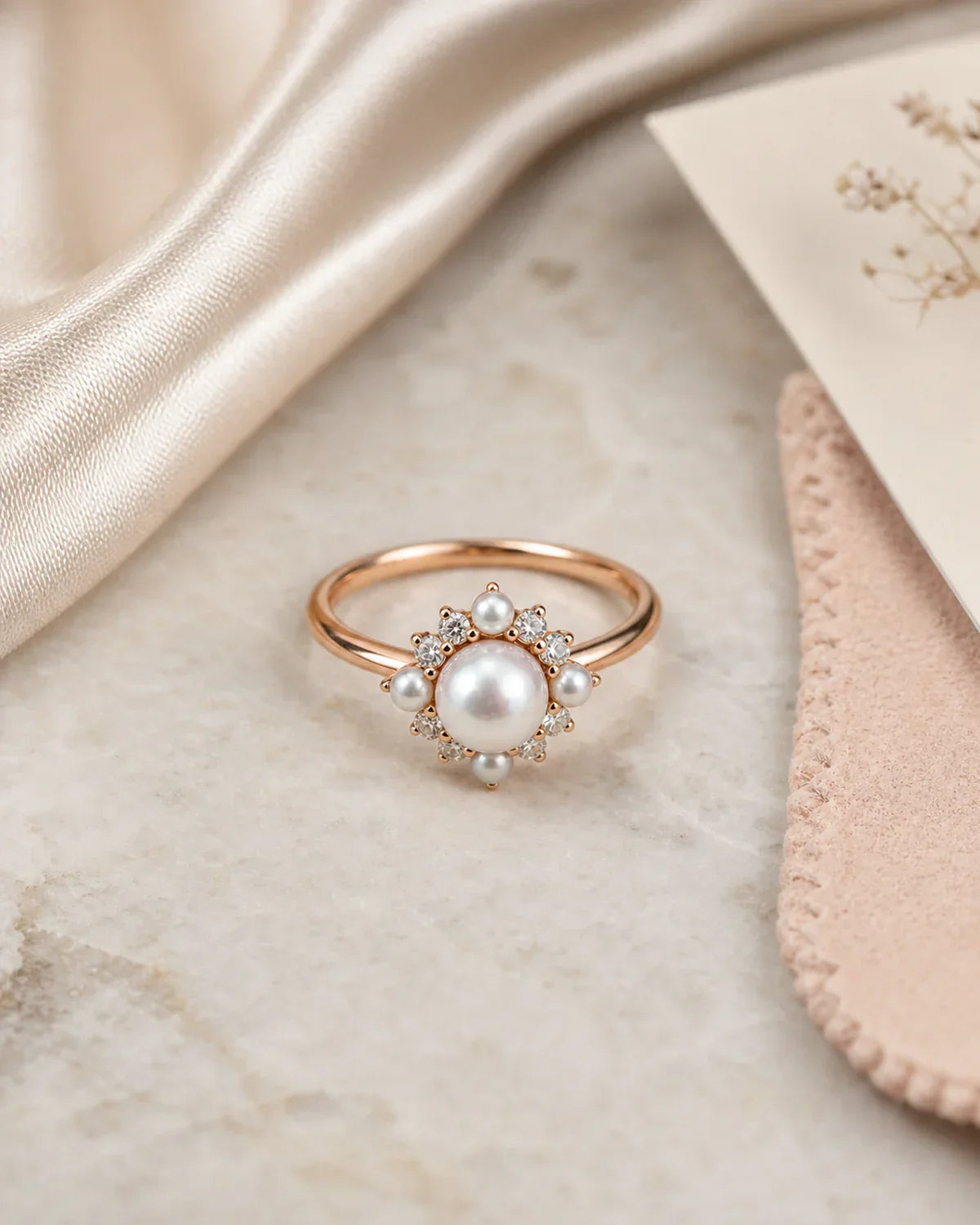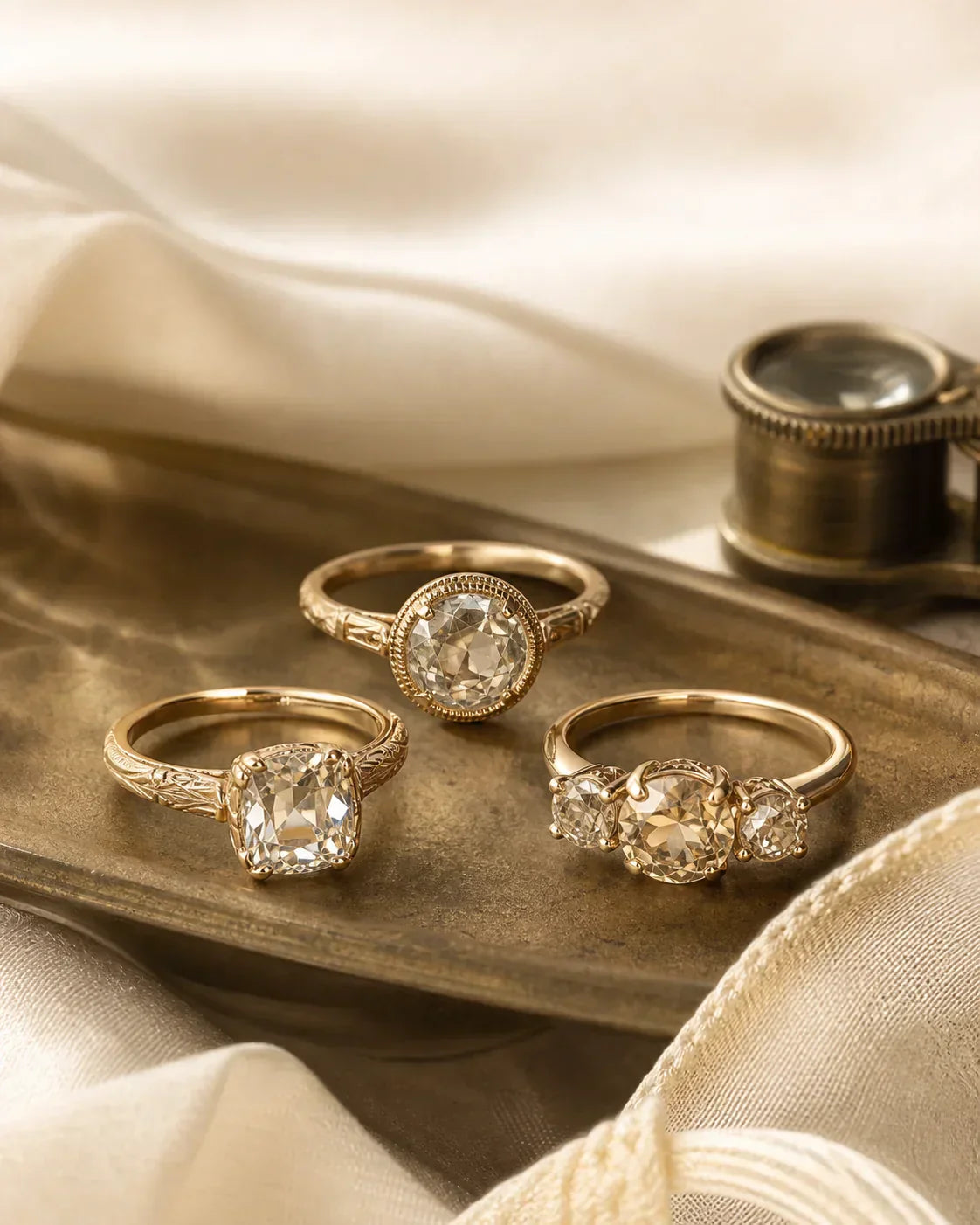

La tendance anti-bague de fiançailles ovale ne rejette pas vraiment les diamants ovales. Les solitaires ovales restent élégants, flatteurs et très appréciés. Le changement est plus subtil. Un nombre croissant de futures mariées stylées recherchent une bague qui semble moins être le choix par défaut et davantage un objet avec une personnalité affirmée.
C'est pourquoi la bague de fiançailles trois pierres revient dans la conversation. La couverture mode récente autour de la bague de Devon Lee Carlson a clairement défini l'ambiance : pas un autre solitaire ovale épuré, mais une bague trois pierres d'inspiration vintage avec des proportions anciennes, la chaleur de l'or jaune et une personnalité diamantaire plus douce. Who What Wear a décrit la bague en évoquant les diamants de taille ancienne, une couleur chaude comme à la lueur d'une bougie et un serti clos à dos bouton d'inspiration géorgienne. Cette combinaison en dit long sur l'évolution des goûts en matière de bague de fiançailles.
La nouvelle réaction contre la bague par défaut
Pendant plusieurs années, le solitaire ovale a été le choix mode sûr : allongé, photogénique, gracieux sur la main et facile à associer avec une alliance. Sa popularité est compréhensible. Mais lorsqu'une silhouette devient trop familière, les acheteuses les plus soucieuses de style commencent souvent à regarder ailleurs.
L'état d'esprit anti-ovale n'est pas anti-beauté. Il est anti-formule. Au lieu d'un ovale centré qui fait tout le travail, une bague vintage trois pierres offre plus de détails à lire : une pierre centrale, des pierres latérales, une architecture en métal, une hauteur de galerie, un caractère de serti clos ou à griffes, et la façon dont l'ensemble de la bague repose sur le doigt. Elle semble choisie plutôt que copiée.
Cette distinction est importante pour les acheteuses qui veulent une bague de fiançailles non standardisée. Une bague peut être raffinée, nuptiale et intemporelle sans être minimaliste. En fait, les styles de bagues de fiançailles vintage les plus intéressants en ce moment ne sont pas tape-à-l'œil. Ils sont nuancés.

Pourquoi les trois pierres semblent si actuelles
Une bague de fiançailles trois pierres a un sens inné de la composition. Les pierres latérales élargissent le design, encadrent le centre et donnent plus de présence à la bague sans nécessiter une pierre centrale énorme. Cela rend le style substantiel dans la vie réelle, pas seulement sur les photos en gros plan.
L'ancienne signification aide toujours : trois pierres sont souvent interprétées comme le passé, le présent et le futur. Mais l'attrait renouvelé est visuel. Les trois pierres brisent l'habitude de la pierre unique. Elles créent un rythme. Elles permettent à une bague de ressembler davantage à un héritage, surtout lorsque les pierres latérales sont rondes, en poire, en marquise, en kite ou légèrement désuètes dans leurs proportions.
Pour explorer, les bagues de fiançailles trois pierres sont un bon point de départ car la catégorie montre à quel point la disposition peut changer. Un centre rond avec de petits côtés ronds semble classique. Un centre allongé avec des côtés en poire ou en marquise semble plus directionnel. Un centre de couleur avec des pierres d'accent blanches semble personnel mais toujours reconnaissable comme bague de fiançailles.

L'énergie de la taille ancienne européenne, même avec une pierre moderne
L'expression bague de taille ancienne européenne évoque une ambiance très spécifique : ronde, ancienne, à la lueur d'une bougie, moins nette qu'un brillant moderne. Les diamants de taille ancienne européenne ont souvent des facettes plus grandes, une impression de couronne plus haute et un retour de lumière qui semble plus lent et plus doux. Ils n'essaient pas de ressembler à un projecteur parfaitement optimisé.
Toutes les acheteuses n'ont pas besoin d'un véritable diamant ancien pour participer à la tendance. L'important est le langage visuel. Une pierre centrale ronde, une couleur légèrement plus chaude, un serti en or jaune, un bord serti clos ou une galerie d'inspiration vintage peuvent tous pointer dans la même direction. Les meilleures versions modernes empruntent l'impression sans prétendre être des pièces de musée.
Pour l'éducation sur les diamants, la page des facteurs de qualité des diamants du GIA est une référence neutre utile car elle sépare la couleur, la taille, la pureté et le poids en carats. Cette distinction est importante ici : une couleur de diamant plus chaude peut être un choix de style délibéré, tandis que la taille et les proportions déterminent toujours la beauté de la pierre.
C'est l'une des raisons pour lesquelles la taille ronde redevient intéressante. Un solitaire rond moderne peut sembler très épuré, mais une pierre ronde dans un serti vintage trois pierres semble plus spécifique. Si un solitaire ovale allonge la main, un centre rond vintage ajoute souvent de l'intimité. Il se lit moins comme un modèle tendance et plus comme une pièce de famille trouvée exactement au bon moment.
L'or jaune rend la tendance intentionnelle
L'or jaune fait un travail discret mais important dans cette tendance. Il adoucit la bague, réchauffe le diamant et rend les détails d'inspiration ancienne plus faciles à remarquer. Le milgrain, les épaules en feuille, les bords sertis clos et les montures basses deviennent tous plus expressifs lorsque le métal a de la couleur.
Le métal blanc peut être beau, mais il pousse souvent l'œil vers la luminosité et le contraste. L'or jaune permet à la bague de s'orienter vers l'éclat. C'est pourquoi il fonctionne si bien avec le style de taille ancienne européenne, les tons de diamant chauds, l'agate mousse, l'alexandrite, la moissanite et les designs de diamant sel et poivre. Il rend la bague moins clinique.
Pour un usage quotidien, l'or 14 carats est souvent le juste milieu pratique. Il a suffisamment de chaleur pour soutenir le look vintage, tout en offrant un profil de durabilité que beaucoup préfèrent pour une bague de fiançailles. Le meilleur choix dépend toujours du mode de vie, du budget et du fait que la porteuse souhaite une ambiance ancienne plus douce ou une finition de haute joaillerie plus nette.
Le détail du serti clos fait partie de l'ambiance anti-ovale
L'une des raisons pour lesquelles les montures d'inspiration géorgienne apparaissent dans les conversations sur les tendances est qu'elles donnent à la bague un aspect construit, pas simplement monté. Un serti à dos bouton ou de type clos encadre la pierre avec intention. Cela peut rendre la bague plus basse, plus lisse et plus intime.
C'est très différent du look de solitaire monté haut que de nombreuses acheteuses associent aux bagues de fiançailles modernes. Un serti clos ou semi-clos peut donner à une bague l'impression d'être un artefact personnel. Il donne également plus de caractère à la vue de profil, ce qui est important car une bague n'est pas seulement vue de dessus.
Si la porteuse souhaite l'impression vintage mais aussi la sécurité et la praticité au quotidien, les bagues à serti clos valent la peine d'être comparées. Le style peut protéger les bords, encadrer visuellement le centre et créer le type de finition ancienne qui rend une bague moins attendue.
Comment choisir sans transformer la bague en costume
L'erreur la plus facile avec le style vintage est d'ajouter trop de détails historiques à la fois. Une bague trois pierres n'a pas non plus besoin de tous les indices antiques possibles. Si les pierres sont expressives, le corps peut être plus discret. Si la galerie est détaillée, la vue de dessus peut être plus épurée. Si la couleur est chaude, le serti doit rendre cette chaleur intentionnelle.
Une bonne bague de fiançailles vintage a généralement une idée principale. Peut-être que l'idée est la douceur de la taille ancienne européenne. Peut-être que c'est une disposition à trois pierres. Peut-être que c'est l'or jaune. Peut-être que c'est un cadre serti clos. Les détails de soutien doivent amplifier cette idée plutôt que de rivaliser avec elle.
C'est là que les bagues de fiançailles vintage deviennent utiles comme ensemble de comparaison plus large. Elles montrent comment différentes époques et détails peuvent se chevaucher : géométrie Art déco, romantisme victorien, épaules inspirées de la nature, encadrement en halo et grappes de style ancien. L'objectif n'est pas de choisir la bague la plus décorée. L'objectif est de choisir celle dont la personnalité reste claire.
Un moyen simple d'affiner le choix est de regarder la bague à trois distances. De l'autre côté de la pièce, la silhouette doit être lisible : trois pierres, un centre distinctif ou un contour vintage clair. À bout de bras, la couleur du métal et les pierres latérales doivent sembler équilibrées sur la main. De près, les détails doivent récompenser l'attention sans donner l'impression que la bague est chargée. Si une bague ne fonctionne qu'en photo macro, ce n'est peut-être pas la bonne pièce quotidienne.
Ce qu'il faut remarquer avant d'en choisir une
Commencez par la forme de la pierre centrale. Un centre rond donne le sentiment le plus ancien européen, surtout avec un ton plus chaud ou une ambiance de facettes de style ancien. Un centre ovale peut toujours fonctionner dans un contexte anti-ovale si le serti change l'histoire, mais il a besoin de pierres latérales, de chaleur métallique ou de détails vintage pour ne pas être perçu comme un autre solitaire ovale standard. Un centre en marquise, en kite ou de couleur semblera plus intentionnellement alternatif.
Ensuite, regardez l'échelle des pierres latérales. Les pierres latérales doivent encadrer, pas dominer. Si elles sont trop petites, la bague peut ressembler à un solitaire avec décoration. Si elles sont trop grandes, le centre perd de l'autorité et la bague peut ressembler davantage à une bague cocktail. Les bagues vintage trois pierres les plus portables maintiennent généralement une hiérarchie claire : centre d'abord, pierres latérales ensuite, détails métalliques en troisième.
Enfin, vérifiez le profil. Une bague qui est belle de dessus peut toujours sembler maladroite si le serti est trop haut, s'accroche facilement ou laisse les pierres latérales exposées. Pour un usage quotidien en tant que bague de fiançailles, la vue de côté compte autant que la vue de dessus. Des galeries plus basses, des griffes sécurisées, des bords sertis clos et des épaules bien pensées peuvent rendre une bague romantique pratique plutôt que fragile.
Quand un ovale a encore du sens
La tendance anti-bague de fiançailles ovale ne doit pas être interprétée comme une règle. Les bagues ovales ne sont pas dépassées. Un ovale bien taillé dans un beau serti aura toujours sa place car il flatte la main et offre une présence généreuse vue de face. Le fait est que l'ovale n'est plus la seule réponse pour une bague de fiançailles à la mode.
Si quelqu'un veut de la longueur, une symétrie épurée et un appairage facile avec une alliance, un ovale peut encore être le meilleur choix. Mais si elle veut de la texture, de l'histoire, un rythme de pierres latérales et une bague qui semble moins familière au premier coup d'œil, la direction vintage trois pierres a plus de portée émotionnelle.
Les acheteuses qui aiment toujours les centres ronds mais veulent éviter un solitaire simple peuvent également comparer les bagues de fiançailles taille ronde avec des pierres latérales, des halos, des sertis clos ou des épaules vintage. Le contour rond garde la bague classique ; le serti décide si elle semble attendue ou distinctive.
Styles qui valent la peine d'être comparés
Les styles ci-dessous ne sont pas destinés à copier une bague de célébrité. Ce sont des points de comparaison pour la tendance plus large : dispositions à trois pierres, structure vintage, centres ronds ou allongés, or chaud, encadrement de type serti clos et détails latéraux qui rendent la bague personnelle.

Bague trois pierres feuille Calanthe
Or 14 carats à partir de 990,00 $
Une disposition trois pierres d'inspiration vintage avec détail de feuille et rythme de pierres latérales.

Bague trois pierres en agate mousse Seraphine
Or rose 14 carats à partir de 780,00 $
Un centre rond avec pierres latérales pour un profil plus discret d'inspiration ancienne.

Bague trois pierres en moissanite ronde
Or rose 14 carats à partir de 960,00 $
Une option à centre rond pour les acheteuses attirées par les proportions de taille ancienne européenne.

Bague trois pierres marquise Radiance
Or rose 14 carats à partir de 780,00 $
Une alternative allongée qui conserve l'impression anti-solitaire mais ajoute du mouvement.

Ensemble bague agate mousse kite Elowen
Or rose 14 carats à partir de 1 180,00 $
Un ensemble vintage plus distinctif pour les acheteuses qui veulent une forme de centre non standard.

Bague cinq pierres serti clos Luna
Or rose 14 carats à partir de 890,00 $
Un style de comparaison à cadre serti clos pour le côté d'inspiration géorgienne de la tendance.
L'essentiel
La bague vintage trois pierres est de retour car elle répond à un désir très actuel : les gens veulent des bagues de fiançailles avec de l'individualité, pas seulement de la beauté. Le look a de l'histoire sans sembler poussiéreux, du symbolisme sans être sentimental, et suffisamment de structure pour se démarquer de la vague des solitaires ovales.
La meilleure bague de fiançailles anti-ovale n'est pas nécessairement l'opposé d'un ovale. C'est une bague avec une identité plus claire. Un centre rond d'inspiration ancienne européenne, de l'or chaud, des pierres latérales, un cadre serti clos ou une galerie vintage peuvent tous créer cette impression. L'important est de choisir une bague qui semble réfléchie sous tous les angles et qui reste personnelle une fois la tendance passée.