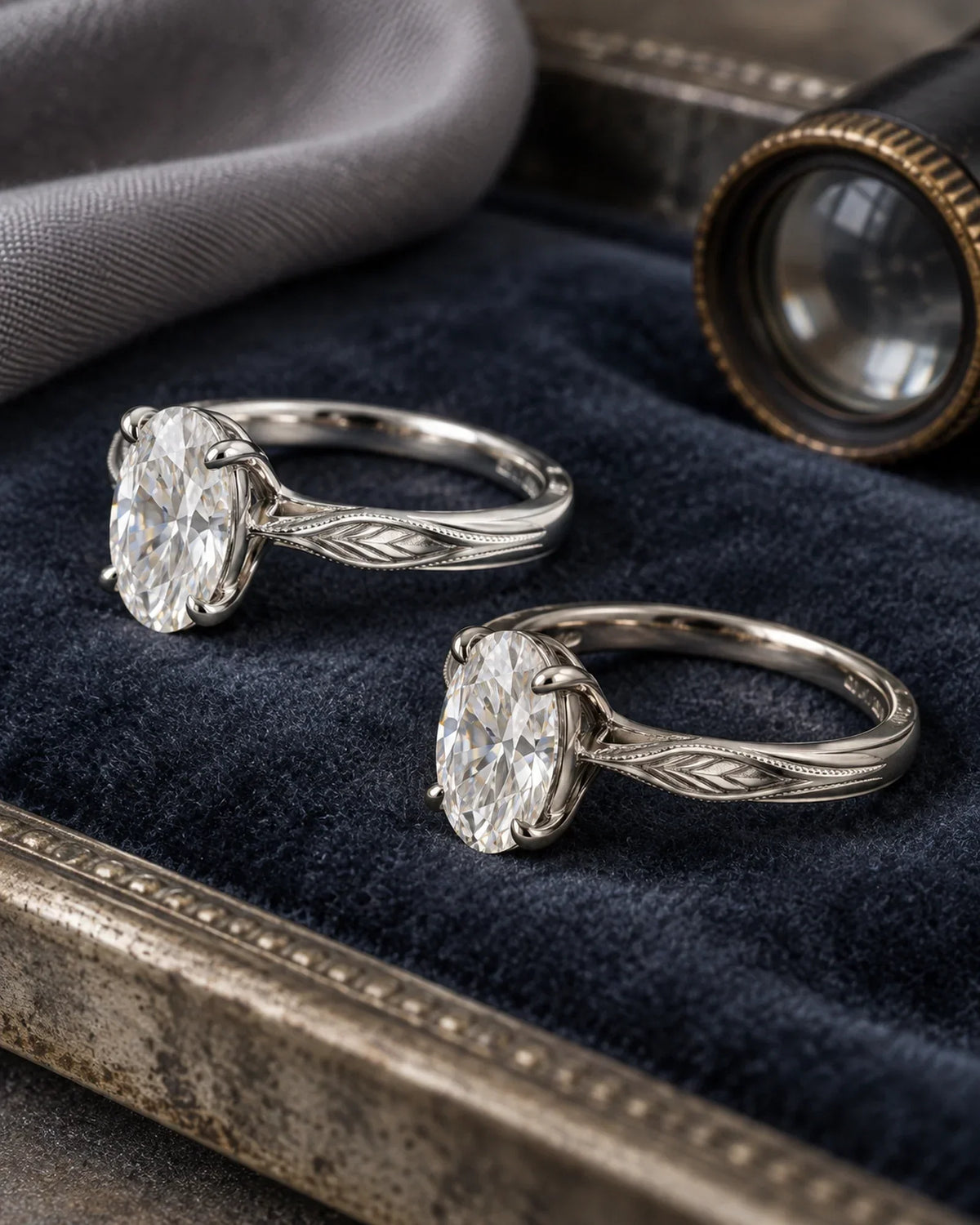

A plain gold solitaire with an undecorated lower shank may be relatively straightforward. A full-eternity ring has no empty sizing area at all. Between those extremes are pavé shoulders, double bands, engraved patterns, openwork galleries and fitted wedding bands. Each adds a different constraint. The center gemstone matters too: some stones tolerate routine bench conditions, while others require strict control of heat, cleaning and handling.
Quick decision table
| Ring construction | Typical resizing outlook | Main question before work |
|---|---|---|
| Plain solitaire or plain band | Usually the most adaptable | Is there enough sound, matching metal at the lower shank? |
| Half-pavé or half-eternity | Often possible within a limited range | Where do the stones stop, and will changing the curve disturb their seats? |
| Full pavé or full eternity | Often unsuitable for conventional resizing | Can a stone-set section be rebuilt without an obvious interruption? |
| Double band or split shank | Possible in some designs, but geometry is sensitive | Can both rails be changed equally while preserving spacing and symmetry? |
| Bridal set | Each ring must be assessed, then rechecked together | Will the contour, gap and contact points still align after sizing? |
| Heat-sensitive or treated gemstone ring | Depends on stone removal and bench method | What is the gem, treatment history and distance from the work area? |
What resizing actually changes
To make a conventional ring smaller, a jeweler generally removes a measured section from the lower shank, brings the ends together, joins them and restores the circle. To make it larger, the shank is opened and a matching piece of metal is added. The join is then shaped, finished and polished so it follows the original profile. White gold may also need its surface finish or rhodium color restored. Platinum requires its own joining and finishing technique.
This process changes more than the inside circumference. When a circle opens or closes, the shoulders can spread or pull inward. Stone seats may shift. A repeated engraving pattern can lose rhythm. Two rails can stop running parallel. A fitted wedding band can meet the engagement ring at a new angle. That is why the phrase “one or two sizes” is only a common rule of thumb for uncomplicated rings, not a guarantee for every design.
The GIA guide to engagement ring settings separates the head, shoulders and shank as structural parts. That vocabulary is useful at the repair counter: the jeweler is not merely changing a number but altering a circular structure connected to the stone-bearing upper ring.

The easiest rings to resize
A plain solitaire with a continuous lower shank is usually the most serviceable starting point. There is room to cut, add or remove metal without rebuilding decorative details. A three-stone or halo ring can also be approachable when its accent stones remain near the head and the lower half is plain. The setting style above the finger is less important than whether the underside supplies a stable work zone.
Even a simple-looking ring needs inspection. Previous sizing seams, porosity, an extremely thin shank, hollow construction or deep engraving can change the plan. A large adjustment can also alter the orientation of prongs and shoulders. For a new purchase, ask for finished shank width and thickness rather than relying on an image. The broader engagement ring anatomy guide explains which parts carry the setting and where decorative shoulders transition into the lower band.
Can a pavé ring be resized?
Often, if the pavé stops well before the bottom of the ring. A half-pavé design leaves a plain section where the bench jeweler can work. The smaller the adjustment and the longer that clean zone, the easier it is to preserve the original spacing. Afterward, every bead and shared prong should be inspected because even a modest change in curvature can reduce pressure on one stone or crowd another.
Pavé extending far around the finger is less forgiving. Tiny stones sit in seats cut into the shank; they are not decoration placed on top of an otherwise independent ring. Closing the circle makes the upper arc tighter, while opening it makes the arc flatter. A visually successful resize therefore includes stone-security checks, not merely polishing the join.

Case study: pavé coverage plus a sensitive center
The Avelisse moss agate halo ring shows two separate questions in one design. Its pavé shoulders leave the lower shank as the preferred sizing area, but the moss agate center also needs a conservative heat and cleaning plan. A jeweler should inspect both the accent-stone seats and the natural inclusion pattern before work.
Can an eternity ring be resized?
A true full-eternity ring is one of the hardest structures to resize conventionally because stones and their settings continue around the entire circumference. There is no neutral metal section to cut. Removing one stone may not create enough space for a clean reduction, and adding circumference may require new stones, new seats and a rebuilt segment. The visual rhythm, stone size and setting pattern all have to remain consistent.
A half-eternity band is different. If its lower shank is plain, a limited adjustment may be practical. Three-quarter coverage sits between the two and requires measurement rather than assumption. When future size flexibility matters, compare half and full eternity rings before choosing continuous sparkle.

Case study: ornament continues around the circle
The Majesta ruby crown eternity band makes the limitation visible: ruby settings, crown points and repeated cross details occupy the circumference. A conventional cut-and-insert repair would interrupt more than a plain shank. For a major size change, a remake in the correct size may preserve the design better than forcing a local alteration.
Double bands, split shanks and openwork
A double-band engagement ring may look like one ring from above, but the lower structure can contain two rails, bridges or negative spaces. Both sides must change by the same effective amount. If one rail is shortened or opened differently, the spacing can narrow, flare or twist. The head may then sit off-center even if the inner circumference measures correctly.
Some split shanks merge into one plain band at the back, which gives the jeweler a conventional work area. Others remain separate farther around the finger or use stone-set rails. Decorative openwork creates another concern: resizing can alter the angle of leaves, branches or geometric cells. The right question is not “is this a double band?” but “where do the rails join, and what moves when the rear arc changes?”

Case study: two rails must remain one composition
The Eclipsara black-gold double-band ring has two stone-set rails framing a large cluster head. Resizing must preserve rail spacing, head alignment and the dark surface finish. The finishing plan matters because polishing and local work can reveal a different metal color at the altered area.
How to resize a bridal set without losing the fit
To resize a bridal set, assess each ring independently first. The engagement ring may have a plain lower shank while the wedding band has pavé or a deep contour. Their safe adjustment ranges may be different. After sizing, the pair must be checked together from the top and side for contour contact, prong clearance, rotation and any new gap.
If the rings are soldered together, the jeweler may need to separate them before work. If they remain independent, one can sometimes be adjusted while the other stays unchanged, but the final stack still needs a fit test. A small change in one circle can move the point where a curved band meets the engagement-ring shoulders. The comparison of bridal sets and separate rings explores why coordinated design improves fit but does not make later servicing identical.


Case study: contour fit is part of the repair
The Elaris leaf bridal set combines an open botanical engagement ring with a shaped wedding band. The rings should be marked and measured separately, then nested again after work. A correct finger size is not a complete result if the V-shaped band no longer centers under the oval setting.
Gemstone risk: hardness is not the whole answer
Resizing takes place at the shank, but heat travels through metal and finishing may involve cleaning. A diamond, sapphire, ruby or moissanite often gives the bench more options than a fracture-filled, heavily included or heat-sensitive gem, yet no stone should be treated as automatically safe. Existing chips, loose prongs and unknown treatments change the risk.
Emerald commonly contains fractures and may be oil- or resin-treated. Opal can react badly to high heat or sudden temperature change. Moonstone has directional cleavage. Moss agate can contain internal features that deserve inspection before heating or ultrasonic cleaning. GIA research on gemstone durability explains why inclusions, treatments and thermal behavior affect repair decisions beyond a simple hardness number.
A jeweler may remove the center stone, use controlled laser work, shield the setting, change the cleaning method or decline a risky procedure. Ask what happens if the stone cannot remain mounted. For a wider wearability comparison, see the everyday gemstone durability guide.

Alternatives when conventional resizing is a poor choice
Sizing beads can reduce spinning or improve the fit across a large knuckle without cutting a complex upper ring. They change the effective interior at two small points and are often reversible. An inner sleeve or spring insert can provide broader contact for a top-heavy ring, although space, comfort and maintenance must be considered.
A temporary ring guard can help while finger size is changing, but it is not a permanent repair and should not scrape a delicate finish. For a worn or previously altered shank, a half-shank replacement may provide a stronger result than inserting another small piece. When stones cover the full circle or a large size change would distort the design, remounting or remaking the ring may be the most faithful option. A new correctly sized mounting can reuse suitable stones while restoring intended spacing and thickness.
Finger size can change with temperature, pregnancy, medication, arthritis and weight change. If the change may be temporary, choose a reversible solution before removing metal. The alloy also matters: the guide to 10K, 14K and 18K gold explains how composition influences color, wear and bench work.
Checklist before ordering or approving a resize
- Confirm the intended finger and measure it at more than one time of day.
- Ask for the practical resize range of this exact design, not the metal in general.
- Locate where pavé, engraving, texture or plating stops on the lower shank.
- Record finished shank width and thickness, especially for a custom ring.
- Disclose known gemstone treatments, repairs and previous sizing seams.
- Ask whether stones will remain mounted and which cleaning method will be used.
- For double bands, confirm how rail spacing and head alignment will be checked.
- For a set, bring every ring and request a final nested fit inspection.
- Clarify whether refinishing includes rhodium, black plating, milgrain or engraving.
- Understand how third-party alterations affect the service policy.
Frequently asked questions
How many sizes can a gold ring be resized?
There is no universal number. One or two sizes is often quoted for a straightforward solid-gold ring with a plain lower shank, but width, thickness, alloy, stone coverage, pattern symmetry and prior repairs can narrow or expand the practical range. A large change may require a half-shank replacement or remake.
Can a pavé ring be resized without losing stones?
Many half-pavé rings can be resized when they have enough plain metal at the bottom. The risk rises as pavé extends farther around the shank or the requested change becomes larger. Every accent stone should be checked and tightened as needed after the circle is altered.
Can an eternity ring be resized?
A full-eternity ring is usually not a good candidate for conventional cutting and adding or removing metal. A specialist may rebuild a stone-set section in selected designs, but a correctly sized remake is often cleaner. Half-eternity rings are generally more adaptable because the underside remains plain.
Can you resize a bridal set?
Often, but the engagement ring and wedding band may have different limits. Each ring should be measured and serviced individually, then checked together for contour alignment, clearance and comfort. Soldered sets may need to be separated first.
Does resizing weaken an engagement ring?
A well-planned resize performed on sound metal should restore a continuous, properly finished shank. Repeated alterations, extreme changes, very thin metal or an old damaged seam can reduce reliability. Ask the jeweler to document any existing weakness before work.
Is it better to order a new ring than resize?
For a simple ring and modest correction, resizing is usually sensible. For full-eternity coverage, complex repeated detail, severe wear or a large size change, a remake or remount may preserve proportions and stone security better. The least invasive option is the one that protects both structure and design.
This guide is educational. A bench jeweler must inspect the physical ring before confirming a method, price or safe adjustment range.