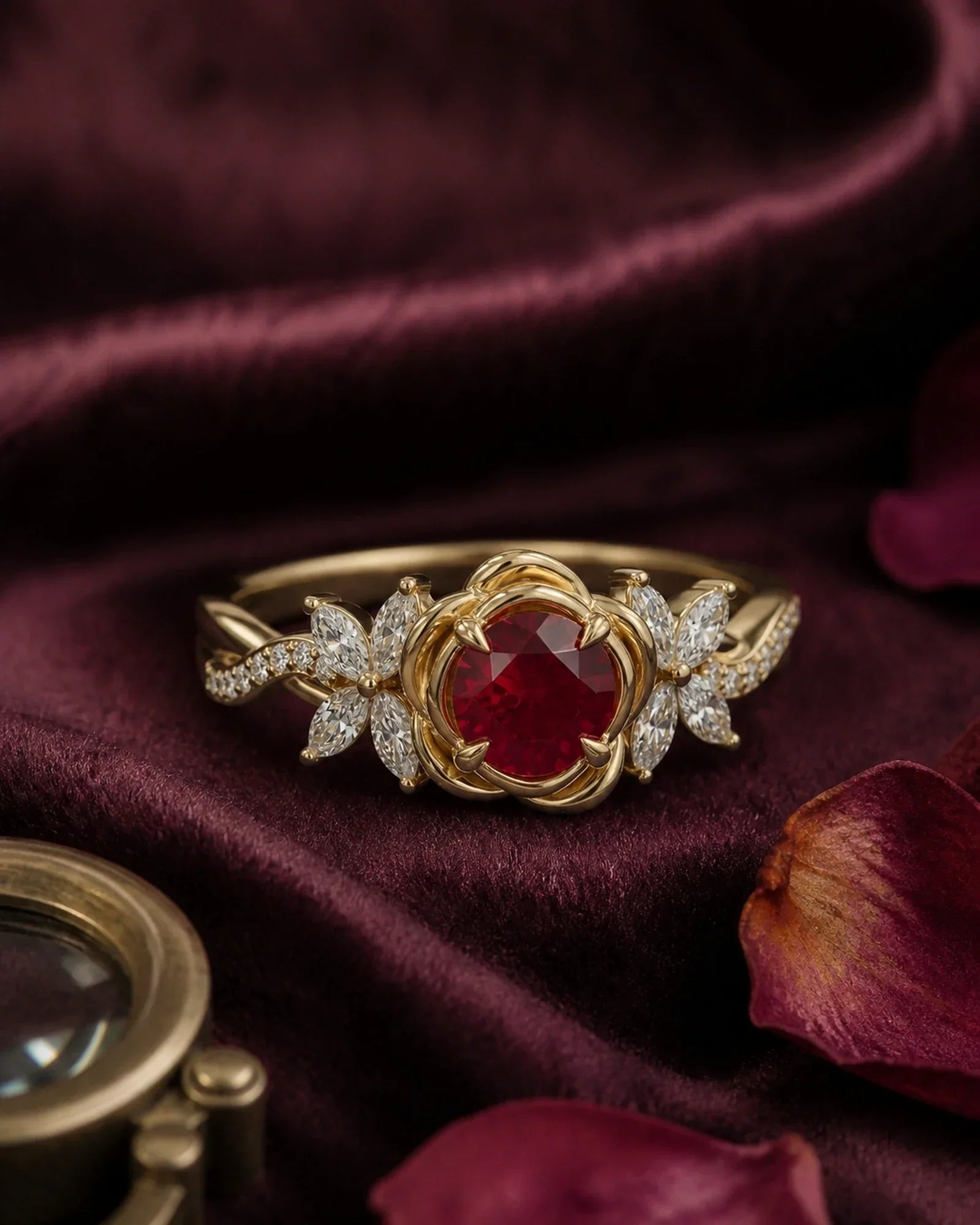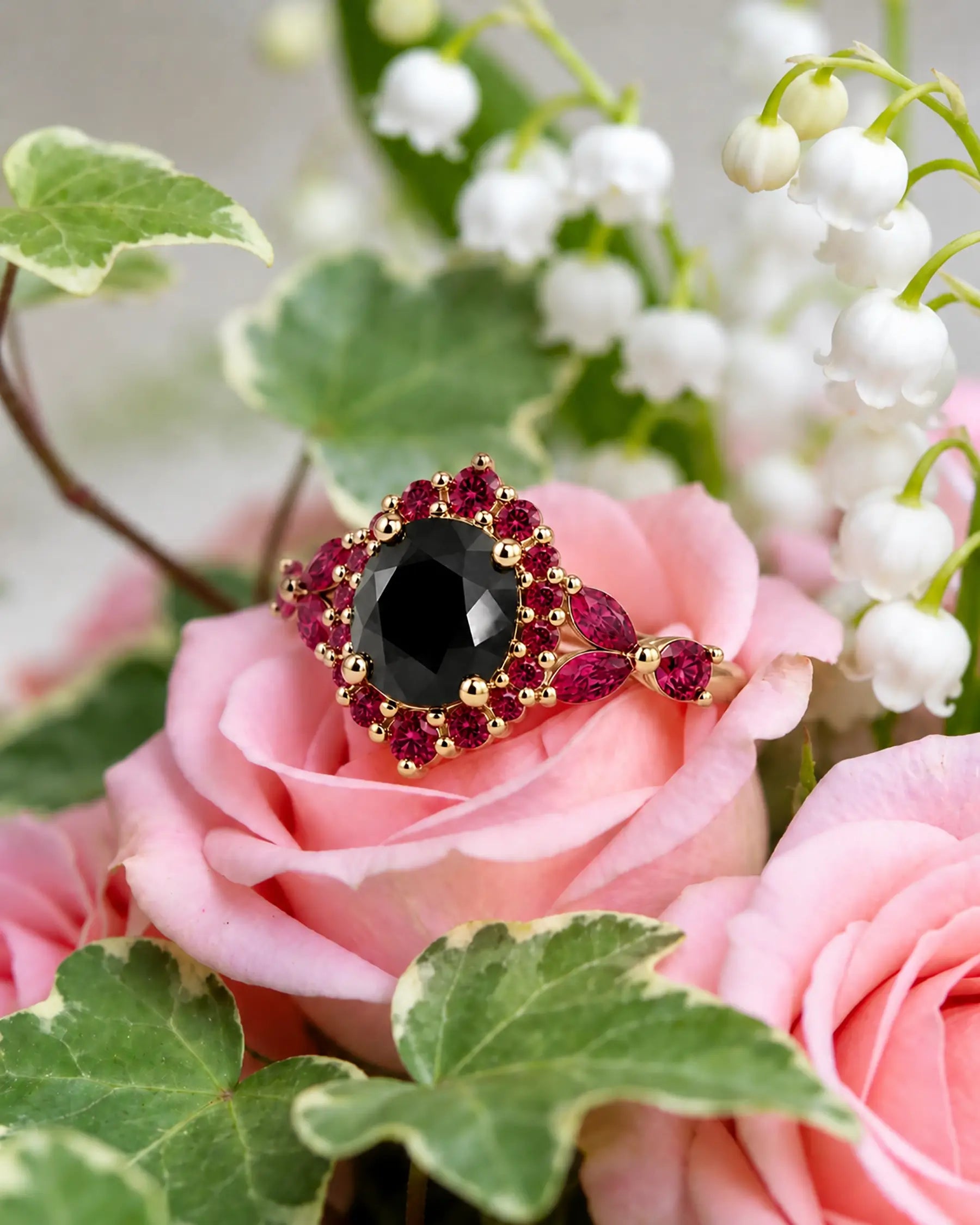

Une alliance peut se porter serrée contre la bague de fiançailles, laisser une fine bande de peau visible entre les deux, ou suivre la courbe du chaton central. Aucune de ces options n'est intrinsèquement meilleure. Le bon empilement de bagues de mariage est celui qui respecte la construction de la bague de fiançailles, protège ses surfaces les plus exposées et reste confortable après plusieurs heures de mouvements naturels de la main.
Le problème commence lorsque l’on considère le « flush fit » comme une finition que n’importe quel bijoutier peut ajouter à la fin. Ce n’est pas le cas. Qu’une alliance droite puisse atteindre le jonc de la bague de fiançailles dépend en grande partie du panier, du pont, du halo, des pierres latérales et des griffes inférieures de la bague de fiançailles. Si ces éléments occupent le même espace que l’alliance, celle-ci doit s’arrêter avant, se courber autour d’eux ou s’ouvrir pour les contourner.
Alliances flush fit ou avec espace : en 60 secondes
| Solution d’empilement | Idéale lorsque | Principal avantage | À vérifier |
|---|---|---|---|
| Alliance droite à ajustement flush | La bague de fiançailles dispose d’un dégagement de pont suffisant et d’un panier compact | Ligne continue et nette ; l’alliance peut souvent se porter seule sans paraître galbée | Le bord supérieur de l’alliance ne touche pas les griffes inférieures, le pavé ni la pierre centrale |
| Alliance courbe ou contour | Un panier bas, un halo, un ensemble ou des pierres latérales dépassent du jonc | Epouse l’obstacle et réduit l’espace visible | Profondeur de la courbe, orientation et équilibre de l’alliance lorsqu’elle est portée seule |
| Alliance ouverte | La tête nécessite un dégagement localisé, mais une courbe continue profonde paraît trop décorative | Crée de l’espace exactement là où se situe la tête de la bague de fiançailles | Extrémités ouvertes, sécurité des pierres, rotation et alignement de l’espace |
| Espace intentionnel | Les surfaces ornées ont besoin de respirer ou la personne préfère une séparation visuelle | Peut réduire les frottements et préserver la lisibilité de chaque bague | L’espace reste intentionnel plutôt que de varier de façon imprévisible lorsque les bagues tournent |
| Bague intercalaire | Le pavé, la gravure, les ceintures exposées ou les griffes nécessitent un tampon lisse | Déplace le contact dommageable vers une surface plus simple et remplaçable | La bague intercalaire est assez haute pour intercepter le contact et confortable dans la largeur totale |
Si vous choisissez la bague de fiançailles et l’alliance ensemble, partez du duo plutôt que d’acheter chaque bague comme un objet isolé. Les parures de bagues de mariage coordonnées rendent cette relation visible dès le départ. Une parure n’est pas automatiquement confortable, mais elle vous donne une géométrie définie à tester au lieu de demander à une future alliance de résoudre un obstacle inconnu.
Diagnostiquer la bague de fiançailles avant de choisir l’alliance
Observez la bague de fiançailles de profil, et pas uniquement vue du dessus. La vue de dessus vous renseigne sur le style. La vue de profil vous indique où une alliance peut physiquement se loger. Quatre zones déterminent la plupart des résultats d'ajustement.
Dégagement du pont
Le pont est la structure la plus basse sous le chaton central. Un pont surélevé peut permettre à une alliance droite de passer en dessous. Un pont bas ou absent fait souvent du panier lui-même le point de butée.
Empreinte du panier
Un panier compact peut tenir dans la largeur de l'anneau. Un panier large, une base de halo ou un serti clos peuvent déborder vers l'anneau voisin, même lorsque la bague paraît modérément haute.
Projection latérale
Les pierres en grappe, les épaules en feuille, les halos cachés et les pierres latérales basses peuvent s'étendre sous ou au-delà du contour supérieur apparent. Leurs griffes peuvent être les premières parties à toucher l'alliance.
Hauteur de contact
La mesure importante n'est pas seulement la hauteur totale de la bague. Comparez la hauteur du bord supérieur de l'alliance avec chaque point de contact possible sur la bague de fiançailles.
Une bague peut être à profil haut et pourtant échouer au test d'ajustement affleurant parce que son panier inférieur s'évase vers l'extérieur. Une autre bague peut paraître basse mais accepter une alliance droite parce qu'un pont étroit soulève l'obstruction juste assez. Le guide associé sur le profil des bagues de fiançailles et le dégagement de l'alliance explique ces distinctions de hauteur plus en détail.
Lors d'un essayage, ne forcez pas l'alliance jusqu'à ce que les bagues paraissent affleurantes. Si une pression est nécessaire, l'alliance ne s'ajuste pas ; elle appuie contre un autre composant. Sous grossissement, identifiez le premier point de contact exact. Il peut s'agir d'une griffe inférieure, du bord d'un halo, d'une épaule décorative, d'un rondiste de gemme exposé ou du côté du panier. La solution correcte dépend de cet emplacement.
Quand une alliance droite peut vraiment s'ajuster affleurante
Une alliance droite est l'option la plus polyvalente lorsque la tête de la bague de fiançailles laisse un passage dégagé. Elle peut généralement se porter seule sans espace manquant évident, et elle offre aux futures alliances anniversaires une ligne de référence simple. Les alliances droites tournent aussi sans modifier le contour de l'ensemble, ce qui peut être utile sur les doigts où les bagues bougent tout au long de la journée.
Affleurant ne signifie pas comprimé. Les deux anneaux peuvent se toucher légèrement sur une partie de leur circonférence, mais le bord supérieur de l'alliance ne doit pas s'enfoncer sous les griffes ni soulever la bague de fiançailles. Vue de profil, les deux bagues doivent reposer à plat sur le doigt. Vue du dessus, l'alliance ne doit pas s'écarter parce que son centre est bloqué.

Les alliances droites serties nécessitent plus de dégagement que les alliances simples
Une alliance fine et simple peut souvent s’approcher d’une bague de fiançailles sans ajouter beaucoup de projection verticale. Une alliance à griffes partagées, sertie en perles ou ornée de pierres marquise peut être plus haute et plus large au sommet. Même si un modèle simple affleure parfaitement, la version sertie choisie peut toucher la bague de fiançailles. Testez le profil réel de l’alliance, pas un substitut ayant la même taille de bague.
Portez une attention particulière aux ceintures des pierres précieuses. Si une pierre d’une bague entre en contact avec le métal ou une pierre de l’autre bague, les mouvements normaux peuvent ébrécher un bord exposé ou créer une rainure d’usure. Un petit espace visible est préférable à un contact dur caché. Cela est particulièrement important avec les accents allongés marquise, poire et baguette, dont les pointes ou les coins peuvent dépasser la ligne du métal.

Exemple concret : une ligne droite peut tout de même rencontrer un obstacle
La parure de bagues en diamant de laboratoire taille cerf-volant rend la distinction visible : une alliance droite simple peut s’approcher de la tige de la bague de fiançailles, tandis que le centre pointu et la disposition des accents inférieurs exigent un tracé ajusté du côté décoré. La leçon est pratique. Jugez une alliance droite à la hauteur où elle rencontrera réellement le chaton, et non d’après son contour seul.
Alliances courbées et contournées : suivre l’obstacle
Une alliance courbée s’écarte de la tête de la bague de fiançailles puis revient vers la tige. Une alliance contournée appartient à une catégorie plus large : elle est façonnée pour suivre le contour d’une autre bague et peut adopter un arc doux, un V, un chevron, une courbe asymétrique ou une silhouette ajustée plus complexe.
La meilleure courbe n’est pas nécessairement la plus profonde. Elle doit dégager l’obstacle avec une petite tolérance pratique tout en gardant l’ensemble visuellement cohérent. Une courbe trop peu profonde entre encore en collision. Une courbe beaucoup plus profonde que nécessaire peut laisser une cavité exagérée, retenir les saletés ou sembler déséquilibrée lorsqu’elle est portée seule.
Mesurez trois parties de la courbe
Mesurez d'abord la profondeur : la distance entre la ligne droite de l'épaulement de l'anneau et le point le plus profond de la courbe. Mesurez ensuite la largeur : l'étendue horizontale de la zone courbe. Comparez enfin la hauteur : une courbe peut correspondre au contour supérieur mais heurter le panier si l'anneau est trop haut. Un dessin personnalisé utile inclut ces trois dimensions et montre les deux anneaux ensemble, vus de dessus et de côté, en vraie grandeur.
L'orientation compte. Une courbe symétrique peut généralement se placer au-dessus ou en dessous de la bague de fiançailles. Un contour asymétrique peut avoir un sens et une position de rotation privilégiés. Si les anneaux tournent indépendamment, le contour ajusté peut dériver et créer des espaces variables. Un ensemble relié, un anneau plus stable ou une soudure professionnelle ponctuelle peuvent être envisagés, mais une soudure permanente modifie les possibilités de mise à taille et de réparation et ne doit pas être automatique.

Exemple concret : la profondeur du contour et la hauteur des pierres vont de pair
La parure en agate mousse taille cerf-volant et anneau baguette utilise un contour directionnel sous un centre pointu. Les baguettes sont dégressives vers la partie la plus profonde de l'ajustement, de sorte que la courbe vue de dessus et la hauteur verticale de leurs sertis comptent toutes les deux. Un anneau peut épouser parfaitement le cerf-volant sur le papier et pourtant frotter si sa pierre la plus haute atteint les griffes du serti central.
Les alliances ouvertes résolvent le dégagement local
Une alliance ouverte interrompt le sommet de l'anneau pour que la tête de la bague de fiançailles puisse occuper cet espace. Elle est utile lorsque l'obstruction est localisée et qu'un contour complet ajouterait plus de courbe que ce que la personne souhaite. L'ouverture peut être étroite et minimale, ou plus large avec des pierres dégressives menant vers chaque extrémité.
Le mot « ouvert » décrit l'architecture du sommet, pas la possibilité d'ajustement. Une alliance ouverte de joaillerie fine ne doit pas être serrée ou élargie à répétition comme une bague fantaisie temporaire. Ces mouvements peuvent fatiguer le métal, desserrer les pierres et modifier les points de contact prévus. Commandez-la et faites-la dimensionner pour le doigt et l'empilement souhaités.

Vérifiez soigneusement les extrémités ouvertes
Les extrémités d'un anneau ouvert peuvent porter des griffes, des billes, des pointes marquise ou du métal décoratif. Ces extrémités ne doivent pas appuyer sur le centre de la bague de fiançailles, s'accrocher sous son panier ou rayer un pavillon exposé. Demandez ce qui se passe lorsque l'anneau pivote de plusieurs degrés. Un modèle qui n'est sûr que dans une position parfaitement ajustée peut exiger plus de stabilité que le doigt de la personne qui le porte ne peut en offrir.
Vérifiez également le confort du doigt. L'ouverture modifie la façon dont le haut fléchit et répartit la pression. Un anneau ouvert bien proportionné doit conserver un bas de tige continu et soutenant. Des extrémités ouvertes extrêmement délicates fixées à une base fine risquent de se déformer plus facilement lorsque la personne saisit une poignée ou se pousse pour se lever d'une chaise.

Exemple concret : un rehausseur peut encadrer l'espace plutôt que l'effacer
La parure de mariée fleur d'opale avec rehausseurs boutons de rose traite les ouvertures autour de la bague centrale comme une partie à part entière du design. Ses extrémités florales ne se comportent pas comme un rail droit générique ; elles encadrent l'opale depuis des directions opposées. Vérifiez que chaque extrémité dégage le chaton central tout au long de la rotation normale de l'anneau, car un design visuellement ouvert peut tout de même créer un petit point de contact.
Un espace intentionnel peut être la meilleure superposition de mariage
Un espace étroit entre une bague de fiançailles et une alliance n'est pas la preuve que les bagues sont mal assorties. Historiquement et visuellement, de nombreuses superpositions de mariage comportent une séparation. L'espace peut souligner chaque anneau, rendre les épaules ouvragées plus lisibles et réduire le contact direct entre les surfaces vulnérables.
La différence entre un espace intentionnel et un problème d'ajustement non résolu réside dans la maîtrise. Un espace intentionnel présente une largeur visuelle reproductible, les bagues reposent confortablement sur le doigt et aucun composant caché n'est forcé. Un espace accidentel peut s'élargir et se refermer au fur et à mesure que les bagues pivotent, n'apparaître que parce qu'une bague est inclinée, ou masquer un point de contact dur sous le chaton central.
Un espace est souvent approprié lorsque la bague de fiançailles comporte une gravure, un milgrain, un relief de feuillage, des pierres latérales basses ou un panier qui nécessiterait un contour extrême. Il peut aussi alléger une superposition large. La ligne de peau devient un espace négatif au lieu d'ajouter une nouvelle rangée de métal ou de pierres.

Exemple concret : épouser le contour sans surcharger les détails
Le set de bague de fiançailles vintage en agate mousse taille cerf-volant associe une bague de fiançailles trois pierres à pointe et un anneau assorti à motif botanique. La courbe suit la géométrie centrale, mais les feuilles marquise et les détails en billes ont encore besoin d'espace. Un ajustement techniquement affleurant qui comprime ces éléments peut sembler surchargé et peut créer plus de frottement qu'un espace étroit et maîtrisé.
Ce qu'une bague intercalaire peut faire et ne peut pas faire
Une intercalaire est généralement une bague fine et relativement simple portée entre deux bagues plus détaillées. Son rôle est d'absorber le contact qui se produirait autrement entre les griffes exposées, les ceintures de pierres, la gravure ou les bords pavés. Elle peut être en métal poli uni, en métal légèrement texturé ou d'un design sobre à sertissage bas. Une intercalaire n'est pas utile simplement parce qu'elle est fine.
Pour protéger, sa hauteur verticale doit intercepter les composants que vous séparez. Si la bague de fiançailles a une griffe haute en saillie et que l'intercalaire se situe en dessous, l'alliance peut encore atteindre la griffe par-dessus l'intercalaire. Si l'intercalaire a des bords vifs à grains sertis, elle peut introduire une abrasion supplémentaire. Comparez la section transversale complète, pas seulement la largeur vue de dessus.
Les intercalaires augmentent aussi la largeur totale de l'empilement. Trois bagues confortables peuvent devenir inconfortables en groupe si elles appuient contre l'articulation ou le doigt voisin. Essayez la largeur combinée exacte pendant au moins dix minutes en fermant le poing de façon détendue, en tapant au clavier et en tenant une tasse. Une intercalaire de 1,2 mm semble négligeable, mais son effet physique inclut les bords et les relations de pression qu'elle modifie.

Le confort, c'est plus que l'espace entre les bagues
Un empilement peut sembler parfaitement aligné et pourtant mal se porter. Le confort dépend de la largeur totale, du profil intérieur, de la forme des bords, de la taille de la bague, de la conicité du doigt, de la taille de l'articulation et de la façon dont les bagues bougent ensemble. Évaluez l'empilement après que le doigt s'est réchauffé et à différents moments de la journée ; les doigts peuvent gonfler avec la chaleur, l'activité, les voyages, l'apport en sel et les changements hormonaux.
Pincement et peau coincée
Deux bagues qui bougent indépendamment peuvent brièvement coincer la peau, surtout si leurs bords adjacents sont vifs ou si leurs tailles diffèrent. Un empilement combiné plus large peut aussi serrer davantage que chaque bague seule, car il couvre une plus grande partie du doigt conique. Les empilements plus larges nécessitent souvent une stratégie de taille légèrement différente, mais l'ajustement correct est individuel. Ne commandez pas automatiquement chaque bague plus grande sans essayer la largeur complète.
Rotation et espaces changeants
Une bague de fiançailles à tête volumineuse peut tourner tandis qu’une alliance plus légère reste centrée. Une alliance contour ou ouverte peut alors perdre son alignement. La cause peut être une différence importante entre la taille de l’articulation et celle de la base du doigt, un anneau de bague de fiançailles étroit, une tête irrégulière ou un simple ajustement de taille. Abaisser le chaton n’est qu’une réponse possible. Le profil de l’anneau, les billes de ajustement, une largeur d’anneau plus stable ou une connexion coordonnée peuvent aider, selon l’anatomie et le design.
Accès pour le nettoyage
Un empilement très serré et affleurant peut accumuler de la crème et des débris là où les bagues se touchent. Si les bagues ne sont pas jointes, séparez-les pour un nettoyage et une inspection appropriés. Un contour avec une cavité profonde peut nécessiter une attention particulière autour de sa courbe intérieure. Le confort inclut l’hygiène et l’entretien, pas seulement la sensation de l’empilement lors du premier essayage.
Prévenir l’usure du métal et des gemmes
Toutes les bagues portées ensemble montreront une certaine usure avec le temps. L’objectif n’est pas un contact nul ; il s’agit d’éviter un contact destructeur et de comprendre quelles surfaces vont changer. Les anneaux en or peuvent se polir mutuellement, développer des zones de contact aplaties ou former des rainures. Le milgrain fin et la gravure peuvent s’adoucir là où une autre bague frotte. Les billes de pavage et les pointes de griffes méritent une inspection régulière, car l’usure se concentre sur de petites zones.
Le contact entre une gemme et le métal peut endommager le chaton et, dans certains cas, la gemme. Les arêtes du diamant et de la moissanite peuvent abraser l’or plus tendre. Une pierre de couleur vulnérable peut être ébréchée par l’arête dure d’une bague voisine. Ne supposez pas que la pierre la plus dure constitue l’empilement le plus sûr : la dureté décrit la résistance aux rayures, tandis que le risque d’ébréchure dépend aussi de la ténacité, du clivage, de la taille et de l’exposition.
Les métaux mélangés peuvent être portés ensemble, mais différents alliages peuvent s’user à des rythmes différents. Un anneau plus dur peut marquer un voisin plus tendre. Les traitements de surface et les finitions sombres peuvent aussi modifier les zones de frottement. Si préserver une finition est important, discutez du contact direct avant de commander et attendez-vous à ce que l’entretien fasse partie de la possession.
Planifiez la paire d’aujourd’hui pour l’empilement de demain
Si une alliance anniversaire peut être ajoutée plus tard, décidez si l’empilement doit rester symétrique. Certains porteurs souhaitent que la bague de fiançailles soit centrée entre deux anneaux assortis. D’autres préfèrent une composition directionnelle qui s’agrandit d’un côté. Les deux fonctionnent, mais ils exigent des choix différents dès maintenant.
Un contour profond conçu pour un seul côté peut être difficile à reproduire en miroir plus tard. Une alliance ouverte peut magnifiquement encadrer la bague de fiançailles, mais ne laisser aucun emplacement stable pour une troisième bague. Une paire droite et affleurante offre plus de flexibilité future, tandis qu’un espace intentionnel peut accueillir une fine bague intercalaire ou une alliance commémorative sans donner l’impression que l’ensemble d’origine est incomplet.

Exemple concret : planifiez la largeur finale avant d’ajouter la deuxième alliance
La parure de mariage trois pièces en moissanite taille poire illustre l’effet visuel et physique d’un ensemble complété des deux côtés en même temps. Les anneaux en miroir créent une symétrie, mais ils augmentent aussi la couverture totale du doigt et réduisent l’espace disponible au niveau de l’articulation. La flexibilité future passe par la vérification dès maintenant de la largeur totale de l’empilement et du confort, et non par la supposition qu’un anneau extérieur assorti procurera la même sensation plus tard.
Pour une comparaison plus large, examinez les alliances selon leur profil latéral et la forme de leur bord supérieur, plutôt que selon la couleur des pierres uniquement. Si vous possédez déjà la bague de fiançailles, les alliances assorties offrent des points de départ utiles pour le contour, mais les dimensions réelles doivent tout de même être vérifiées. Lorsque la bague de fiançailles n’est pas encore choisie, comparez la construction de la galerie et du panier parmi les modèles de bagues de fiançailles avant de supposer qu’une future alliance droite conviendra.
Un essayage de parure de mariage en dix minutes
- Placez les deux bagues sur le doigt sans les forcer l’une contre l’autre.
- Observez de dessus, des deux côtés et côté paume. Identifiez le premier point de contact.
- Fermez le poing sans serrer et vérifiez qu’aucun bord de bague ne pince.
- Tapez sur un clavier pendant deux minutes et tenez une tasse ou une bouteille pour ressentir la pression en prise.
- Laissez les bagues tourner naturellement, puis vérifiez si une courbe ou une ouverture reste alignée.
- Vérifiez si un bord de gemme, une griffe, une perle de pavé ou une surface gravée touche une autre bague.
- Séparez et réempilez les bagues sans miroir. Un empilement quotidien ne doit pas exiger une chorégraphie délicate.
- Essayez chaque anneau seul. Décidez si l’apparence individuelle compte pour vous.
- Ajoutez un anneau simple d’essai pour représenter une éventuelle bague d’anniversaire future.
- Répétez une fois le doigt réchauffé ; un ajustement confortable le matin peut sembler différent plus tard.
Ce qu’il faut valider avant la fabrication d’un anneau sur mesure
Une photographie de la bague de fiançailles à côté d’une règle ne suffit pas pour une alliance ajustée. L’artisan a besoin de la bague exacte ou d’un modèle tridimensionnel précis de ses surfaces concernées. De petites différences au niveau des griffes inférieures, de la largeur du panier et de l’alignement de l’anneau peuvent modifier le contour.
- Confirmez la taille de la bague de fiançailles et si un ajustement de taille est prévu au préalable.
- Notez la largeur et l’épaisseur finales de l’alliance, et non seulement celles du modèle avant polissage.
- Montrez les deux bagues ensemble de dessus et de profil, en vues réelles.
- Indiquez les dimensions de la profondeur de courbe, de la largeur de courbe, de la largeur d’ouverture et de l’écart souhaité.
- Marquez les points de contact ou de dégagement exacts autour du panier, des griffes et des pierres.
- Confirmez si l'anneau ajusté est directionnel et quel côté fait face à la bague de fiançailles.
- Modélisez les bagues sur un même cercle de taille de doigt pour que l'échelle soit cohérente.
- Vérifiez une future troisième alliance si un empilement d'anniversaire fait partie du projet.
- Approuvez un échantillon en résine ou en métal lorsque le contour est complexe ou asymétrique.
- Conservez une vue d'approbation datée avec le tableau complet des dimensions.
Un anneau ajusté doit être conçu avec une petite tolérance fonctionnelle plutôt que copié comme un contour à jeu nul. Les bagues bougent, les doigts changent et le polissage final modifie légèrement les surfaces. L'objectif est une relation maîtrisée, pas deux objets fusionnés numériquement.
Questions fréquentes
Une alliance doit-elle être affleurante à la bague de fiançailles ?
Uniquement si elle peut l'être sans appuyer sur le panier, les griffes ou les pierres. L'ajustement affleurant est une option esthétique et structurelle, pas une exigence de qualité. Un espace maîtrisé peut être plus confortable et plus sûr pour les bagues ornées ou à serti bas.
Pourquoi y a-t-il un espace entre ma bague de fiançailles et mon alliance ?
Le panier, le pont, le halo, les pierres latérales ou les griffes inférieures de la bague de fiançailles peuvent empiéter sur l'espace qu'occuperait une alliance droite. La rotation de la bague et les hauteurs de bande différentes peuvent aussi modifier l'espace visible. Identifiez le premier point de contact de profil avant de choisir une solution.
Quelle alliance convient à une bague de fiançailles à serti bas ?
Une alliance courbe, contour, en chevron ou ouverte fonctionne souvent mieux qu'une alliance droite, car elle contourne le panier bas. Le choix exact dépend de la largeur, de la hauteur et de la symétrie de l'obstruction. Certains porteurs préfèrent conserver un espace délibéré.
Quelle est la différence entre une alliance courbe et une alliance contour ?
Une alliance courbe utilise un arc ou une courbure. Une alliance contour est toute alliance façonnée pour suivre une autre bague et peut être courbe, en V, en chevron, asymétrique ou plus complexe. Dans le langage courant, les termes sont souvent employés de manière interchangeable ; fiez-vous aux dimensions réelles et aux photographies.
Les alliances ouvertes sont-elles ajustables ?
Elles ne doivent pas être pliées de façon répétée pour être ajustées. Les alliances ouvertes de joaillerie fine sont conçues avec une ouverture, une taille et un équilibre structurel spécifiques. Des pressions répétées peuvent fatiguer le métal, déformer la bague et desserrer les pierres.
Une bague intercalaire empêche-t-elle les dommages ?
Elle peut réduire le contact direct si sa hauteur et sa surface interceptent les griffes, pierres ou gravures vulnérables. Une bague intercalaire qui se situe sous le point de contact ne protège pas les bagues. Elle ajoute aussi de la largeur à l'empilement, le confort doit donc être testé.
Une alliance peut-elle endommager une bague de fiançailles ?
Oui. Le frottement direct peut user l’or, les grains de pavage, les griffes, la gravure et les finitions. Une pierre voisine ou un bord en métal dur peut également entrer en contact avec une gemme. Faites vérifier l’empilement réel sous grossissement et planifiez des inspections régulières.
Dois-je souder ma bague de fiançailles et mon alliance ensemble ?
La soudure peut maintenir un contour ajusté aligné et réduire le frottement indépendant, mais elle modifie les options de mise à taille, de réparation, de nettoyage et de port séparé. Essayez d’abord l’empilement non soudé et discutez des implications en matière de service avant de rendre la décision définitive.
Quelle largeur un empilement de mariage confortable doit-il avoir ?
Il n’existe pas de maximum universel. Les empilements plus larges semblent souvent plus serrés parce qu’ils couvrent une plus grande partie du doigt, et le confort dépend de la forme du doigt, de la taille de l’articulation, du profil intérieur et de la forme des bords. Essayez la largeur combinée exacte plutôt que d’additionner les mesures de chaque anneau sur le papier.
Puis-je ajouter une bague d’anniversaire plus tard ?
Oui, mais planifiez dès maintenant l’orientation. Demandez-vous si la bague de fiançailles doit rester centrée, si le contour peut être mis en miroir et si une troisième bague perturberait une bande ouverte ou une courbe ajustée. Une simple bague d’essai peut révéler la largeur et l’alignement futurs avant l’achat.
L’empilement le plus confortable est conçu intentionnellement
Un empilement de mariage n’est pas réussi parce qu’aucune peau n’apparaît entre ses anneaux. Il est réussi lorsque chaque anneau repose naturellement, que les composants vulnérables évitent tout contact destructeur, que la largeur combinée convient au doigt et que la composition reste agréable lorsque la main bouge.
Commencez par le dessous de la bague de fiançailles. Identifiez l’obstruction, comparez la hauteur réelle de l’alliance et décidez si la meilleure réponse consiste à passer en dessous, à contourner, à s’ouvrir autour ou à la laisser visible. Cette séquence transforme l’ajustement affleurant d’une préférence vague en un choix pratique et fait d’un espace apparent non pas une erreur, mais l’un de plusieurs outils de design valables.